
The essential event video elements that separate forgettable footage from a film worth watching are multi-camera coverage, professional audio capture, story-driven editing, and rapid content delivery. These are not optional upgrades. They are the foundation of every professional event video, from a corporate conference in Manhattan to a wedding in New Jersey. Tools like the Zoom F6 audio recorder, wireless lapel mics, and ATEM Mini switchers have become standard gear because they solve real problems that camera-mounted mics and single-angle shots cannot. Getting these components right before the event starts is what makes the difference between coverage and cinema.
1. What are the essential event video elements?
The key elements for event videos fall into four categories: camera coverage, audio fidelity, storytelling, and post-production delivery. Each category depends on the others. Great visuals with poor audio produce unwatchable content. Strong audio with no narrative structure produces a recording, not a film. Professional event videography treats all four as non-negotiable.
2. What camera setups work best for event videos?
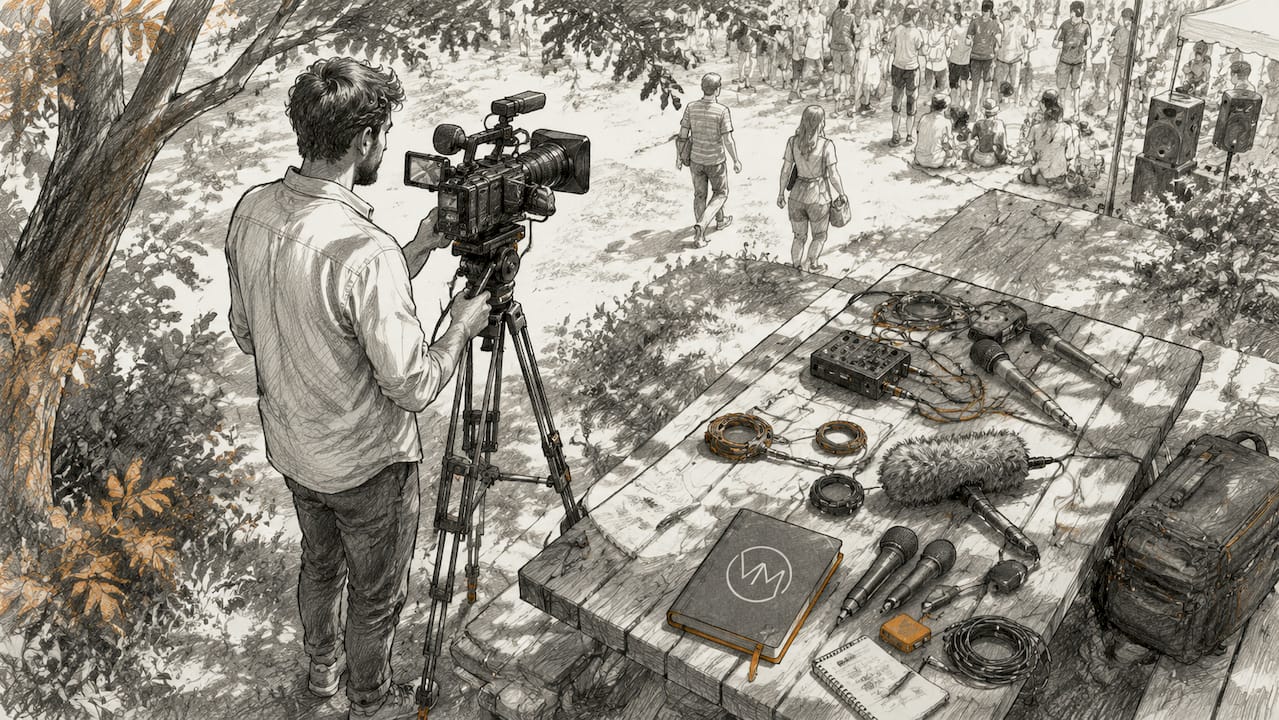
Professional event video setups use at least 2–3 cameras: a locked wide-angle for full-room coverage, a close-up on a tripod for speaker or subject focus, and a roving handheld or gimbal for candid and atmospheric shots. Each camera serves a distinct role. The wide shot gives editors a safety net. The close-up captures emotion. The roving camera catches unrepeatable moments.
Camera placement matters as much as camera count. Position the wide camera at the back of the room on a sturdy tripod. Place the close-up camera at a 45-degree angle to the stage for a natural, cinematic look. The roving operator should move through the audience during key moments, capturing reactions, tears, and laughter that no fixed camera can reach.
- Wide locked camera: Full-room coverage, safety net for editors
- Close-up tripod camera: Speaker focus, emotional detail
- Roving camera: Candid moments, audience reactions, atmosphere
- PTZ cameras: Useful for large venues with limited crew
- Backup batteries and cards: Non-negotiable for multi-hour events
Shot sequences that mix wide, medium, and close shots give editors the variety they need to build dynamic cuts. Without that variety, even a well-filmed event becomes monotonous in the edit.
Pro Tip: Visit the venue before the event day. Early site visits reveal ambient light levels, power outlet locations, and AV infrastructure. That information directly shapes your camera positions and lighting plan.
3. How important is professional audio for event videos?
Bad audio is the fastest way to lose a viewer. Never rely solely on camera-mounted mics. A direct feed from the venue's audio mixing board is the industry standard for capturing clean speech. Pair that feed with wireless lapel mics on primary speakers for a redundant, reliable audio chain.
External recorders like the Zoom F6 capture multi-channel audio at broadcast quality. That means if the soundboard feed clips or cuts out, the lapel track saves the recording. Redundancy is not paranoia. It is professionalism.
- Wireless lapel mics: Clip to primary speakers for isolated, clean audio
- Soundboard direct feed: Captures all amplified audio from the venue system
- External recorder (e.g., Zoom F6): Records multi-channel backup tracks
- Ambient mic: Captures crowd reactions and room atmosphere
- Backup batteries: Replace before every session, not when they die
Pro Tip: Contact the venue's AV team at least one week before the event. Ask for a direct soundboard output and confirm the connector type. Showing up without that conversation means scrambling on event day.
4. What storytelling elements elevate event videos?
The most common mistake in event video production is focusing on camera coverage instead of story-driven content with clear objectives. A video built around lead generation looks different from one built for social media hype. Define the goal before the crew arrives.
Story-driven event videos prioritize emotional peaks: keynote moments, award presentations, audience reactions, and candid interactions. These are the frames that make viewers feel something. B-roll footage of venue details, branded signage, and behind-the-scenes preparation adds pacing and polish between those peaks. For wedding videos specifically, capturing cinematic emotional results requires planning those emotional beats in advance.
- Define objectives first: Lead generation, brand awareness, or social content each require different framing
- Prioritize emotional moments: Vows, keynotes, awards, and candid reactions drive engagement
- B-roll is not filler: Venue details, crowd shots, and sponsor activations build narrative texture
- Interviews add depth: Short on-camera interviews with speakers or guests give the video a human voice
- Branded materials: Signage, programs, and decor tie the video to the event's identity
The benefits of storytelling in videography extend beyond aesthetics. A video with a clear narrative arc is more likely to be shared, remembered, and used in future marketing.
5. Why does rapid content delivery matter for event videos?
Releasing a highlight reel within 48–72 hours captures the momentum of the event while the audience is still talking about it. That window is short. Miss it and the social conversation moves on.
The standard deliverable set for professional event video includes a 60–90 second highlight reel, three to five short social clips at 30–60 seconds each, and a full-length recording for archival use. Each format serves a different platform. LinkedIn favors longer, professional cuts. Instagram Reels and TikTok reward short, punchy clips with strong opening frames.
- Highlight reel (60–90 sec): Released within 48–72 hours for maximum social impact
- Social clips (30–60 sec): Tailored for Instagram Reels, TikTok, and LinkedIn
- Full recording: Archival use, internal distribution, or on-demand viewing
- Post-event closure shots: Allocate 15–20 minutes post-program to film venue details and audience departures
Pro Tip: Schedule post-program filming before the crew wraps. Closure shots of an empty venue, lingering guests, and branded details give editors the material they need to open and close the film with polish.
6. How to coordinate camera crews for smooth event coverage
A video-friendly run-of-show document signals mission-critical visual beats for each segment of the event. It tells every camera operator what is coming next and what they must not miss. Reacting to moments is always slower than anticipating them.
Clear communication via intercom headsets among camera operators and the director is the standard for live event production. When a speaker goes off-script or an unplanned moment unfolds, the director can redirect cameras in real time without disrupting the event.
| Tool | Function | Best Use Case |
|---|---|---|
| Intercom headsets | Real-time crew communication | Live events with 3+ cameras |
| Run-of-show document | Anticipate key visual moments | All event types |
| Shot list | Define required coverage | Scripted or semi-scripted events |
| ATEM Mini switcher | Live switching between camera feeds | Livestreamed or hybrid events |
| Walkie-talkies | Backup communication | Large venues with dead zones |
Tech checks and rehearsals before the event start are not optional. They reveal audio routing issues, camera blind spots, and lighting problems that cannot be fixed mid-ceremony.
Key takeaways
Strong event videos require multi-camera coverage, professional audio, story-driven editing, and fast delivery working together as one production system.
| Point | Details |
|---|---|
| Use at least 3 cameras | Wide, close-up, and roving cameras cover every critical angle and emotional moment. |
| Never use camera mics alone | A direct soundboard feed plus wireless lapels is the industry standard for clean audio. |
| Define story goals before filming | Clear objectives shape every technical decision from shot framing to interview questions. |
| Deliver highlights within 72 hours | Releasing a 60–90 second reel fast captures social momentum while the event is still relevant. |
| Plan with a run-of-show | A detailed shot document lets crews anticipate key moments instead of reacting to them. |
What I've learned about event video after years on set
The gear conversation always comes first, but it is rarely where events are won or lost. I have filmed weddings where the camera package was flawless and the video still felt flat. The reason is almost always the same: no one defined what the film was supposed to make the viewer feel.
Audio is the one area where I will not compromise. A shaky handheld shot can feel intentional. Muffled vows or a clipped speech cannot be fixed in post. Invest in the Zoom F6, get the soundboard feed, and clip a lapel on every speaker. That decision alone separates professional work from amateur footage.
The other thing I tell every couple and event planner I work with: let the crew disappear. The best moments happen when people forget the cameras are there. Oversized rigs, constant repositioning, and visible lighting setups kill authenticity. The candid videography approach is not a style choice. It is a strategy for capturing real emotion. Follow us on Instagram to see how that philosophy shows up in every film we make.
— Anthony
Visualizemedia's approach to cinematic event coverage
Visualizemedia specializes in luxury wedding and event cinematography across New York and New Jersey, built on exactly the production standards covered in this guide. Every package includes multi-camera coverage, professional audio capture, and color-graded edits that prioritize emotional storytelling over simple documentation.
Visualizemedia also delivers rapid-turnaround highlight reels and social clips formatted for Instagram Reels and LinkedIn. If you are planning a wedding or a high-stakes event and want a film that holds up years from now, reach out through the contact form to discuss packages and availability. The team brings the same filmmaker's eye to a 70-person ceremony as to a 500-guest corporate gala.
FAQ
What is the minimum number of cameras for event video?
Professional event video requires at least 2–3 cameras: a locked wide, a close-up tripod, and a roving handheld. Fewer cameras mean missed moments that cannot be recreated.
Why is audio more important than video quality for events?
Poor audio causes viewer disengagement faster than any visual issue. A direct soundboard feed plus wireless lapel mics is the industry standard for capturing clear, usable speech.
How quickly should an event highlight reel be released?
Releasing a 60–90 second highlight reel within 48–72 hours captures peak social momentum. Waiting longer means the audience has already moved on to the next conversation.
What should an event video shot list include?
A strong shot list covers wide room shots, speaker close-ups, audience reactions, B-roll of venue details, and branded materials. Mission-critical visual beats should be flagged in the run-of-show document.
How does Super 8 film work in wedding videography?
Super 8 cameras shoot on physical film stock, producing a warm, grainy texture that digital cameras cannot replicate. Many couples add Super 8 footage as a stylistic layer within a larger multi-camera wedding film for a timeless, emotional quality.