
Most couples benefit from booking a combined photography and videography package. You get style consistency across both media, one point of contact instead of two, and often a lower combined price than hiring separately. Hybrid photo+video packages also reduce the decision friction of coordinating two vendor schedules on the most logistically demanding day of your life.
Your immediate next steps:
- Shortlist vendors by tier (starter, mid, premium) based on your budget and must-have deliverables
- Ask every vendor for a full wedding gallery AND a full highlight film, not just curated samples
- Request a written scope covering crew count, hours, revision rounds, and file ownership before signing anything
Visualizemedia's portfolio, including multi-camera films like Nestor & Elsa and Kesha & Bhadresh, shows what a premium NY/NJ joint package looks like in practice.
Key Takeaways
A joint photography and videography package gives most couples the best combination of style consistency, logistics simplicity, and value, provided the contract clearly defines scope, crew, revisions, and rights.
| Point | Details |
|---|---|
| Joint packages suit most couples | Bundled photo+video reduces vendor friction, aligns style, and often costs less than two separate contracts. |
| Match tier to budget and priorities | Starter for intimate events; mid for full-day coverage; premium for multi-camera and drone. |
| Ask three questions before signing | Request a full wedding gallery, a full highlight film, and a written crew and equipment list from every vendor. |
| Lock scope in the contract | Define hours, revision rounds, file formats, and ownership rights in writing to avoid surprises at delivery. |
| Visualizemedia for NY/NJ couples | Visualizemedia offers cinematic joint packages with defined scope, drone coverage, and multi-camera setups across New York and New Jersey. |
What does a joint photography and videography package actually include?
A joint package bundles a photographer and a videographer (or a hybrid team covering both) into a single contract with aligned pricing, a shared schedule, and a consistent visual style. You deal with one invoice, one run sheet, and one creative direction conversation.
The main advantages:
- Style coherence: the color palette in your photos matches the grade in your film
- Fewer logistics headaches: one team, one timeline, one point of contact
- Potential cost savings: combined teams often offer discounts and bundled add-ons compared with hiring separately
- Better on-the-day rhythm: shooters who know each other anticipate each other's moves
The trade-offs worth knowing:
- Less flexibility to mix-and-match vendors if you love one studio's photos but prefer another's film style
- If a vendor is stronger at one medium, the weaker one comes along for the ride
- Scope creep risk if the contract doesn't specify deliverables precisely
A typical joint package covers 8–10 hours of coverage, one lead photographer, one lead videographer, a highlight film (3–5 minutes), a full edited photo gallery, and digital delivery. Hours, crew size, and deliverable formats vary significantly by tier.
Pro Tip: Ask to see the same moment (first kiss, first dance) in both photo and film from a single wedding. Cohesion between the two media is the clearest sign a team actually works together rather than just sharing a contract.
How do package tiers break down, and what should you expect to pay?
Video production packages bundle services into predictable offers that simplify budgeting. Here's how the three tiers typically shake out in the US market.
Starter tier lower pricing range
- Half-day to full-day coverage (4–8 hours)
- One photographer and one videographer, or a single hybrid shooter
- Basic color correction on photos; simple cut on video
- Social media teaser (60–90 seconds)
- Digital gallery delivery (no physical album)
Good for intimate ceremonies, elopements, or couples who prioritize one medium over the other.
Mid-tier moderate pricing range
- Full-day coverage (8–10 hours)
- Dedicated photographer and videographer, sometimes with a second shooter
- Highlight film (3–5 minutes) with licensed music
- Full edited photo gallery with hundreds of images
- 2–3 social media cuts in multiple aspect ratios
- Optional album credit or basic album included
This is where most couples land. The mid-tier is also where tiered pricing steers clients toward the highest perceived value, so vendors often make this their flagship offering.
Premium tier higher pricing range
- Multi-day or extended coverage (10–16 hours across one or more days)
- Multi-camera ceremony coverage, second shooters for both photo and video
- Drone aerial footage
- Custom color grade and cinematic sound design
- Documentary-length edit (20–40 minutes) plus highlight film
- Same-day edit for reception playback
- Premium lay-flat album and archival USB
Premium packages are where post-production choices, including color grading, motion graphics, as well as multiple aspect-ratio deliverables, materially affect both cost and long-term value.
How do you choose the right joint package for your wedding?
Start with your priorities, not the vendor's pitch. Decide which deliverable you'd miss most if you had to cut one, how many hours of coverage your day actually needs, and whether photo or video carries more weight for you.
Questions to ask every vendor (copy and send these):
- Can you share a full wedding gallery and a full highlight film from a recent event?
- How many crew members are included, and what equipment do they use?
- What are the exact hours of coverage, and what's the overtime rate?
- How many rounds of revisions are included, and what triggers an extra fee?
- Who owns the copyright? What usage rights do we receive?
- Are raw files available, and at what cost?
- What backup equipment and contingency plans do you have?
- What file formats will we receive, and how are files delivered?
Red flags that should make you pause:
- Scope described as "X videos" with no specified lengths or formats
- Revision policy that says "until you're happy" with no defined limit
- No crew list or equipment list available on request
- Portfolio shows only highlight reels, never full ceremonies or full galleries
- Noticeable style mismatch between the photos and the films in their samples
Trust signals worth looking for: a full wedding gallery from a comparable event, a written equipment and crew list, client testimonials that mention specific moments (not just "they were amazing"), and a contract with defined revision rounds and a clear delivery timeline.
Pro Tip: When reviewing a portfolio, look for how the same moment reads across both media. If the photo of the first kiss is warm and golden but the film version is cool and desaturated, that team hasn't aligned their creative direction. That gap will show up in your wedding too.
Three sample package templates to compare vendor quotes
Use these as a baseline when vendors send proposals. Adjust deliverables up or down based on your ceremony-first or reception-first priorities.
Template A — Starter
- 6 hours coverage, 1 photographer, 1 videographer
- 300 edited photos, 60-second social teaser
- Digital delivery within 6 weeks
- 1 round of video revisions
- Estimated range: few thousand dollars
Template B — Mid
- 10 hours coverage, 1 photographer, 1 videographer, 1 second shooter
- 500 edited photos, 4-minute highlight film, 3 social cuts (16:9, 9:16, 1:1)
- Basic album credit included
- 2 rounds of video revisions, delivery within 10 weeks
- Estimated range: mid-range pricing
Template C — Premium
- 12 hours coverage, 2 photographers, 2 videographers, drone operator
- 700+ edited photos, 30-minute documentary edit, 5-minute highlight film, same-day edit
- Premium lay-flat album, archival USB, 3 rounds of revisions
- Delivery within multiple weeks
- Estimated range: premium pricing range
For a ceremony-heavy wedding (long religious rites, multiple cultural traditions), shift Template B or C toward more video crew and a longer documentary edit. For a reception-heavy celebration, prioritize a second photographer and additional social cuts.
Day-of logistics: how do photo and video teams share your wedding day?
A shared run sheet is the single most important coordination tool. Both teams need it before the day starts.
Typical wedding-day timeline (photo + video):
- Getting ready (2–3 hours): videographer captures detail B-roll; photographer works portraits and flat lays
- First look / portraits (1 hour): both teams present; stagger positions to avoid blocking each other
- Ceremony (1–2 hours): videographer anchors at the altar; photographer moves; drone window pre-cleared with venue
- Cocktail hour (1 hour): second shooter covers guests; lead videographer captures speeches and candids
- Reception (3–4 hours): multi-camera setup for speeches and first dance; B-roll shooter covers room details
- Exit (30 minutes): both teams positioned for coverage; drone cleared if outdoor
Crew roles and positions:
- Lead photographer: moves freely, owns key portrait moments
- Second photographer: covers guests, candids, and alternate angles
- Lead videographer: anchors ceremony and speeches, directs the narrative
- B-roll shooter: room details, reactions, ambient footage
- Drone operator: pre-scheduled windows only; check venue permits and local FAA rules in advance
Practical coordination tips:
- Designate one person (usually the lead videographer or photographer) as the single point of contact for the couple and venue coordinator
- Agree on visual signals between teams to avoid verbal interruptions during vows
- Mark no-fly windows for the drone on the run sheet (indoor ceremonies, low ceilings, noise-sensitive moments)
- Share a keyed shot list covering vows, rings, first kiss, first dance, cake cut, and exit
Pro Tip: Give both team leads a copy of your venue floor plan the week before. Knowing where the light falls at 4 PM and where the altar is positioned relative to windows changes how both teams set up. A five-minute call between the photographer and videographer before the day prevents most on-the-day friction.
What deliverables, rights, and turnaround times should you expect?
Common file formats by deliverable:
- Photos: JPEG (web/social), TIFF (archival/print)
- Highlight film: H.264 or HEVC MP4 (web delivery), ProRes (archival master)
- Documentary edit: same as above, larger file size
- Social cuts: MP4 in 16:9, 9:16, and 1:1 aspect ratios
Ownership checklist:
- In the US, copyright typically stays with the vendor unless you negotiate a full transfer in writing
- Most contracts grant you a personal usage license: you can share, print, and display but not resell
- Raw files (unedited photos, ungraded footage) are rarely included by default; additional fees may apply if you want them
- Confirm in writing: who owns the master files, how long the vendor retains backups, and whether you can post to social media without watermarks
Most providers include 2–3 rounds of revisions; additional rounds carry extra fees. Get the revision count in writing before signing. For guidance on reviewing wedding video edits efficiently, Visualizemedia's blog walks through the process in detail.
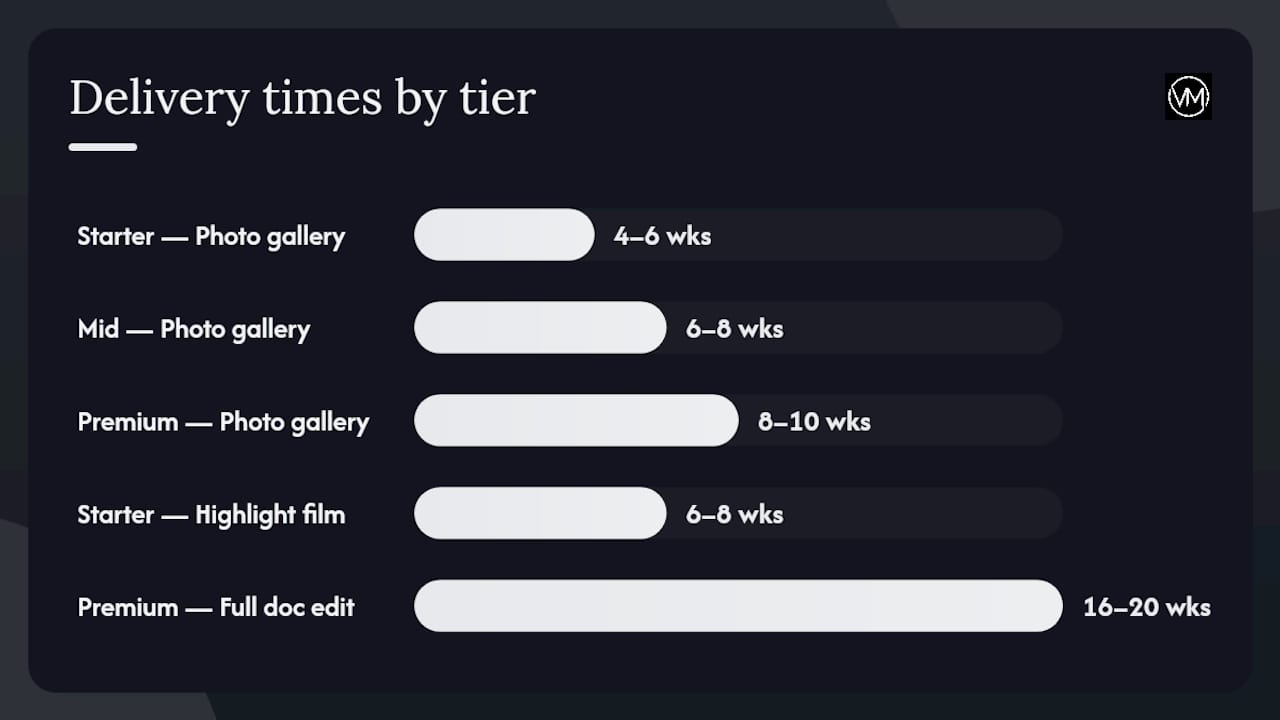
Typical delivery windows by tier:
| Package Tier | Photo Gallery | Highlight Film | Full Documentary Edit |
|---|---|---|---|
| Starter | 4–6 weeks | 6–8 weeks | Not included |
| Mid | 6–8 weeks | 8–12 weeks | Not included |
| Premium | 8–10 weeks | 10 weeks | 16–20 weeks |
Which add-ons are worth the extra cost?
Not every upgrade earns its price. Here's a practical breakdown:
- Drone footage ($300–$800): High visual impact for outdoor venues with open airspace. Worth it for estate weddings, beach ceremonies, or venues with dramatic exteriors. Requires FAA Part 107 compliance and venue permission; confirm both before booking.
- Same-day edit ($500–$1,500): A 3–5 minute film cut and screened at the reception. High emotional payoff for large weddings where guests want to relive the ceremony. Adds crew time and a dedicated editor on-site.
- Raw files ($300–$800): Useful if you want full creative control later or plan to work with another editor. Most couples never use them. Skip unless you have a specific reason.
- Premium album ($800–$2,500): A lay-flat or heirloom album is the one physical artifact most couples say they wish they'd invested in. Digital files get lost; a printed album doesn't.
- Extended coverage ($200–$400/hour): Worth adding if your reception runs late or you have a long getting-ready window. Build it into the contract rather than negotiating overtime on the day.
Post-production choices like vertical cuts, captions, and motion graphics increase upfront cost but significantly improve how your content performs on social media. If you plan to share your wedding film widely, budget for at least three aspect-ratio versions.
AI-assisted tools like Adobe Firefly and Canva Smart Stack are also making joiner-style composite images faster to produce as social deliverables, so ask your vendor if creative composites are available as an add-on.
How Visualizemedia structures joint packages for NY/NJ couples
Visualizemedia builds its packages around cinematic storytelling for weddings in New York and New Jersey, with a consistent approach across both photo and film. Their portfolio covers multi-camera ceremony coverage, drone aerials, custom color grading, and documentary-length edits, with sample films like Aryana and Priyanka showing the range of cultural and stylistic coverage they handle.
What their packages typically include:
- Multi-camera coverage of ceremony and reception
- Aerial drone footage (where permitted)
- Professional color grading and sound design
- Full ceremony and speech edits
- Social media teasers and short-form cuts
- Adventure sessions and engagement films
- Photo booth services and corporate video as add-ons
Revision rounds and delivery windows are defined in writing. Equipment and crew lists are available on request. For South Asian weddings with multi-day events like Mehndi ceremonies, their Mehndi ceremony videography guide covers day-specific coordination in detail.
Visualizemedia's approach treats every wedding as a film production: the run sheet, crew briefing, and shot list are prepared before the day so the team can focus on capturing moments rather than managing logistics on the fly.
Pro Tip: Follow @visualizemedia on Instagram to see recent work before your consultation. Their feed shows the actual color grade, editing style, and coverage range across different venue types, which tells you more than a curated highlight reel ever could.
What actually matters most in a joint package, from a cinematographer's perspective
Couples spend a lot of time comparing highlight films on YouTube and not enough time asking about what happens when something goes wrong. The backup plan matters as much as the portfolio.
When I evaluate a joint package, three things tell me whether a team is genuinely prepared: their lighting contingency (do they carry off-camera flash and LED panels, or are they natural-light only?), their data backup protocol (dual-card recording, off-site backup same night?), and whether the photographer and videographer have actually worked together before. A team that met at your wedding is not a team.
Chemistry between shooters shows up in the work. When two people have shot together dozens of times, they move around each other without thinking. You can see it in the footage: no blocked shots, no awkward pauses, no moment where the photographer walks into the frame. Ask vendors how many weddings they've shot together as a team, not just how long each has been working individually.
The other thing couples underestimate is the engagement session. If your package includes one, use it. It's not just about getting comfortable in front of the camera. It's the one chance the photo and video teams have to rehearse their coordination before your wedding day, in lower-stakes conditions. The couples who skip it almost always wish they hadn't.
Visualizemedia covers NY/NJ weddings with cinematic precision
Visualizemedia offers luxury wedding videography and photography packages across New York and New Jersey, built around multi-camera coverage, drone aerials, and cinematic color grading. Every package comes with a defined scope, a written crew list, and clear revision terms so there are no surprises at delivery.
Whether you're planning an intimate ceremony or a multi-day celebration, Visualizemedia's team has covered the full range of NY/NJ venues and cultural traditions. Request a portfolio review or schedule a video call to walk through sample packages at Visualizemedia. Follow their work on Instagram to see current projects before you reach out.
Sources
- Video production packages
- Why Hybrid Photo-Video Packages Sell Better Than Either Alone
- Joiner Photography: How to Make a Joiner Photo Like David Hockney
- Why Choose Photo & Video for your DREAM Wedding | Pros & Cons for Wedding Photo & Video Packages Queenstown New Zealand — Dawn Collective
- Elevate visual storytelling: creative post-production ideas