
Filming multicultural wedding traditions well comes down to three things: research the rituals before the day, build audio redundancy into every ceremony, and position multiple cameras respectfully so no sacred moment is missed. For couples and planners in New York and New Jersey briefing a luxury videographer, here is the short version you can hand directly to your vendor:
- Send a cultural questionnaire at least six weeks out covering every ritual, its order, duration, language, and any filming restrictions.
- Require multi-camera coverage with at least one dedicated audio tech and a backup recorder running at all times.
- Discuss a Super 8 or vintage film insert for texture moments — entrances, garland exchanges, haldi — to give the final film warmth and visual contrast.
Quick NYC/NJ logistics note: outdoor ceremonies in city parks require permits, drone flights need FAA Part 107 clearance plus venue approval. Multilingual audio should be captured at the source (soundboard feed or direct lav) rather than relying on room pickup alone.
Key Takeaways
Filming multicultural wedding traditions requires a cultural questionnaire, multi-camera positioning, audio redundancy, and a subtitle workflow to preserve ritual meaning and cinematic emotion.
| Point | Details |
|---|---|
| Start with a questionnaire | Send a ritual map questionnaire six weeks out covering order, language, duration, and filming restrictions. |
| Build audio redundancy | Run dual recorders and a soundboard feed simultaneously; never rely on a single lav for multilingual vows. |
| Assign cameras by ritual role | Use a four-camera configuration: locked wide, roaming documentary, telephoto for sacred moments, and a detail body. |
| Use Super 8 for texture inserts | Place Super 8 footage in informal or emotional moments, not during sacred prayers. |
| Visualizemedia for NY/NJ coverage | Visualizemedia provides multi-camera, multilingual subtitle, and Super 8 insert workflows for multicultural luxury weddings in New York and New Jersey. |
How do you plan multicultural wedding coverage before the event?
The single biggest mistake in multicultural celebration videography is arriving without a ritual map. A one-page questionnaire sent to both families and the officiant six weeks before the wedding should cover:
| Information to Collect | Why It Matters |
|---|---|
| Full ritual list and order (sangeet, mehndi, haldi, ketubah, bedeken, paebaek, tea ceremony, etc.) | Determines camera deployment and crew call times |
| Who leads each ritual and their role | Identifies who gets a lav mic and who needs a long lens |
| Expected duration per ritual | Builds buffer time into the timeline |
| Language(s) spoken during vows/blessings | Flags need for subtitle workflow and ambient translation capture |
| Photography/videography restrictions | Prevents crew from violating sacred space rules |
| Wardrobe changes and location shifts | Protects against missed coverage during transitions |
Once the questionnaire comes back, build a timeline table with 15-minute buffers between rituals. Share it with the photographer, planner, and house sound operator at least two weeks out. Multi-day celebrations work best when coverage is spread intentionally across days rather than compressed into marathon shoots where energy and attention both drop.
Pro Tip: Request a 20-minute walkthrough with a key elder or the officiant the morning of the event. Even a brief walk through the ritual space reveals camera-position problems — a low ceiling, a sacred object that blocks sightlines — that no floor plan shows.
What shot list and storyboard work for ritual-driven ceremonies?
Ritual moments have a fixed emotional arc: arrival, preparation, symbolic act, blessing, and release. Your storyboard should map to that arc, not to a generic wedding shot list. Cinematic wedding films capture emotion through shot prioritization and intentional pacing — and for multicultural ceremonies, that means knowing which beats are non-negotiable before the day starts.
Always capture:
- Procession entrance (wide establishing, then tight on the subject's face)
- Symbolic object close-ups: rings, garlands, unity candle, ketubah signing, tea cups
- Officiant's hands and face during blessings
- Unscripted family reaction shots (these are the emotional core of any cultural film)
- The exit or send-off
Capture if time and position allow:
- Slow-motion inserts of fabric, flowers, and ritual objects
- Super 8 inserts during informal moments (haldi application, mehndi detail, pre-ceremony laughter)
- Wide environmental shots that establish the venue's cultural decoration
Avoid filming:
- Moments the officiant or family has flagged as private
- Close-ups of guests who have not consented
- Sacred objects from above or at an angle the family considers disrespectful
For storyboarding, assign each ritual a camera position (A-cam locked wide, B-cam roaming, C-cam telephoto) and a lens choice before the day. That pre-assignment is what lets a crew move quietly and confidently without mid-ceremony huddles.
Which camera systems and positions protect ritual integrity?
A four-camera configuration covers most multicultural luxury weddings without crowding the space:
| Camera Role | Position | Lens Range | Primary Job |
|---|---|---|---|
| A-cam (primary) | Locked on tripod, center-rear | telephoto zoom | Full ceremony wide and medium coverage |
| B-cam (roaming) | Fluid, off to one side | portrait zoom | Documentary close-ups, family reactions |
| C-cam (telephoto) | Rear balcony or far side | 70–200mm | Intimate distant shots, sacred moments from a respectful distance |
| D-cam (detail/B-roll) | Static near symbol table | macro lens | Object close-ups, décor, ritual props |
| Super 8 (optional insert) | Handheld, informal zones | Fixed lens | Texture inserts, warm vintage aesthetic for informal moments |
Dual-native ISO sensors matter in candlelit mandap or synagogue settings where adding artificial light is not an option. Venue views and staging directly affect shot choices, so share the venue diagram with your cinematographer early — balcony access, ceiling height, and procession routes all change where cameras can realistically go.
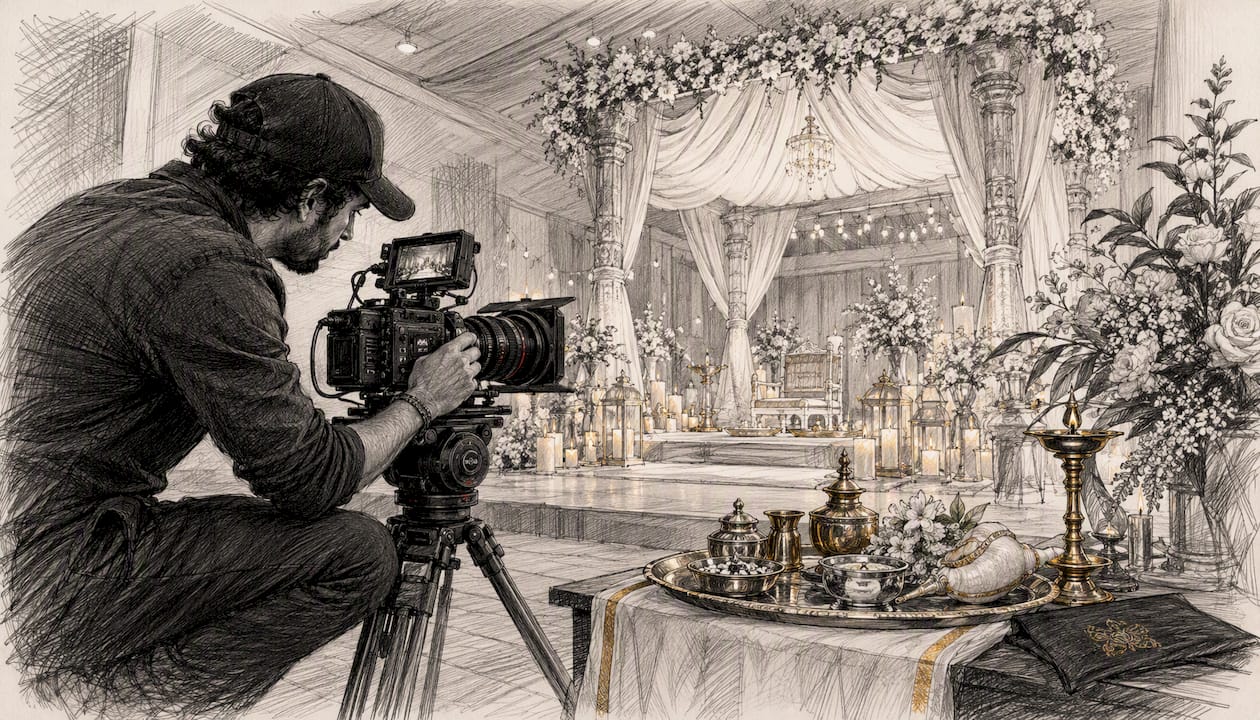
Pro Tip: Pre-position a static body in any room you know the ceremony will move through. A camera already in place is invisible; one carried in mid-ritual is a distraction.
How do you handle lighting across different luxury venue types?
Luxury venues in New York and New Jersey range from high-contrast hotel ballrooms with mixed LED rigs to candlelit loft ceremonies and outdoor golden-hour settings. Each needs a different exposure approach. Venue lighting and setup coordination is one of the most overlooked pre-production steps for multicultural weddings.
On-site lighting checklist (run during vendor setup):
- Set base ISO and test skin tones across the full range of attendees — multicultural weddings often include guests with a wide range of skin tones, and a single exposure setting will clip or crush someone
- Check white balance against the venue's dominant color temperature; mixed LED and tungsten stages often require a custom WB rather than a preset
- Test ritual fabrics: white bridal lehengas, gold metallic dupattas, and silk saris all reflect differently under stage lighting
- Confirm with the lighting designer whether color-temperature shifts are programmed during vows — if so, request a freeze or a slow fade rather than an abrupt change
For log profiles, shoot in the camera's native log format and set exposure for the brightest ritual fabric in frame. Shadow recovery in post is far easier than highlight reconstruction on a blown-out white sari.
Coordinate with the planner to limit rapid color shifts during vows and blessings. A lighting designer who knows the ceremony timeline can hold a warm, flattering temperature through the most sacred 10 minutes.
How do you capture clean audio across multiple languages?
Audio is where multicultural wedding films succeed or fail in post-production. Shot lists and audio redundancy are the foundation of cinematic, emotionally resonant results — and for multilingual ceremonies, redundancy is non-negotiable.
Primary audio plan: lav mic on the officiant (always), lav on the partner speaking vows when permitted, shotgun on the A-cam for ambient pickup, and a direct feed from the venue soundboard when available. Capturing ambient sound and multilingual vows preserves cultural meaning that no amount of post-production can reconstruct if the recording is lost.
Redundancy checklist:
- Two separate recorders running simultaneously (e.g., a Zoom F6 and a backup channel on the camera body)
- A spare lav clipped and live on a second channel throughout the ceremony
- Room-tone capture from three positions in the space after the ceremony ends
For multilingual moments, record a short post-ceremony voiceover from a family member or the officiant — with their consent — explaining any untranslated blessing. That 90-second recording becomes the subtitle source in editing.
Pro Tip: Always confirm mic placement with clergy before finalizing audio positions. Some officiants cannot wear a lav during certain prayers; knowing this in advance lets you position a directional mic on a stand rather than scrambling mid-ceremony.
For deeper audio guidance, Visualizemedia's audio tips for wedding films walk through recorder settings and redundancy configurations in detail.
What does the day-of crew and logistics plan look like?
| Role | Primary Responsibility |
|---|---|
| Lead cinematographer | A-cam operation, crew communication, ritual pacing calls |
| Second cinematographer | B-cam roaming, family reactions, procession coverage |
| Audio technician | All lav placement, recorder monitoring, soundboard liaison |
| Super 8 operator (optional) | Handheld texture inserts, informal moments |
| Production assistant | Battery/card swaps, gear staging, planner liaison |
For quick space changes between rituals, pre-position gear bags at each location before the ceremony begins. Communicate with the photographer using a shared channel (earpiece or group text) so camera moves are coordinated rather than competitive. Venue features like ceiling height, balcony access, and procession routes determine camera placement — walk every space with the planner the morning of the event.
Contingency go/no-go checklist: confirm backup batteries charged, two formatted SD cards per camera body, and a printed ritual timeline in every crew member's pocket. If a ritual shifts location unexpectedly, the lead cinematographer calls the new A-cam position and the team follows without discussion.
How do you film with cultural sensitivity and earn trust on the day?
Respectful camera behavior is not just etiquette — it determines whether families invite you into sacred moments or quietly close them off. A few concrete rules:
- Keep distance during prayers. Use the 70–200mm telephoto rather than walking into a prayer circle.
- Ask before entering gender-separated spaces. A short, direct question to the family elder is always appropriate: "Is it acceptable for our camera to be present during this portion?"
- Remove shoes and cover your head when the ceremony requires it. Brief your entire crew on this before arrival.
- Avoid flash in any form during candlelit or low-light rituals unless explicitly approved.
Sample consent phrase for elders or officiants: "We want to be respectful of this moment. Can you tell us where you'd prefer we stand, and if there's anything you'd like us not to film?"
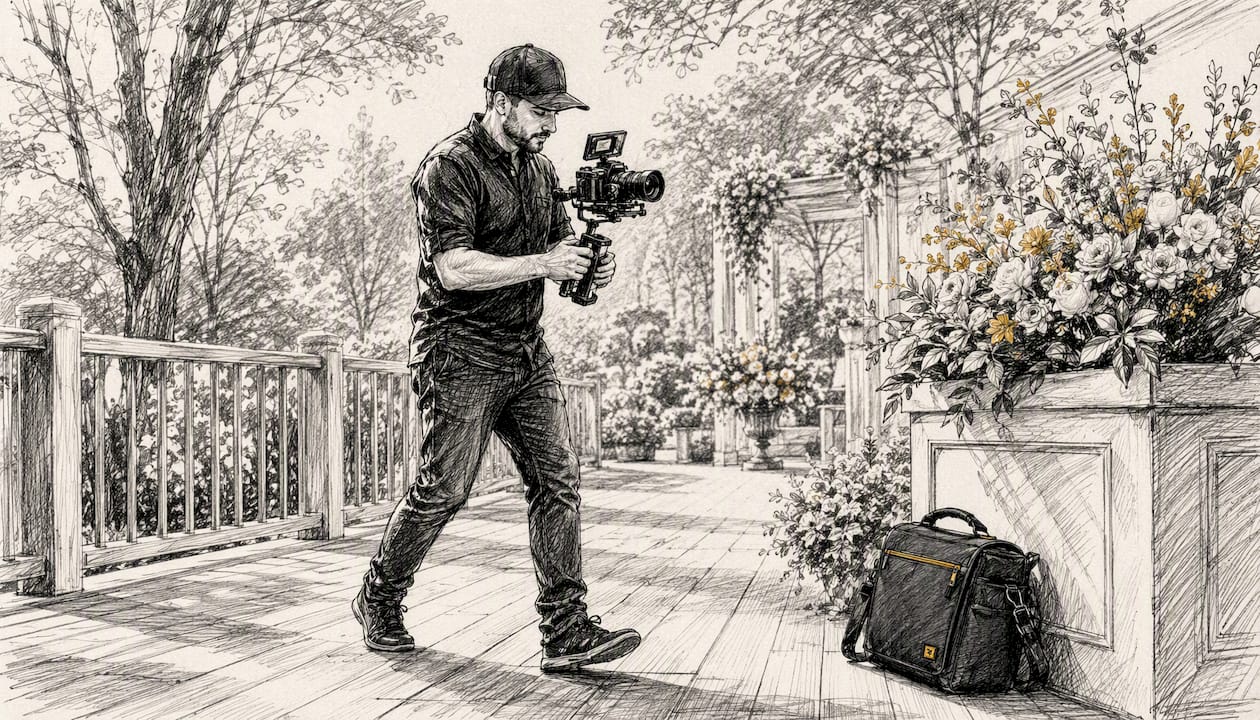
Pro Tip: Rehearse camera movement during the pre-event walkthrough. When a crew member has already moved through a space quietly and respectfully once, they do it again on the day without hesitation.
How should the final film be edited for authenticity and cultural accuracy?
Editing a multicultural wedding film is as much translation work as it is storytelling. Authentic musical elements and sound design preserve cultural meaning and should be the first editorial decision, not the last.
| Edit Element | Best Practice |
|---|---|
| Ritual completeness | Keep full ritual sequences for the long-form edit; use highlights only for the short film |
| Subtitle workflow | Timecode notes from production → native-language transcriber or approved family translation → styled subtitles that preserve cultural names and honorifics |
| Music selection | Use authentic ceremony music when recorded cleanly; blend with cinematic score only in transitions |
| Super 8 inserts | Place in informal or emotional moments (mehndi, haldi, first look) — not during sacred prayers where vintage texture can read as distancing |
| B-roll of symbolic objects | Cut these into the edit at the moment the object is used, not as generic filler |
Pro Tip: Send a rough cut of any subtitled section to a family member for review before the final export. A mispronounced name or mistranslated blessing in the finished film is far harder to fix than a correction in the edit.
For film grain and vintage aesthetic choices that complement multicultural ceremonies without overshadowing them, Visualizemedia's blog covers the full workflow.
Printable checklists: gear, shot recipes, and timeline matrix
| Checklist Item | Details |
|---|---|
| Primary cameras (×2 minimum) | A-cam locked, B-cam roaming; both with dual-native ISO |
| Telephoto body | 70–200mm for sacred/distant moments |
| Super 8 camera + film stock | Kodak Vision3 film stock depending on venue light level |
| Audio: lavs (×3), shotgun (×1), recorders (×2) | Redundant channels running throughout every ceremony |
| Backup batteries and SD cards | Two full sets per camera body, charged night before |
| Printed ritual timeline | One copy per crew member |
Shot recipe table:
| Ritual Type | Camera | Lens | Placement |
|---|---|---|---|
| Procession/entrance | A-cam + B-cam | wide and portrait lenses | Center-rear + side aisle |
| Vow/blessing exchange | C-cam telephoto | 200mm | Rear balcony or far side |
| Symbolic object (rings, garlands, tea cups) | D-cam detail | macro lens | Static near altar/table |
| Family reactions | B-cam roaming | prime lens | Crowd-level, unobtrusive |
| Super 8 texture inserts | Super 8 handheld | Fixed | Informal zones, pre-ceremony |
Timeline matrix template:
| Time Window | Ritual/Event | Camera Deployment | Portrait Window |
|---|---|---|---|
| T-90 min | Getting ready | B-cam + Super 8 | Bridal suite micro-portraits |
| T-minutes | Pre-ceremony setup | A-cam lock, D-cam static | None |
| Ceremony | All rituals per questionnaire | multi-camera | None during ceremony |
| Post-ceremony | Room flip | B-cam only | 10-min couple portraits |
| Reception | Entrances, speeches, first dance | A-cam + B-cam | Family formals during dinner |
How Visualizemedia approaches a multicultural luxury wedding: sample workflow
A sample multi-day South Asian wedding covered by Visualizemedia illustrates how this all connects. Day one (sangeet): B-cam and Super 8 operator capture dancing, mehndi detail, and family candids. No locked A-cam — the energy is fluid and the Super 8 inserts give the edit warmth. Day two (haldi and baraat): four-camera deployment, audio tech on the officiant from the moment the baraat begins, telephoto locked on the groom's face during the procession. Day three (ceremony and reception): full crew, soundboard feed running into dual recorders, subtitle notes logged in real time by the lead editor monitoring playback.
Portfolio reference: the Hinal & Brijesh film and the Kesha & Bhadresh film both demonstrate this multi-day, multi-ritual approach — watch them for examples of how ritual sequences are preserved in full while the short film uses cinematic inserts for emotional pacing.
Lessons that transfer to any multicultural wedding: the questionnaire saves more time than any gear upgrade, the Super 8 operator should be briefed separately from the main crew, and the subtitle review with a family member before delivery prevents the most common post-production complaint.
What the ritual actually means to the final film
Every ritual in a multicultural wedding carries meaning that the couple's grandchildren will one day want explained. That is the standard a cinematographer should hold themselves to — not "did we get the shot?" but "does this footage tell someone 40 years from now what this moment meant?"
The practice that makes the biggest difference: before every wedding, spend 20 minutes reading about the specific traditions being celebrated. Not to become an expert, but to know what to look for. When you know that the saptapadi (seven steps) represents seven vows rather than a choreographed walk, you hold on the couple's faces through all seven. When you know the bedeken is the groom seeing the bride for the first time, you pre-position the telephoto before he enters the room.
Follow @visualizemedia on Instagram for behind-the-scenes footage, Super 8 clips from real multicultural weddings, and examples of how these workflows look in practice.
Visualizemedia's multicultural wedding cinematography for NY/NJ couples
Multicultural luxury wedding cinematography in New York and New Jersey requires a team that already knows how to film cultural events — not one learning on your day. Visualizemedia brings multi-camera coverage, dedicated audio technicians, multilingual subtitle workflows, and optional Super 8 inserts to every multicultural wedding package. The questionnaire, the ritual map, the crew choreography — all of it is built into the process before your wedding date arrives.
Start by filling out the Visualizemedia wedding questionnaire to share your ritual list and timeline. From there, the team can match your ceremony's specific needs to the right crew configuration and package. Ready to see the work first? Browse the full wedding and events portfolio or reach out directly through the Visualizemedia homepage to check availability for your date.