
Your wedding film is the one artifact that lets you relive the exact feeling of your day, not just see it. For couples planning upscale celebrations in New York and New Jersey, the difference between a mediocre video and a genuinely cinematic film comes down to preparation, skilled execution, and an unwavering focus on authentic emotion. This guide walks you through every stage of the process, from building your gear kit and planning your shot list to filming key moments and understanding what arrives in your inbox weeks later. Whether you're vetting videographers or simply want to know what great coverage looks like, you'll find clear, actionable answers here.
Table of Contents
- Wedding videography essentials: Tools and planning checklist
- Step-by-step: Filming an upscale wedding day
- Common mistakes and troubleshooting on wedding shoots
- What to expect after filming: Delivery and highlights
- Our experience: Why emotion matters more than perfection
- Capture your NYC/NJ wedding with cinematic artistry
- Frequently asked questions
Key Takeaways
| Point | Details |
|---|---|
| Plan with the right gear | Upscale wedding filming requires cinema-grade cameras, professional audio, and backup equipment. |
| Follow a structured workflow | A step-by-step filming process ensures you capture every key moment without stress. |
| Prioritize audio quality | Clear, reliable audio is vital to preserving vows, speeches, and emotional reactions. |
| Expect a 4–8 week delivery | Professional wedding films are typically delivered within two months after the event. |
| Emotion over technical perfection | The most meaningful wedding films focus on genuine emotion, not flawless technique. |
Wedding videography essentials: Tools and planning checklist
Before a single frame is recorded, the foundation of a stunning wedding film is built in the weeks leading up to the day. Gear and planning decisions made early have an outsized impact on what's possible on the day itself.
Core equipment for cinematic wedding coverage:
- Cinema or mirrorless cameras (Sony FX3, Canon R5C, Blackmagic Pocket 6K) for rich color depth and low-light performance
- Wireless lavalier microphones clipped to the officiant and groom for clean ceremony audio
- Directional shotgun microphones mounted on camera for ambient sound
- External audio recorders (Zoom H4n or similar) as a backup source
- A drone for aerial establishing shots of the venue and property
- Prime and zoom lenses for flexibility between wide, medium, and close shots
- Backup batteries, memory cards, and chargers for every piece of equipment
Learning to capture emotion and artistry on camera requires this level of redundancy, because weddings offer zero second takes.
Industry benchmarks for upscale weddings:
| Element | Standard benchmark |
|---|---|
| Number of videographers | 2 or more |
| Hours of coverage | 8 to 12 hours |
| Camera setup | Cinema or mirrorless multi-cam |
| Full film duration | 15 to 30 minutes |
| Highlights reel | 3 to 5 minutes |
| Typical turnaround | 4 to 8 weeks |
These upscale wedding benchmarks reflect what couples should realistically expect from a premium videography team. Settling for a single-camera setup at a multi-venue New York event simply means missed moments.
Early planning conversations should also clarify your preferred style. Choosing your videography style early, whether that's a cinematic narrative approach, a documentary feel, or a hybrid of both, shapes every creative decision from lens choice to music selection.
Pro Tip: Share your wedding timeline, venue floor plan, and a "must-have moments" list with your videography team at least four weeks before the date. The more context they have, the better they can anticipate where to be and when.
Step-by-step: Filming an upscale wedding day
Now that the gear is prepped and the plan is locked in, here is how a skilled team actually executes a high-end wedding day shoot from start to finish.
1. Morning setup (2 to 3 hours before ceremony) Arrive early to test all audio equipment and confirm wireless frequencies don't conflict with the venue's sound system. Walk the ceremony space and identify the best camera positions that keep equipment out of guest sightlines. Capture detail shots, including rings, flowers, stationery, and venue architecture, while natural light is at its best. Coordinate with the lead photographer so both teams know each other's shooting angles.
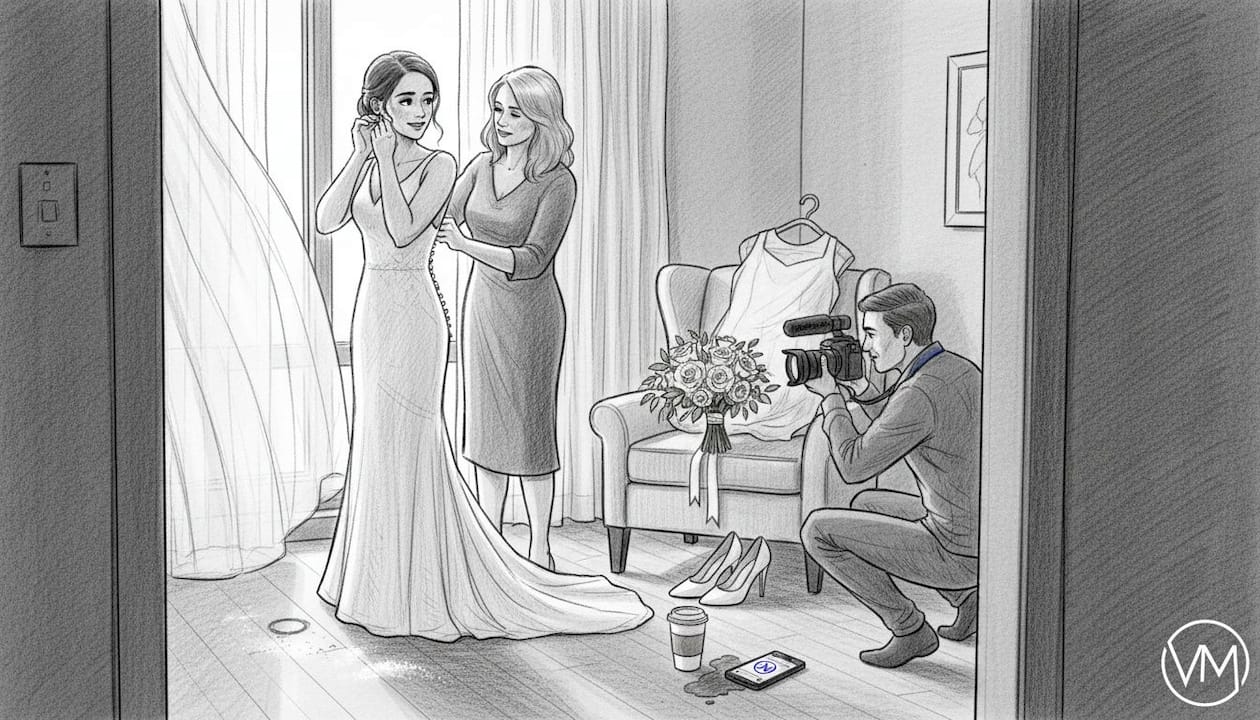
2. Getting-ready coverage Film genuine moments, not posed ones. The nervous laugh while tying a bow tie, a mother fastening a button, the quiet moment before the veil goes on. These clips are emotional anchors in the final edit.
3. Ceremony coverage Place wireless lavalier mics on the officiant and the groom well before guests arrive. Superior audio with wireless lavs, a shotgun mic on the second camera, and a backup external recorder running simultaneously creates three separate audio sources. If one fails, the others save the day. Position one camera on a locked-off wide shot, a second on a roving medium shot, and a third (when available) for guest reactions during vows.
4. Cocktail hour and reception Line audio directly from the DJ or PA system for toasts to guarantee clean speech recordings regardless of room noise. Assign one videographer to candid coverage while another focuses on key moments at the head table.
5. Speeches, first dance, and send-off These three moments are the emotional peak of most wedding films. Treat them with the same care as the ceremony: multiple cameras, confirmed audio, and a clear team briefing so no one misses a cutaway shot.
Run-and-gun vs. pre-planned multi-camera approaches:
| Approach | Best for | Risk |
|---|---|---|
| Run-and-gun (one shooter, reactive) | Small intimate weddings | Missing simultaneous moments |
| Pre-planned multi-camera | Upscale, multi-venue events | Requires larger team and budget |
| Hybrid (planned framework, fluid execution) | Most NYC/NJ weddings | Requires experienced communication |
When choosing your wedding videographer, ask specifically how they handle simultaneous moments like the bouquet toss overlapping with an unplanned grandparent dance on the other side of the room.
Pro Tip: Ask your videography team to do a radio check on all wireless audio gear at least 30 minutes before the ceremony begins. Venue Wi-Fi, DJ equipment, and hearing loop systems can all interfere with wireless frequencies.
Common mistakes and troubleshooting on wedding shoots
Even the best-prepared team encounters surprises. Knowing the most common failure points means you can ask the right questions before booking.
Mistakes that derail wedding films:
- Relying on a single audio source. If the lav mic falls off or gets muffled by a jacket, a ceremony's vows can be lost forever. Backups are essential in both audio and video recording. Three independent audio sources is the professional standard.
- Running out of storage or battery mid-reception. Formatted cards and fully charged batteries should be verified the night before, not the morning of. Bring twice what you think you need.
- Blocking the photographer's key shots. Poor positioning damages your relationship with the photographer and creates unusable footage. A pre-event walkthrough with the photo team prevents this entirely.
- Forgetting candid reactions. Technically perfect shots of the couple mean nothing without the grandmother crying in the third row or the best man barely holding it together during the speech. Reaction shots are the emotional soul of a wedding film.
"The most heartbreaking footage to lose is always the audio from the vows. Couples can see their ceremony in photos, but they can only hear the words they promised each other on film."
Understanding expected video turnaround is also part of managing the post-wedding experience and avoids the anxiety of not knowing where your footage stands.
What to expect after filming: Delivery and highlights
The wedding day ends, but the filmmaking process is far from over. Post-production is where raw footage transforms into the cinematic film you'll watch for decades.
Standard post-wedding deliverables:
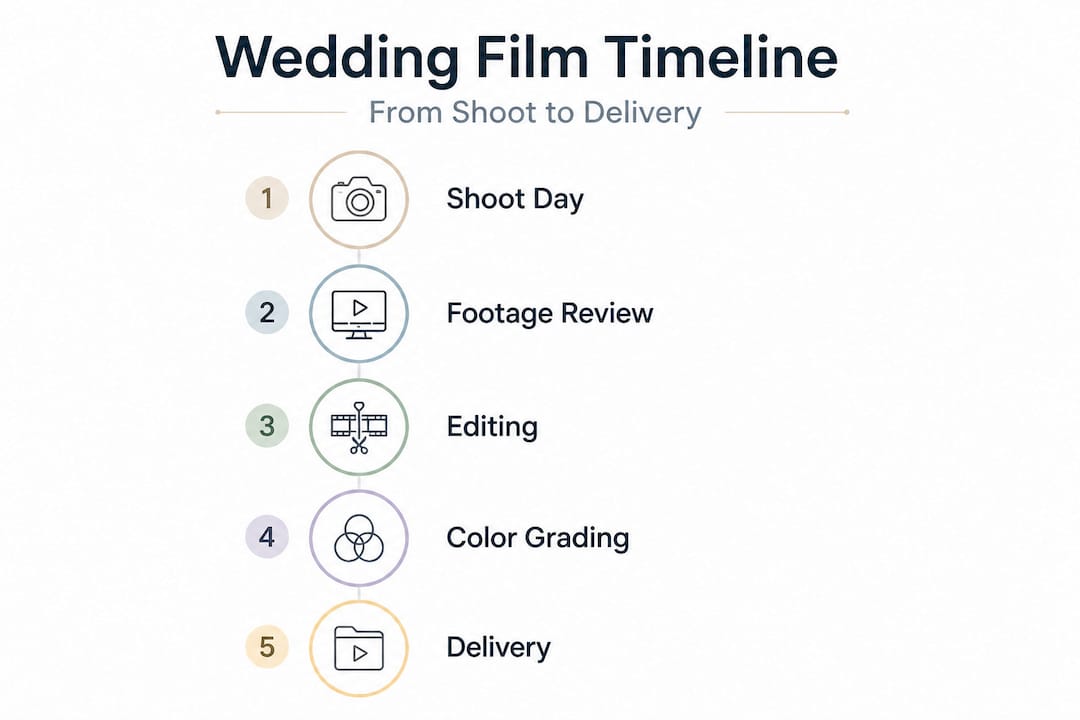
- Full-length film (15 to 30 minutes): A complete narrative of the day, from morning preparations through the final dance. Color graded, scored with licensed music, and edited to flow as a cohesive story.
- Highlights reel (3 to 5 minutes): A condensed, emotionally charged version built for sharing with family and friends.
- Social media teaser (60 to 90 seconds): Optimized for Instagram and TikTok, where vertical or square formats matter.
- Drone footage inclusion: Aerial shots of the venue are often woven into the opening sequence of the main film.
- Private online delivery: Most teams deliver via a password-protected streaming link and a downloadable file for permanent storage.
A standard 4 to 8 week turnaround reflects the volume of footage, the complexity of color grading, and the time required to license and properly sync music. Rush edits are sometimes available for an additional fee.
Working with your videographer to personalize your wedding film before filming even begins, by sharing song preferences, key relationships to feature, and moments that matter most, results in a final cut that genuinely feels like yours.
Our experience: Why emotion matters more than perfection
Here is something most videography guides won't tell you directly: technical perfection can actually work against a great wedding film.
We have filmed weddings at some of the most stunning venues across New York and New Jersey, from ballrooms in Manhattan to waterfront estates in Bergen County. And the clips that couples replay most often are never the perfectly composed architectural shots. They are the unscripted ones. A father quietly mouthing "I love you" across a crowded reception room. A groom finally exhaling when he sees his bride at the end of the aisle. A flower girl deciding mid-processional that sitting down is a better option than walking.
Chasing perfect focus and flawless composition at the expense of being present in the moment costs you those shots. Skilled wedding cinematographers know when to lock off a camera and simply watch, because the most powerful footage often arrives in the seconds before or after the planned moment.
This is why reviewing videography styles and trends matters more than it might seem. A team that prioritizes authentic storytelling over a rigid shot list will consistently deliver a film that makes you feel something, not just remember something.
Perfectionism has its place in color grading and audio mixing, not in human moments. The best wedding films we've made are the ones where we trusted emotion over the checklist.
Capture your NYC/NJ wedding with cinematic artistry
Creating a film that genuinely reflects the emotion and luxury of your wedding takes more than good equipment. It takes a team that understands how to find the story inside the day.
At Visualize Media, we specialize in cinematic wedding films for couples across New York and New Jersey. Our wedding cinematography services include multi-camera coverage, aerial footage, custom color grading, and full narrative edits that honor every detail of your celebration. From your first inquiry to final delivery, we keep communication clear and the process personal. If you're ready to start planning, fill out our wedding questionnaire and let's talk about your day.
Frequently asked questions
How many videographers are needed for upscale wedding coverage?
Two or more videographers are recommended for upscale events to ensure every angle and key moment is captured without gaps in coverage. This is the standard for upscale coverage at multi-venue and large-scale weddings.
What's the standard turnaround time for receiving our wedding film?
Wedding films are typically delivered within 4 to 8 weeks, including both the highlights reel and the full-length edit. 4 to 8 weeks is standard across the professional wedding videography industry.
Why is capturing high-quality audio so important?
High-quality audio preserves vows, speeches, and emotional moments that cannot be recreated after the day is over. Prioritizing wireless lav mics and external recorders as backups is the professional standard for this exact reason.
What is usually included in a wedding video package?
Most packages include a 15 to 30 minute main film, a 3 to 5 minute highlights reel, and optional extras like drone footage or social media teasers. Full films and highlight reels are the core deliverables across premium packages.