
Book a Part 107–certified pilot, secure written venue permission, confirm proof of insurance, and schedule your aerial windows into the run-of-show at least several weeks before the event. That is the short version. Everything below is the playbook to execute it without legal exposure, timeline chaos, or unusable footage.
Your immediate action checklist:
- Confirm the pilot holds a current FAA Part 107 Remote Pilot Certificate — the FAA classifies selling drone media as commercial use, so recreational certification is not enough.
- Get written permission from the venue or property owner before signing any vendor contract.
- Request proof of commercial liability insurance and hull coverage from the operator.
- Check for active NOTAMs or Temporary Flight Restrictions (TFRs) at the event location.
- Add aerial windows to your run-of-show with 15-minute buffers on each side.
- Assign one point of contact (POC) who communicates directly with the pilot on the day.
Confirm deliverables in writing before the event: file format, resolution (minimum high resolution), color-grade status, and turnaround date. Ambiguous contracts are the single biggest source of post-event disputes with drone operators.
Key Takeaways
Incorporating drone footage into an event plan requires a certified pilot, written venue permission, a formal flight plan, and deliverables confirmed in writing before the event day.
| Point | Details |
|---|---|
| Hire a Part 107–certified pilot | The FAA classifies selling drone media as commercial use; verify the certificate number directly before signing. |
| Secure permissions before booking | Get written venue permission, confirm LAANC or waiver status, and require a COI from the operator. |
| Schedule aerial windows in the run-of-show | Build 15-minute buffers around each flight window and assign one POC to relay schedule changes to the pilot. |
| Limit aerials to a few purpose-driven shots | Most final edits use only a handful of aerial clips; overuse reduces impact and complicates logistics. |
| Confirm deliverables in writing | Specify file format, resolution, color-grade status, and turnaround date to avoid post-event disputes. |
| Visualizemedia for full-service coverage | Visualizemedia integrates aerial and ground coverage into a single cinematic package for NY and NJ events. |
How do you decide what drone footage your event actually needs?
Before booking anyone, map your intended use to specific shot types. A marketing reel for a corporate sponsor needs different aerials than a wedding recap film or a live-streamed festival. Mixing up the goal at the start means you collect the wrong footage and spend money on clips that never make the final cut.
Each drone shot should serve the story rather than exist because aerials look impressive. Run this quick exercise: write down each deliverable (recap film, social teaser, marketing reel, livestream overlay, highlight package), then assign 1–3 aerial shot types to each.
Common shot types and their best use:
- Establishing shot (a short duration, arrival or pre-event): wide overhead of the venue that orients the viewer. Best captured before guests arrive.
- Reveal shot (a brief duration, ceremony or main stage): slow pull-back or rise that shows scale. Works for ceremony aisles, festival stages, and corporate keynote venues.
- People-movement shot (a short duration, cocktail hour or crowd peak): overhead of guests moving through a space. Adds energy without identifying individuals.
- Venue layout shot (a brief duration, pre-event): bird's-eye map of the full property. Useful for marketing and sponsor content.
- Golden-hour portrait (several seconds, before sunset): low-altitude couple or executive portrait with dramatic sky. The most cinematic shot in the set.
Most final edits use only a few aerial clips. Drone photography adds dramatic scale but is best used sparingly — overloading a film with aerials dilutes their impact and signals to viewers that the ground coverage was thin.
Deliverables to confirm in writing:
| Deliverable | Recommended format | Resolution | Typical use | Delivery window |
|---|---|---|---|---|
| Archival master | ProRes 422 or HEVC | 4K | Full edit, color grade | a few weeks post-event |
| Social teaser clips | MP4 | standard HD or higher resolution | Instagram, TikTok, Reels | a few days post-event |
| Same-day highlight | Proxy MP4 | standard HD | Same-day reel or livestream | Day-of |
| Color-graded aerials | ProRes or DNG stills | 4K | Marketing, print, web | 1–2 weeks post-event |
What legal and venue permissions do you need before flying?
This is where most planners get caught short. Skipping even one item on this list can ground the drone on the day or expose the event to liability.
FAA regulatory checks:
- Verify the pilot's Part 107 certificate number on the FAA DroneZone registry before signing a contract.
- Confirm the aircraft is registered with the FAA and the registration number is displayed on the drone.
- Check for active TFRs and NOTAMs at the event location using the FAA's B4UFLY app or SkyVector. TFRs around stadiums during sporting events, presidential movements, or wildfires can appear with very short notice.
- If the venue is in controlled airspace (Class B, C, D, or E near an airport), the pilot must obtain authorization through LAANC (Low Altitude Authorization and Notification Capability) or a manual FAA waiver. Airspace complexity near airports and stadiums requires advance authorization and can significantly affect both feasibility and cost.
- Remote ID compliance is now required for most commercial operations — confirm the aircraft broadcasts Remote ID.
Venue and local permissions:
- Get written permission from the property owner or venue manager. Verbal agreements are unenforceable when something goes wrong.
- Ask the venue whether their own insurance policy requires a certificate of insurance (COI) from the drone operator before allowing flights. Many venues demand COIs before permitting any drone activity on property.
- Check local ordinances. Some municipalities restrict drone flights over public gatherings regardless of FAA authorization.
- Address attendee privacy and consent. If the drone will capture identifiable individuals, consider a disclosure in event communications or a visible signage notice at entry points.
Insurance and liability:
- Require proof of commercial general liability coverage (ask for a baseline commercial general liability coverage amount recommended by event insurers — confirm with your event insurer what they require).
- Hull insurance covers the aircraft itself; liability insurance covers damage or injury to third parties. You need both confirmed.
- For high-attendance events, ask your legal counsel to review the indemnification language in the drone operator's contract.
Legal note: This article is general planning guidance, not legal advice. Confirm current FAA rules and local ordinances with a qualified aviation attorney or directly through FAA.gov before flying at any regulated venue or airspace.
How do you build a flight plan that fits inside your run-of-show?
Professional drone operations require a written flight plan, a site survey, and safety planning completed before the day of the event. The flight plan does not need to be a 20-page document. It needs to answer five questions clearly.
Flight plan outline (include this in your run-of-show packet):
- Objectives: Which shots are being captured and in what order?
- Flight windows: Exact time blocks (e.g., 9:00–9:20 AM for venue establishing shots, 6:45–7:15 PM for golden-hour portraits).
- Altitudes and flight paths: Maximum altitude per window, no-fly zones (directly over the ceremony, over catering tents, over emergency access routes).
- Launch and recovery zone: A clearly marked, crowd-free area at least 30 feet from any guest cluster.
- Emergency abort procedure: Who calls the abort, what triggers it (unexpected crowd movement, wind gust above threshold, aircraft anomaly), and where the drone lands.
A flight plan can be drafted in the field using mobile apps or prepared in advance with web-based flight-planning software that maps paths and sets geographic boundaries before the pilot arrives on site.
On-site roles:
- Pilot: Operates the aircraft, holds final authority on go/no-go decisions.
- Visual observer (VO): Keeps eyes on the drone at all times while the pilot monitors the controller screen. Required for safe crowd operations.
- Event POC: Your designated contact who relays schedule changes to the pilot in real time.
- Security liaison: Briefs venue security and emergency services on flight windows and the launch zone location.
- Editor contact: Receives the shot log and any same-day proxy files.
Brief your security team and any on-site emergency services at least 24 hours before the event. Tell them the flight windows, the launch zone, and the abort signal. A drone appearing without warning over a security perimeter is a fast way to get the operation shut down.
Preflight documentation to have on paper:
- Printed LAANC authorization or FAA waiver
- Pilot's Part 107 certificate copy
- Aircraft registration certificate
- COI from the operator
- Written flight plan with exclusion zones marked
- Weather check (wind speed, precipitation probability, visibility minimums)
- Battery inventory and swap schedule
Visiting the site before the shoot and arriving early on the day to build in setup time are among the most consistently cited practices from experienced event drone operators. A 30-minute site visit weeks before the event catches problems that no amount of satellite imagery reveals.
How do you vet and hire the right drone operator for your event?
The Part 107 certificate is the floor, not the ceiling. Plenty of certified pilots have never flown over a live crowd of 300 people. Event drone work requires a specific skill set: managing airspace, reading crowd movement, communicating with a ground team, and delivering usable footage under time pressure.
Vendor vetting checklist:
- Verify the Part 107 certificate number directly with the FAA, not just from a PDF the operator sends.
- Review portfolio work specifically from events, not landscape or real estate shoots. Ask for examples of crowd operations.
- Confirm LAANC experience if your venue is near an airport or in controlled airspace.
- Ask for references from at least two previous event clients.
- Request proof of insurance with the coverage amounts listed, not just a statement that they are insured.
- Ask whether they use a visual observer. A solo pilot with no VO is a red flag for crowd operations.
For questions to ask when vetting any videography vendor, the same principles apply to drone operators: ask about their process, their contingency plan, and what happens if the footage is unusable.
Contract clauses that protect you:
- Scope of work: Specific shot list, flight windows, and number of deliverable clips.
- Weather and NOTAM rescheduling: Who bears the cost of a reschedule, and what is the rescheduling window?
- Indemnification: The operator indemnifies the event organizer for damage or injury caused by the aircraft.
- Usage rights: Who owns the footage? Confirm you have full rights for marketing, social, and commercial use.
- Delivery specs: File format, resolution, color-grade status, and hard delivery date.
- Cancellation policy: What is the refund or credit structure if the event is canceled?
Pro Tip: Ask the operator to share their standard flight plan template before you sign. An operator who cannot produce one has likely never filed a formal plan — and that is a significant operational risk at a permitted event.
Red flags:
- No proof of insurance or refusal to provide it in writing
- Cannot provide pilot certificate or aircraft registration details
- Vague deliverables ("we'll get you great footage")
- Unwillingness to coordinate with venue security or your event team
- No visual observer for crowd operations
What aerial shots work best, and when should you schedule them?
The most useful aerial moments in event coverage fall into four categories, each with a natural scheduling slot.
Establishing shots belong at the very start of the day, before guests arrive. An empty venue from 150 feet up tells the whole story of the space in 20 seconds. Schedule this window during venue setup, typically 60–90 minutes before doors open. No crowd management required, no noise complaints, and the light is usually clean.
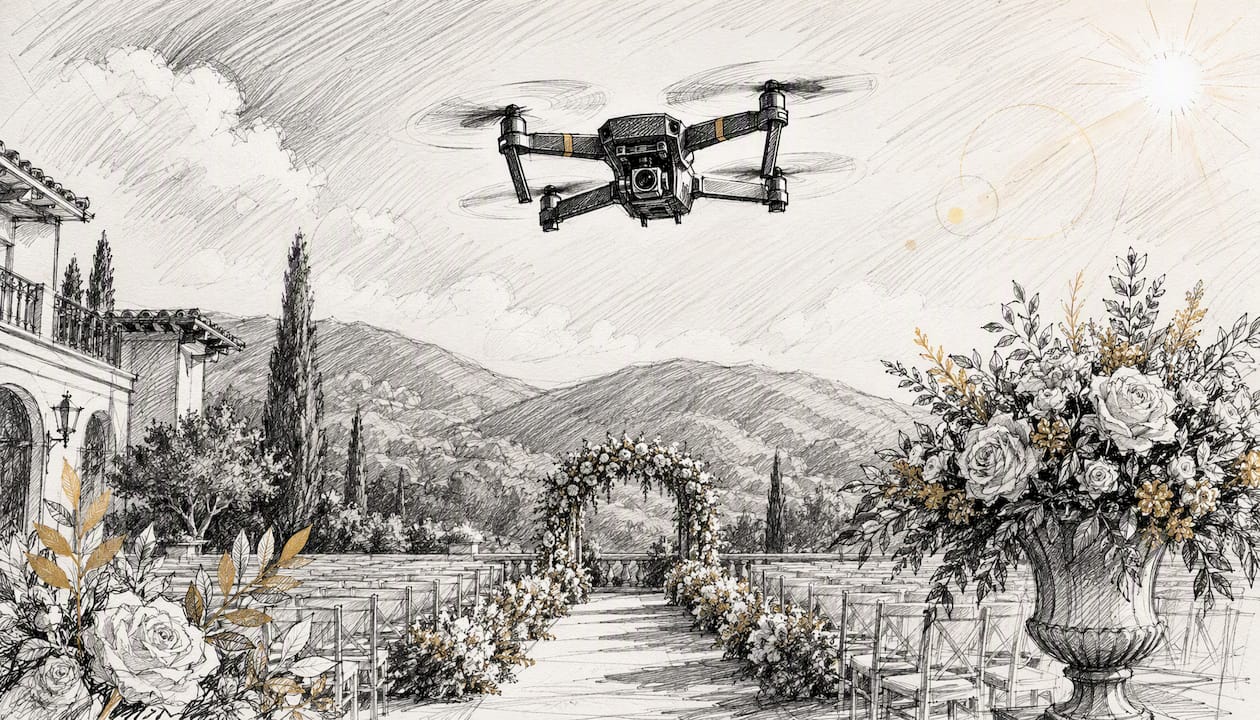
Ceremony or stage reveals work best at the moment of peak visual drama: the processional beginning, the first look at a decorated reception hall, or the opening of a festival main stage. The pilot needs to be pre-positioned and ready to fly the moment the cue comes. Build a 5-minute buffer before and after this window in the run-of-show.
Crowd pullback shots during cocktail hour or a festival crowd peak add energy and scale. These require the pilot to fly at a higher altitude and avoid direct overflight of guests. The FAA's operational guidance strongly discourages flying directly over people who are not involved in the operation — factor that into your shot design.
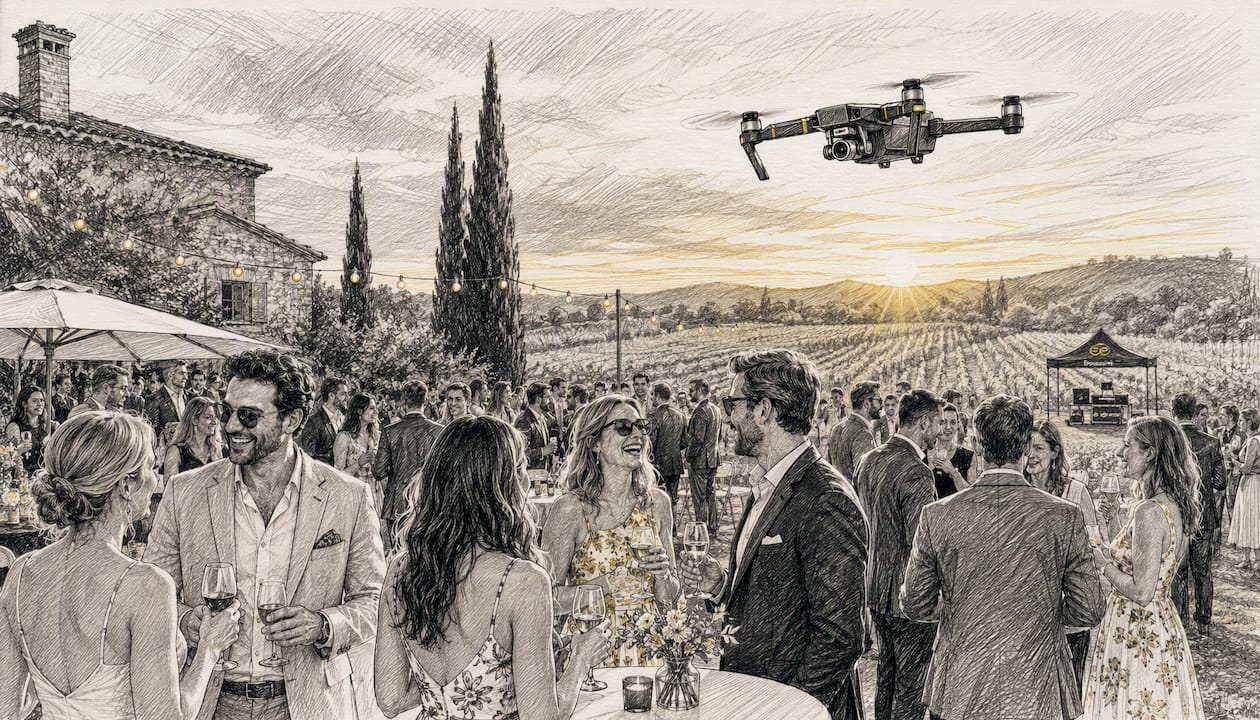
Golden-hour portraits are the most cinematic shot available at an outdoor event. The window is narrow (roughly 20–30 minutes), so schedule it precisely and protect it from schedule drift. For weddings, this is typically 30–45 minutes before sunset.
Most final films contain only a handful of aerial clips. Trying to capture aerials during every phase of the event creates logistics pressure, increases noise disruption, and rarely produces more usable footage. Limiting drone usage to a few purpose-driven shots is the consistent recommendation from experienced event filmmakers.
When to skip aerials entirely:
- Indoors or under tent structures
- Tightly packed crowds where maintaining safe separation is impossible
- Active TFRs (stadiums during games, political events, emergency zones)
- Wind speeds above the aircraft's rated limit (typically typical rated wind speeds for consumer-grade cinematic drones)
- Night operations without an FAA waiver for operations over people
For wedding timeline planning in New York, aerial windows need to account for venue-specific constraints like rooftop access, adjacent flight paths, and noise ordinances that vary by borough.
What deliverables and formats should you ask for in the final files?
Getting the footage is only half the job. Getting it in a format your editor can actually use is the other half. Mismatched frame rates and color profiles between drone and ground cameras are the most common technical problem in post-production.
Matching frame rates, shutter speeds, and color profiles between drone and ground cameras is critical to a smooth edit. Before the event, share your ground camera specs with the drone operator and agree on a common frame rate (typically 24fps for cinematic work, 30fps for corporate or broadcast) and a color profile (Log or flat picture profile for maximum grading flexibility).
Deliverables checklist:
- Native raw or Log files from the drone (not just compressed MP4s)
- Color-graded aerial clips matched to the ground camera grade
- Social-ready cuts (vertical 9:16 and square 1:1 versions for Reels and TikTok)
- Proxy files for same-day edits if a same-day highlight reel is part of the package
- LUT notes or the shared LUT file used for color matching
- A shot log with timecodes for each usable clip
- Consistent file naming (date, event name, shot type, take number)
Pre-production alignment between the drone operator and ground camera crew, including shared LUTs and a shot log, saves hours in post and produces a consistent final film. Build this alignment into your pre-event production meeting, not as an afterthought on the morning of the event.
Format by use case:
- Archival and high-end edit: 4K ProRes 422 or HEVC. Larger files, maximum quality.
- Quick social delivery: MP4 at standard HD or higher resolution. Compressed, fast to upload.
- Same-day edit proxies: standard HD MP4, low bitrate. Fast to ingest and cut.
Schedule the drone operator's delivery relative to your other vendors. If the photographer delivers within two weeks and the ground videographer within four, the drone operator should match the shorter timeline for social clips and the longer one for graded masters.
What does drone coverage cost, and how far in advance should you book?
Pricing for event drone coverage varies widely based on a handful of factors, and understanding those factors helps you evaluate quotes rather than just compare numbers.
What drives the price:
- Pilot experience and equipment: A cinematic drone (DJI Inspire 3, Zenmuse X9) costs more to operate than a compact prosumer model. Experienced event pilots with LAANC credentials charge accordingly.
- Airspace complexity: A venue in Class B airspace near a major airport requires advance LAANC authorization or a manual FAA waiver. That work takes time and sometimes fees, and operators price it in.
- Time on-site: A two-hour window for establishing shots and golden-hour portraits is a different scope than a full-day festival coverage package.
- Post-production: Color grading, social cuts, and proxy delivery all add to the cost. A raw-files-only delivery is cheaper; a fully graded, multi-format package is not.
Qualitatively, event drone packages fall into three tiers: a basic coverage window (establishing shots and one or two portrait moments, minimal post), a mid-tier event package with color grading and social deliverables, and a high-end multi-camera day rate that integrates the drone operator into a full production team. For large-scale drone light shows, the cost model is entirely different — consult specialist resources on drone light show pricing before budgeting for a choreographed aerial spectacle.
Booking timeline:
- Routine outdoor events: Book drone coverage at the same time as your other primary vendors, typically several weeks out at minimum.
- Controlled airspace or complex permits: Add additional weeks for LAANC processing or manual waiver applications. Some waivers take longer.
- High-demand dates (peak wedding season, major holidays): Experienced event pilots book out months in advance.
Contingency planning:
- Build a weather reschedule window into the contract (typically 24–48 hours before the event).
- Identify two or three ground shots that substitute for aerials if the drone is grounded (wide-angle rooftop shots, elevated platform angles).
- Confirm whether the contract includes a reshoot credit or partial refund for weather cancellations.
For on-time video shoot planning that integrates specialist operations like drone coverage, the consistent advice is to treat the drone operator as a primary vendor, not an add-on, and schedule accordingly.
A real-world sample timeline and preflight checklist
This timeline is based on a typical outdoor wedding day with aerial windows built in. Adapt the structure for corporate events or festivals by swapping the ceremony and portrait windows for keynote reveals and crowd peaks.
Sample wedding day aerial timeline:
- 7:00 AM — Pilot arrives, conducts site survey, confirms launch zone, checks LAANC authorization.
- 7:30–8:00 AM — Pre-guest aerial window: venue establishing shots, layout overview, detail aerials of ceremony setup.
- 8:00 AM — Guests begin arriving; drone grounded until next scheduled window.
- 11:00–11:15 AM — Brief aerial window during cocktail hour setup (no guests in ceremony space).
- 4:30–5:00 PM — Ceremony aerial reveal (pre-positioned, cued by event POC at processional start).
- 6:45–7:15 PM — Golden-hour portrait window (couple + pilot + VO, away from main guest area).
- 7:15 PM — Drone operations complete; pilot begins file transfer and proxy export for same-day edit.
Full preflight and on-site checklist:
- Printed LAANC authorization or FAA waiver on site
- Pilot's Part 107 certificate copy in event binder
- Aircraft registration certificate confirmed
- COI from operator delivered to venue manager
- Written flight plan with exclusion zones reviewed by security liaison
- Weather check completed (wind, precipitation, visibility) within 2 hours of first flight
- Battery inventory confirmed (number of batteries, charge status, swap schedule)
- Visual observer assigned and briefed
- Launch and recovery zone marked and clear of guests
- Communications protocol confirmed (radio channel or phone number for pilot-to-POC contact)
- Emergency abort procedure reviewed with pilot and security
- Shot log template shared with editor contact
Pro Tip: Capture empty-venue establishing shots in the first 30 minutes after the pilot arrives, before any guests or vendors crowd the frame. Pair one wide aerial with a ground-level Super 8-style insert of the same space for a creative contrast that gives the edit a cinematic, textured feel. The aerial shows scale; the vintage insert shows intimacy. Together they set the tone for the whole film.
How Visualizemedia coordinates aerials without breaking the event flow
The approach that works consistently is simple: one dedicated fly window per event phase, a discreet launch zone away from the main guest flow, and a single pilot-plus-visual-observer team that communicates directly with one event POC. No mid-ceremony surprises, no drone hovering over the dinner tables.
At Visualizemedia, the aerial crew coordinates with the ground camera team before the event to align frame rates, color profiles, and the shot log. On the day, the pilot receives schedule updates through a single channel — one phone call or radio check, not a group text with six people. That keeps the pilot focused on flying and the event team focused on the event.
For visual examples of how aerials integrate into cinematic wedding films, follow Visualizemedia on Instagram at @visualizemedia. The feed shows how aerial establishing shots, ground coverage, and vintage-style inserts work together in a finished film.
Visualizemedia's full-service aerial and cinematic event packages
Visualizemedia offers wedding and event packages that include multi-camera ground coverage, aerial drone footage, professional color grading, social media teasers, and full ceremony and speech edits — everything coordinated by a single production team so you are not managing five separate vendors on the day.
For planners who want drone footage integrated into a complete cinematic film rather than sourced separately, Visualizemedia handles the airspace coordination, the preflight documentation, and the post-production alignment between aerial and ground footage. The result is a film where the aerials feel like part of the story, not inserts from a different shoot.
To get a quote or discuss your event's specific requirements, visit the weddings and events page or complete the shoot questionnaire to share your timeline, venue, and deliverable needs. The team covers events across New York and New Jersey.
Sources
These are the sources worth bookmarking when you move from reading to execution.
- Drone videography for events: What you need to know - Cerious Productions
- Everything You Need to Know About Drone Photography at Weddings
This article is general information, not a substitute for advice from a qualified lawyer. Consult a qualified legal professional about your own circumstances before acting on anything here.
Recommended
- How to Choose a Wedding Videographer in NYC & NJ: 10 Questions | Visualize Media — Visualize Media | Luxury Film
- wedding videography tips NJ — Blog — Visualize Media | Luxury Film
- wedding timeline for video — Blog — Visualize Media | Luxury Film
- how to plan wedding video — Blog — Visualize Media | Luxury Film