
Yes, you can safely include your pet in your wedding film. Limit their on-site time to 3 to 4 hours, hire a dedicated handler, get venue permissions in writing, and plan one short POV or portrait segment. That's the whole plan.
Three moves to make this week:
- Email your venue and ask for written pet approval, including any vaccination proof or cleaning fees.
- Book a handler (a friend, relative, or professional) who will do nothing else that day but manage your pet.
- Schedule a pre-ceremony portrait window and, if you want POV footage, a test run with a GoPro or similar action camera before the wedding.
The Plan A Wedding timeline guide backs the 3 to 4 hour window, and Visualize Media has shot enough pet-inclusive films to know where couples get tripped up. Here's the full playbook.
Key Takeaways
Including a pet in your wedding film succeeds when you cap their on-site time, confirm every permission in writing, and rehearse their role before the day arrives.
| Point | Details |
|---|---|
| Cap on-site time | Keep your pet at the venue for 3 to 4 hours max to avoid fatigue and behavior issues. |
| Get permissions in writing | Confirm venue pet policy, vaccination proof, and cleaning fees via email or contract addendum. |
| Rehearse the role | Practice aisle walks or cues at least three times, with and without treats. |
| Test POV gear first | Use a dog-specific harness, test the GoPro setup in advance, and carry spare batteries. |
| Work with experienced filmmakers | Visualize Media plans pet-inclusive coverage into its wedding packages from the first consultation. |
What Is the Best Day-of Timeline for Including a Pet?
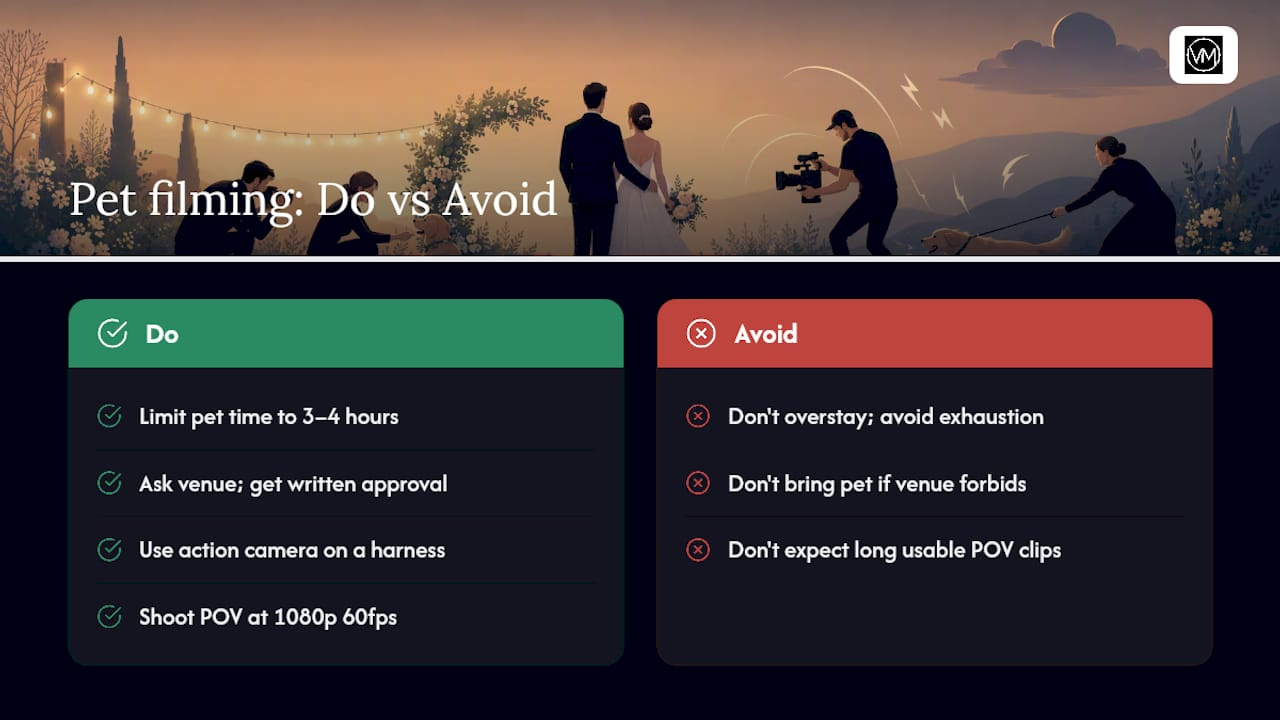
Keep your pet's total on-site time to 3 to 4 hours max. Anything longer and you risk a tired, cranky animal by the time the good light shows up for photos. The Plan A Wedding guide puts it bluntly: leave a dog at the venue for a full 8-hour wedding day and you'll likely get worse behavior and worse footage in exchange.
Here's a timeline that works for most ceremonies:
- Morning: Exercise and groom your pet at home so they arrive calm, not wound up.
- T-minus 60 minutes: Handler brings the pet to the venue, on leash, already fed and walked.
- Pre-ceremony: Portrait session with the couple, 15 to 20 minutes, before guests arrive and stress builds.
- Ceremony: Aisle walk or seated role, whatever fits the pet's training.
- Cocktail hour: A brief 20 to 30 minute appearance for candid guest interactions, then handoff.
- Departure: Handler removes the pet before dinner service starts.
Build in water breaks and a quiet rest zone, ideally a shaded or air-conditioned spot away from the reception noise, plus a bathroom break right before the ceremony.
Pro Tip: Schedule your pet's biggest moments in the first half of the timeline, not the second. A calm dog at 2 p.m. can turn restless and unpredictable by 6 p.m., and that shift shows up on camera.
What Venue and Vendor Permissions Do You Need in Writing?
Get pet approval in writing before you build any part of your film around them. A verbal "sure, that's fine" from a venue coordinator means nothing if a different staff member is working your wedding day.
Confirm these items by email or contract addendum:
- Whether pets are allowed on-site, and which areas are off-limits (dance floor, catering prep, indoor ceremony space).
- Vaccination or health documentation the venue requires.
- Any extra cleaning fee tied to having an animal on the property.
- Whether your officiant has objections, particularly for religious or cultural ceremony formats.
- Insurance or liability waivers, especially for larger dogs or outdoor venues.
- Whether your videographer and photographer have actual experience filming pets, and ask to see sample clips.
If the venue says no, you're not out of options. A pre-wedding photoshoot with your pet, a display of framed photos at the reception, or even a paw-print detail worked into the decor can still bring them into the story, an approach Julia Healey Photography recommends for couples facing venue restrictions.
Who Should Handle the Pet, and How Much Rehearsal Do You Need?
Hire or assign one dedicated handler and rehearse the pet's exact role at least three times before the wedding. This is not optional. Your photographer and videographer are there to shoot the day, not to chase a dog who's slipped a leash.
The handler needs a clear job description:
- Arrival and departure timing, synced to the timeline above.
- Leash, water bowl, and bathroom supplies on hand at all times.
- A designated quiet zone where the pet can decompress between appearances.
- Emergency contacts, including a nearby vet if the venue is unfamiliar territory.
- Authority to pull the pet from any scene if stress signs appear.
For rehearsal, walk through the exact sequence your pet will perform:
- Practice the aisle walk (or whatever role you've chosen) at least three times, ideally in a space similar to your ceremony layout.
- Run it once with treats as a cue, then once without, since treats visible in your ceremony photos rarely look intentional.
- Time a full dry run, including the handoff to and from the handler.
Have a plan ready for the obvious failure points: an escape attempt, sudden barking, or a hot day that makes a heavy-coated breed miserable in formal wear.
How Do You Safely Capture POV Footage of Your Pet?
A camera mounted on your pet can produce some of the most memorable footage in your entire film, but only if the gear is tested and safe for the animal. If you're not confident it will work without stressing your pet, skip the POV mount entirely and let your videography team capture short portrait and coverage segments instead.
Safety comes first, always:
- Use a harness built specifically for pets, never a strap-on rig improvised from photography gear.
- Keep camera weight proportionate to your pet's size; a mount that's too heavy or restricts movement raises injury risk, according to PetsRadar's mounting guide.
- Introduce the harness gradually over days or weeks, not the morning of the wedding.
- Watch for any change in gait or behavior once the camera is attached, and remove it immediately if the pet seems bothered.
For camera settings, couples who've done this with a GoPro typically shoot at 1080p rather than 4K, since lower resolution extends recording time and stabilizes better on a moving animal. A frame rate around 60 fps smooths out the shakier POV movement, and a wide field of view captures more of the scene around your pet. Keep audio on. Recording capacity matters here: plan for roughly 1.5 hours of footage on an extended POV run, and carry at least one spare battery and a second memory card.
Couples who mounted a GoPro on their dog for the ceremony reported the footage was candid and imperfect, but worth every minute of setup, according to Julia Luckett's account of her dog Zhivago filming her wedding.
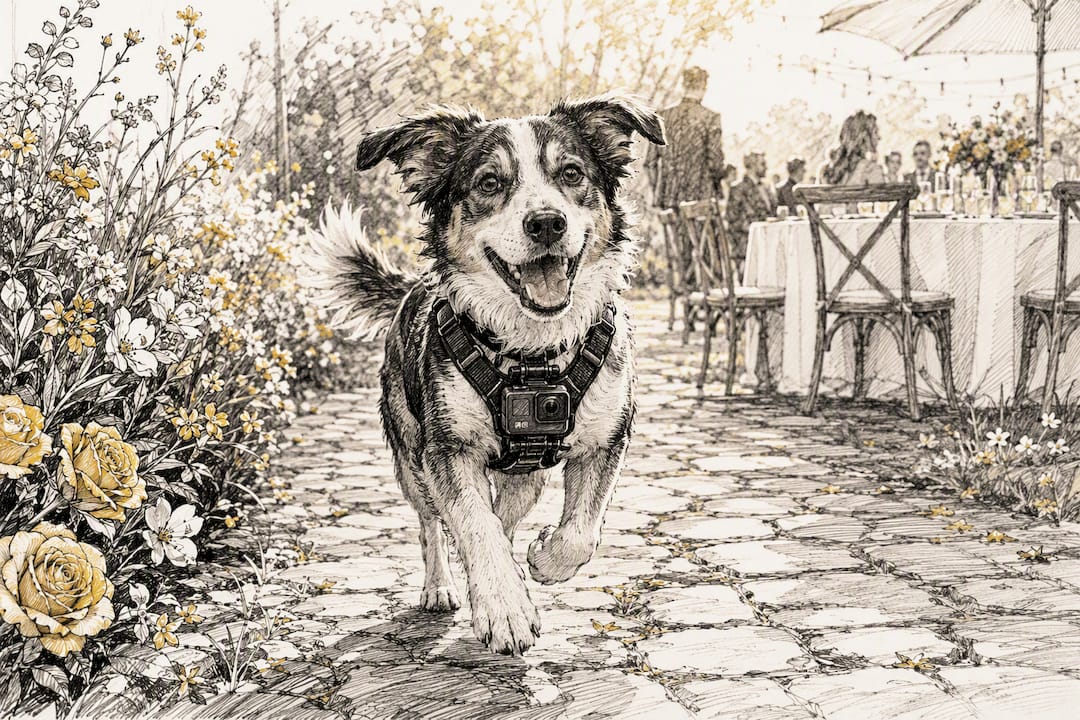
Always run a backup plan alongside any POV setup: a second camera on a tripod for the ceremony itself, plus a few handheld passes during portraits. Test the whole rig on your pet in a similar environment before the actual day.
Pro Tip: Start the GoPro recording about 30 minutes before the ceremony begins. You'll capture pre-ceremony energy you'd otherwise miss, and you avoid fumbling with the camera during the actual walk down the aisle.
Which Pet Roles and Shots Work Best?
Match the role to your pet's temperament, not to what looks best on Pinterest. A shy pet does fine greeting guests or sitting for portraits; a well-trained, confident dog can handle an aisle walk or even a ring-bearing role.
Shot ideas worth requesting from your videographer:
- Short POV clips from the pet's harness camera, 20 to 30 seconds each, not the whole ceremony.
- Pre-ceremony portraits with the couple, shot in natural light before guests arrive.
- Wide and close aisle-walk shots if your pet is part of the processional.
- Reaction shots during vows, but only if the pet is genuinely calm; a restless dog mid-frame distracts from the moment.
- Playful, candid greetings during cocktail hour.
- A final exit shot with the handler as the pet leaves for the day.
If your pet shows any anxiety signs, skip the ceremony-adjacent shots and lean into the earlier, lower-pressure moments instead. A relaxed 15-minute portrait session beats a stressed aisle walk every time.
How Is Pet Footage Actually Used in the Final Film?
Expect candid, imperfect clips rather than polished, ready-to-use coverage. Your editor's job is to find the handful of genuinely great moments buried in the raw footage and build them into a short, emotional segment.
A few things to know going in:
- Editors routinely cut long stretches of unusable POV footage, off-angle shots, wandering attention, or the dog simply eating something off the ground.
- Rapid trims work better than long uncut clips; POV footage reads best in short bursts paired with traditional coverage for context.
- A 30 to 90 second pet montage, or a few pet moments woven into your main story beats, tends to land better than trying to force pet footage into every scene.
- Don't expect the POV camera to catch your vows perfectly. Keep a reliable traditional camera on your key moments and treat the pet footage as a bonus layer.
The Business Insider account of a GoPro-collared dog filming an entire wedding is a good example: the couple's editor had to remove roughly 10 minutes of the dog just eating or wandering off-task, but the surviving clips became the most talked-about part of their film.
Why Trust This Approach?
Visualize Media is a luxury wedding filmmaking company based in New York and New Jersey, with experience shooting cinematic, pet-inclusive coverage alongside niche formats like Super 8 film. Our team has worked through exactly the logistics above, timeline planning, vendor coordination, and safe POV capture, on real wedding days.
The best pet footage in a wedding film almost never comes from forcing a perfect shot. It comes from giving the pet a clear, low-stress role and letting the camera catch what happens naturally.
Browse our wedding videography timeline guidance for more on structuring your day, and follow @visualizemedia on Instagram for recent pet-inclusive edits.
A Filmmaker's Note on Imperfect Pet Footage
We always prioritize pet safety and timeline limits over getting a "perfect" shot. On one test run, a POV camera on a dog's harness caught nothing but grass and sky for ten minutes, then suddenly framed the couple's first look perfectly. That's the trade-off, and it's worth it.
Ready to Film Your Pet-Inclusive Wedding Day?
You've got the timeline, the vendor checklist, and the POV camera plan. What you need next is a filmmaking team that's actually done this before, not one that's improvising a pet role for the first time on your wedding day. Visualize Media builds pet-inclusive coverage into our wedding cinematography packages as a standard planning conversation, not an afterthought, so your dog's fifteen minutes on camera get the same attention as your first look.
We work with couples across New York and New Jersey and can walk you through exactly how we'd handle your pet's role, from handler coordination to POV safety checks. For more on shot planning and pre-ceremony timing, our partners at Winelands Function cover similar ground for pre-drinks photography. Reach out through our main site to request sample pet-friendly edits or book a consultation, and follow @visualizemedia for recent work.
Frequently Asked Questions
How long should a pet stay at a wedding for filming purposes? Keep it to 3 to 4 hours total. That covers arrival, portraits, a ceremony role, and a short cocktail-hour appearance without pushing your pet toward exhaustion.
Do I need special insurance to include my dog in my wedding? Some venues require a liability waiver or proof of vaccination before allowing an animal on-site. Ask your venue directly and get their answer in writing.
What if my venue doesn't allow pets? Book a pre-wedding portrait session instead, or display framed pet photos at the reception. Both keep your pet part of the story without violating venue rules.
What camera works best for pet POV footage? Action cameras like a GoPro, mounted on a dog-specific harness, are the standard choice. Shoot at 1080p and 60 fps for steadier footage during extended recording.
Will POV footage from my pet actually look good in the final film? Expect short, candid clips rather than polished coverage. Editors typically cut long stretches of unusable footage and keep the handful of genuinely emotional moments for a brief montage.
Sources
- How to Include Your Pet in Your Wedding (Without Chaos) | Plan A Wedding
- How to mount a GoPro on a dog | PetsRadar
- GoPro wedding video filmed by our dog Zhivago | Julia Luckett
- A couple's dog filmed their wedding with GoPro attached to his collar | Business Insider