
Lighting setups for wedding videography are the deliberate use of professional continuous LED lights, modifiers, and real-time control techniques to produce flattering, natural-looking footage across every phase of the wedding day. Without controlled light, even the best camera body will deliver muddy skin tones, blown-out windows, or flat, lifeless images. The difference between a cinematic wedding film and a home video almost always comes down to how the light was managed, not which camera was used. Tools like the Godox VL150, Godox SL300III, and Pixel K80 kits give videographers the power to shape light precisely, regardless of what the venue throws at them.
What lighting equipment is ideal for wedding videography?
Professional-grade LED fixtures with a CRI of 95 or higher and a TLCI of 97 or higher are the baseline standard for wedding work. Those numbers matter because they determine how accurately the light renders skin tones on camera. A fixture with a CRI of 80 may look fine to the human eye but will produce greenish or magenta casts in footage, especially in mixed-light environments like ballrooms.
Two main fixture types dominate professional lighting kits for wedding filmmakers: continuous LED panels and COB (chip-on-board) LED spotlights. Panels spread light broadly and work well as fill sources. COB lights like the Godox SL300III produce up to 99,300 lux at 1 meter, making them powerful enough to push through large softboxes in ballrooms without losing exposure. That output level means you can diffuse aggressively and still maintain a clean, bright image.
| Light | Type | Max Output | CRI | Key Feature |
|---|---|---|---|---|
| Godox SL300III | COB LED | 99,300 lux | 96+ | High output, modifier-ready |
| Godox VL150 | LED Panel | 14,760 lux | 96+ | App control, lightweight |
| Pixel K80 | Bi-color Panel | 5,600 lux | 95+ | Portable, budget-friendly |
| Aputure Storm 80c | RGB COB | 7,500 lux | 95+ | Color mixing, compact |
Bi-color tunability is non-negotiable for weddings. Venues shift between 3,200K tungsten candles and 5,600K daylight windows within the same room. A light that locks to one color temperature will fight the ambient constantly. App and remote control features, available on the Godox VL150, let you dial in output and color temperature without touching the fixture or interrupting a moment.
Pro Tip: Always verify that your LED fixtures operate silently. Fan noise from cheaper units will bleed into lavalier microphones during vows and speeches, ruining otherwise perfect audio.
How do you position lights for ceremonies, speeches, and dances?
Each phase of a wedding demands a different lighting approach. Getting this wrong at the ceremony means unusable footage. Getting it right means footage that looks like a feature film.
Ceremony Setup
- Place one soft key light at a 45-degree angle to the couple, positioned just outside the officiant's sightline. This creates dimension without casting harsh shadows.
- Set the color temperature to match the venue's dominant ambient source. For church ceremonies, that is typically 3,200K–3,500K.
- Keep output conservative. The goal is to supplement existing light, not overpower it. A single Godox VL150 at 40–60% output through a small softbox is usually sufficient.
- Never point a bare LED directly at the couple. Always diffuse with a softbox, lantern, or silk.
Speeches and Toasts
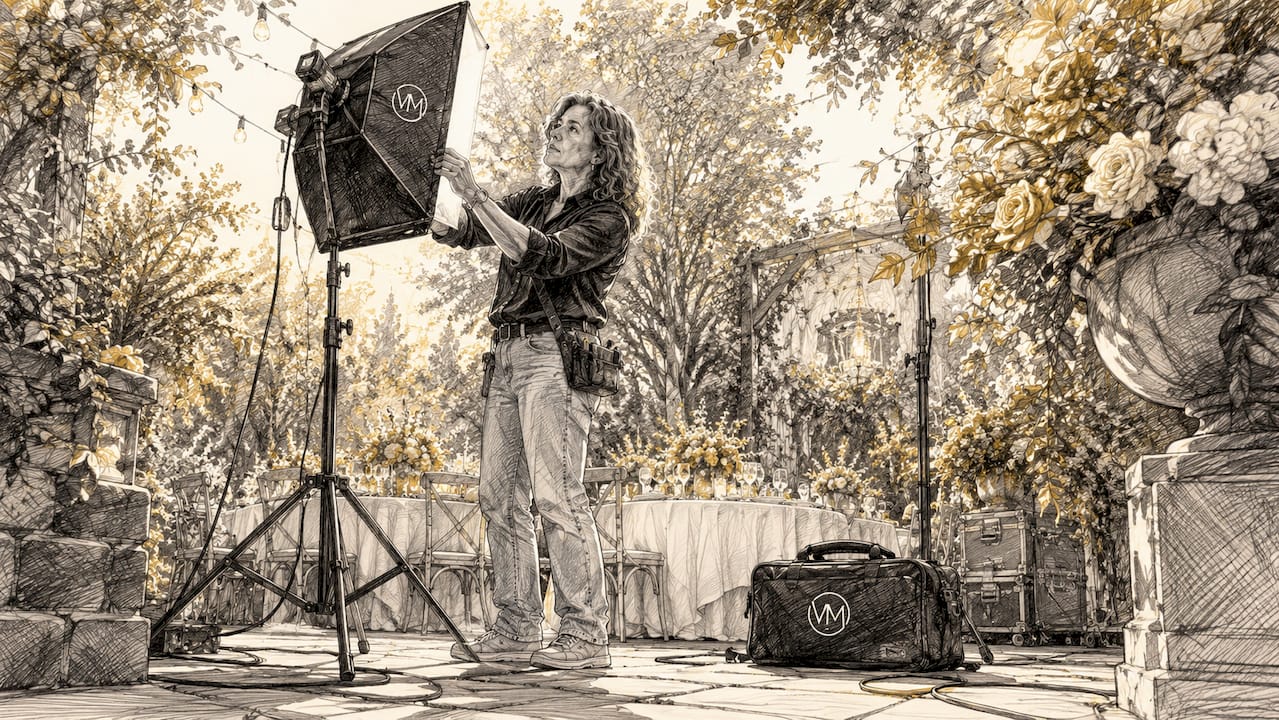
Speeches are the most predictable moments of the day, which makes them the easiest to light well. Position one battery-powered COB light with a softbox at roughly 45 degrees to the speaker, at head height or slightly above. If the room is wide and you have a second operator, add a subtle fill light on the opposite side at half the output of the key. Remote-controllable LED units let you pull down intensity if the venue's house lights suddenly brighten between toasts.
Reception Dances
The first dance is the most emotionally charged moment of the reception. Warm-toned uplighting and a controlled key light create a romantic atmosphere that reads beautifully on camera. Set your key light to around 3,200K, position it at 45 degrees, and let the venue's ambient uplighting serve as your background fill. Avoid chasing the couple with a handheld on-camera light. It creates a harsh, documentary look that conflicts with the cinematic tone of the rest of the film.
Pro Tip: Mark your light positions on a venue floor plan before the event. Knowing exactly where your stands go saves five minutes of setup time during transitions, which adds up across a ten-hour wedding day.
What lighting pitfalls should wedding videographers avoid?
Most lighting mistakes at weddings come from one source: over-reliance on what the venue already has. Venue and DJ lighting setups are designed for atmosphere, not camera sensors. That distinction is critical.
- DJ strobes and color washes: Rapid color changes create flicker and unnatural skin tones in footage. Avoid dynamic colored DJ lights on subjects' faces entirely during key moments.
- Overhead fluorescent or tungsten fixtures: These cast unflattering downward shadows on faces. Always supplement with a side key light to counteract the ceiling source.
- On-camera LED panels without diffusion: A bare panel at close range creates a flat, harsh look. A simple diffusion sock or small softbox transforms the quality immediately.
- Mixing color temperatures without correction: Shooting under 3,200K venue light while your LED is set to 5,600K produces footage with split color casts that are difficult to fix in post.
"Proactive lighting communication with DJs through a checklist of do's and don'ts helps avoid unusable flicker-heavy and harshly colored footage from dynamic club lights."
Providing a lighting checklist to DJs before the event is one of the highest-leverage things you can do as a videographer. Ask them to hold steady, warm-toned lighting during the first dance and speeches, and to save the dynamic effects for open dancing. Most DJs are happy to cooperate when asked professionally and in advance.
How do you build a lighting workflow that holds up all day?
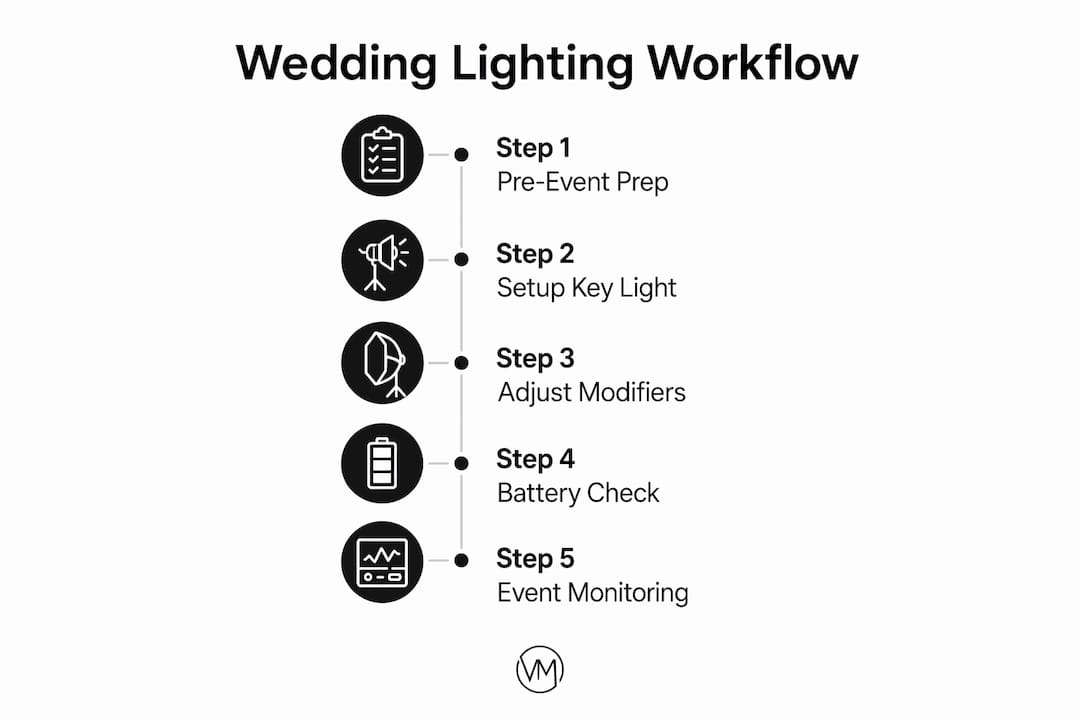
The best lighting kit is the one you can actually set up in three minutes between a ceremony and a cocktail hour. A minimalist lighting kit built around one or two high-output battery-powered COB lights with soft diffusion is generally enough for weddings and keeps transitions fast.
| Event Phase | Recommended Setup | Priority |
|---|---|---|
| Ceremony | 1 key light, softbox, 45-degree angle | High |
| Cocktail hour | Ambient only or 1 fill light | Low |
| Speeches | 1–2 battery COB lights, softbox | High |
| First dance | 1 warm key light, ambient fill | High |
| Open dancing | Ambient only | Low |
Battery-powered lights with quick-release modifier mounts are the standard for run-and-gun wedding cinematography. They eliminate the need to find power outlets in unfamiliar venues and allow repositioning in seconds. Plan your lighting transitions around the wedding timeline. Identify the three or four moments that absolutely require controlled light, and build your kit around those moments.
Pro Tip: Charge all batteries the night before and carry one full spare per fixture. A dead battery during the first dance is not recoverable.
Key takeaways
Effective lighting setups for wedding videography require high-CRI fixtures, deliberate positioning for each event phase, and proactive coordination with DJs and venue staff.
| Point | Details |
|---|---|
| CRI and TLCI standards | Use fixtures with 95+ CRI and 97+ TLCI to guarantee accurate skin tones on camera. |
| Minimalist kit wins | One or two battery-powered COB lights with softboxes cover most wedding scenarios efficiently. |
| Remote control is essential | App-controllable lights like the Godox VL150 let you adjust output without interrupting live moments. |
| DJ coordination matters | Provide a lighting checklist to DJs before the event to prevent flicker and color cast issues. |
| Phase-specific positioning | Each wedding phase needs a different light angle, output level, and color temperature setting. |
What i've learned about lighting after years of wedding films
Most videographers obsess over cameras. The real differentiator is light. I have shot on cameras ranging from Super 8 film to modern mirrorless bodies, and the footage that consistently impresses clients is the footage where the light was controlled and intentional.
The shift that changed my work most was moving from reactive to proactive lighting. Instead of adjusting to whatever the venue offered, I started arriving with a plan: specific fixtures, specific positions, and a conversation with the DJ already done. That single change reduced the number of unusable reception clips dramatically.
The other lesson worth sharing is that cinematic wedding lighting does not require a truck full of gear. The videographers producing the most beautiful work right now are carrying compact, powerful COB lights with quality diffusion. They are not hauling eight-light rigs. Simplicity and control beat complexity every time. Follow us on Instagram to see how these principles translate into finished films.
— Anthony
How Visualizemedia approaches lighting in every wedding film
At Visualizemedia, lighting is treated as a filmmaking tool, not an afterthought. Every wedding film produced for clients in New York and New Jersey is built around deliberate light control, from the ceremony key light to the reception first dance setup.
The team uses professional-grade LED fixtures with verified CRI and TLCI ratings, remote control capability, and phase-specific positioning plans developed before each event. The result is footage that holds up through color grading and delivers the cinematic quality clients expect from a luxury film. If you are planning a wedding in the NY or NJ area and want a film that reflects the full beauty of your day, explore Visualizemedia's wedding cinematography services and see what controlled, intentional light can do for your story.
FAQ
What CRI rating should wedding videography lights have?
Wedding videography lights should have a CRI of 95 or higher and a TLCI of 97 or higher. These ratings guarantee accurate skin tones and consistent color in mixed-light environments.
Is one light enough for wedding videography?
A single high-quality battery-powered COB light with a softbox is often sufficient for run-and-gun wedding coverage. Adding a second light for speeches and dances improves quality without overcomplicating the kit.
How do i handle DJ lighting during receptions?
Provide DJs with a written checklist before the event requesting steady, warm-toned lighting during key moments. Coordinating with venue and DJ lighting setups directly prevents flicker and harsh color casts in critical footage.
What is the best light position for wedding ceremonies?
Place one softbox-diffused key light at a 45-degree angle to the couple, just outside the officiant's sightline. Keep output at 40–60% to supplement ambient light without overpowering it.
Are app-controllable lights worth it for weddings?
App-controllable lights like the Godox VL150 are worth the investment for wedding work. Remote output adjustments during live moments prevent the need to physically approach fixtures and disrupt the event.