
Choosing wedding traditions that feel genuinely yours is harder than it sounds. With so many options pulled from different cultures, faiths, and family expectations, it's easy to end up with a ceremony that feels like a checklist rather than a story. Couples planning upscale weddings in New York and New Jersey are in a unique position: surrounded by extraordinary venues, world-class vendors, and a rich cultural landscape, yet still searching for rituals that feel personal, meaningful, and visually stunning. This guide breaks down the best traditions across cultures, shows you how to blend them, and helps you build a day that actually moves people.
Table of Contents
- How to choose the right traditions for your ceremony
- Timeless American wedding traditions
- Global rituals and their local impact: Tea ceremonies, glass breaking, and more
- Fusion celebrations: Multi-faith and blended weddings in action
- Wedding traditions at a glance: What's right for your celebration?
- A planner's take: Why the real magic is in the flow, not just the tradition
- Elevate your celebration with memory-capturing experts
- Frequently asked questions
Key Takeaways
| Point | Details |
|---|---|
| Blend traditions with meaning | Select rituals that feel personal and represent both families’ histories for a celebration that resonates. |
| Plan your ceremony flow | Sequence each tradition thoughtfully and assign cues to ensure smooth transitions for guests and vendors. |
| Consider logistics early | Account for space, attire changes, and rehearsal needs when mixing multicultural or multi-faith rituals. |
| Prioritize guest experience | Choose traditions that let guests learn, participate, or witness meaningful moments, not just observe. |
How to choose the right traditions for your ceremony
Not every tradition will fit every couple, and that's the point. The first step is deciding which rituals align with your personal values, your families' expectations, and the kind of ceremony experience you want to create.
New York planning guidance highlights the importance of ceremony structure, whether civil, religious, or non-denominational, and how personalizing it through special rituals and meaningful music sets the tone for the entire event. Start there: what kind of ceremony do you actually want? From that answer, you can layer in traditions that serve the story rather than compete with it.
Here are the core criteria to apply when evaluating any tradition:
- Cultural value: Does this ritual carry meaning for you or your family, or is it purely aesthetic?
- Visual impact: Will this moment photograph and film beautifully? Rituals with motion, light, or intimate interaction almost always translate well on screen.
- Guest participation: Can guests engage, or will they sit passively? The most memorable ceremonies invite some level of shared experience.
- Blend-ability: How easily does this tradition sit next to others in the lineup? Some rituals are freestanding; others require time, props, or space that disrupts the flow.
For stress-free wedding planning, map every tradition to a spot on your timeline before you commit to it. Surprises during a ceremony rarely feel magical in the moment.
Pro Tip: Always coordinate transitions and cueing with your planner, officiant, and photo/video team before the rehearsal. Every ritual needs a clear start signal and a clear end signal, or it will drift.
Timeless American wedding traditions
Classic American wedding traditions remain popular for one reason: they work. They give guests a shared framework and give the couple predictable, high-emotion moments that anchor the day.
American wedding traditions commonly include processional elements, a wedding cake, a first dance, and a send-off gesture at the end of the reception. Each of these moments carries its own emotional weight and its own opportunity to personalize.
Consider what each tradition actually offers:
- The processional: The walk down the aisle is the ceremony's opening scene. Who walks with you, what music plays, and how the space is arranged all shape the emotional impact of this moment before a single word is spoken.
- The wedding cake: Traditional tiered cakes remain a centerpiece, but many couples now opt for dessert towers, individual pastries, or culturally specific sweets layered alongside or in place of the traditional cake. The cutting moment still reads beautifully on film regardless of format.
- The first dance: Song selection is everything here. Couples increasingly commission live arrangements, pick unexpected genres, or choreograph short routines that reveal personality. Even a simple, slow first dance with the right song can be the emotional peak of the reception.
- The send-off: Sparklers remain a crowd favorite for the exit, but confetti canons, flower petals, and even glow sticks have all made appearances at upscale New York and New Jersey venues. Always check your venue's rules in writing, as many indoor venues prohibit open flames.
When you're personalizing wedding moments, think about which of these four anchors matters most to you. Then invest your energy there, and simplify the rest.
Global rituals and their local impact: Tea ceremonies, glass breaking, and more
New York and New Jersey are among the most culturally diverse wedding markets in the world. That means couples have real access to traditions from across the globe and real communities that know how to honor them properly.
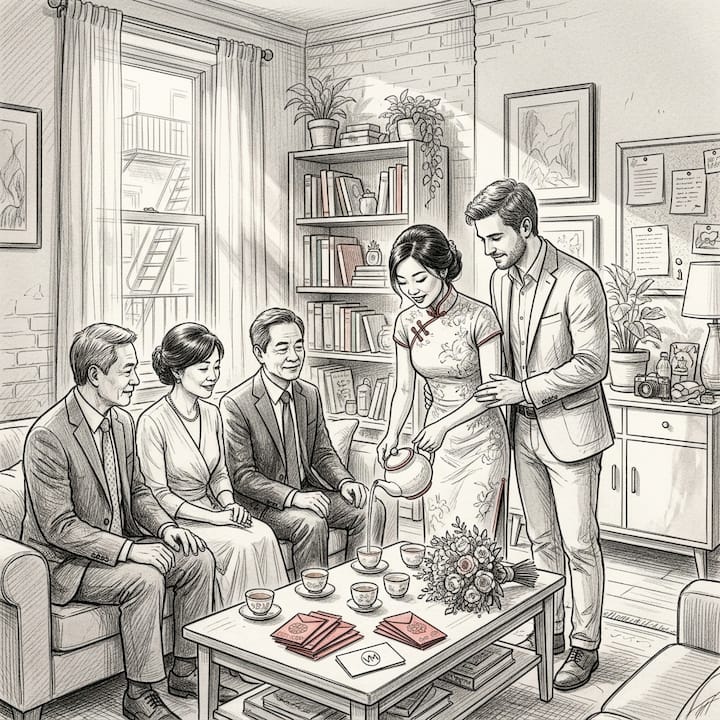
Chinese tea ceremony: The order and family hierarchy of this ritual matter deeply. Couples typically begin by serving tea to elders and parents first, then expand outward to other relatives by seniority, kneeling or bowing as a sign of respect while receiving blessings and gifts. In a NYC or NJ wedding, this ceremony is often scheduled immediately before the reception begins, allowing guests to witness it as an intimate prelude to the celebration.
Jewish traditions: A chuppah, ketubah, and glass breaking are the three pillars of a Jewish ceremony. The chuppah creates a canopied sacred space; the ketubah is a formal marriage contract often displayed as art after the wedding; and the breaking of the glass closes the ceremony with a joyful, collective "Mazel Tov." The glass breaking is one of the most cinematic moments in any ceremony, fast, loud, and immediately emotional. For exploring more global wedding rituals, you'll find traditions like handfasting, unity candles, and shared wine rituals that layer naturally into any ceremony structure.
Additional rituals worth considering:
- Handfasting: A Celtic tradition where the couple's hands are literally bound together, symbolizing their union
- Unity candle: Two individual flames join to light one central candle, representing the merging of two families
- Sand ceremony: Colored sands pour together into one vessel, particularly meaningful for blended families with children
Pro Tip: Schedule ritual moments with photography cues built in. Tell your videographer and photographer what each ritual looks like before it happens so they can position themselves for the most powerful angle. A real multicultural ceremony shows exactly how much visual storytelling is possible when rituals are properly anticipated.
"Balance tradition with flow by assigning each ritual a clear cue and rehearsal slot." — Expert officiant guidance for multicultural ceremonies
Fusion celebrations: Multi-faith and blended weddings in action
Some of the most stunning weddings we've filmed bring two distinct ceremony structures together in one day. A New Jersey fusion wedding can include a full Indian/Hindu ceremony outdoors with a baraat procession and mandap vows, followed by an attire change and a Western chapel ceremony, all within a single event day.
Indian wedding traditions such as the baraat, mandap, and sangeet often require outdoor space and flexible venue staging, which is why choosing the right venue for a fusion event is one of the most critical decisions you'll make. For capturing fusion weddings on film, a multi-camera setup is essential because the action happens simultaneously in multiple locations.
Here's a practical structure for a fusion wedding day:
- Morning: Cultural ceremony one (Hindu, Jewish, or other) with its specific ritual sequence
- Midday break: Attire change, photos, and transition to second ceremony setting
- Afternoon: Cultural ceremony two or civil ceremony
- Evening: Unified reception blending musical, culinary, and visual elements from both traditions
| Fusion combination | Key venue requirements | Ritual highlights |
|---|---|---|
| Indian & Western | Outdoor mandap space + chapel or ballroom | Baraat, mehndi, vows, first dance |
| Jewish & non-denominational | Indoor ceremony space with chuppah anchor | Ketubah signing, glass breaking, unity ritual |
| Chinese & American | Separate room for tea ceremony | Tea service, processional, cake, send-off |
| South Asian & Catholic | Outdoor pavilion + chapel | Sangeet, church vows, reception fusion |
For scheduling multi-faith weddings, add at least 30 minutes of buffer between any two major ceremony blocks. Things run long, and you want your guests relaxed, not rushed.
Wedding traditions at a glance: What's right for your celebration?
Wedding traditions worldwide serve as symbolic actions that connect couples to culture and history. Here's a quick side-by-side view:
| Tradition | Origin | Symbolism | Best timeline position |
|---|---|---|---|
| Processional | Universal | Opening, declaration of arrival | Start of ceremony |
| Tea ceremony | Chinese | Family blessing, respect for elders | Pre-reception |
| Chuppah & glass breaking | Jewish | Sacred union, historical remembrance | Mid to close of ceremony |
| Baraat procession | South Asian | Joyful arrival of the groom | Start of ceremony |
| Unity candle | Western Christian | Merging of two into one | During ceremony vows |
| Sparkler send-off | American | Celebratory close | End of reception |
Before finalizing your tradition list, ask yourself:
- Does this ritual tell part of our actual story?
- Will guests feel included or confused?
- Is this meaningful to both families, or just one side?
- Can the venue accommodate this logistically?
- Will it look intentional on film, or like an afterthought?
Mix and match freely. The best upscale weddings we've seen don't follow any single template.
A planner's take: Why the real magic is in the flow, not just the tradition
Here's something most tradition guides won't tell you: the choice of ritual matters far less than the execution. We've seen the most beautiful traditions fall flat because no one rehearsed the transitions. We've also seen simple unity candle ceremonies move entire rooms to tears because every moment was precisely timed and deliberately paced.
Expert ceremony guidance for New York ceremonies consistently emphasizes engineering flow and transitions, managing mic checks, and rehearsing each ritual's pacing alongside culturally meaningful additions. That's not a detail. That's the whole game.
The couples who walk away with the most cinematic wedding films are the ones who treated their ceremony like a production. They assigned someone to cue each moment. They rehearsed the awkward transitions, like who hands off the rings, where the officiant stands during the tea ceremony, and who cues the musicians after the glass breaks. For capturing the ceremony flow beautifully on film, intentionality in pacing is what separates a good ceremony from an unforgettable one.
Pro Tip: Assign a dedicated stage manager, whether your planner, a trusted coordinator, or an experienced professional, to cue each ritual moment and handle real-time adjustments. Even a 90-second buffer between moments can transform the energy of the room.
"The best wedding stories are told through seamless transitions, where each tradition naturally leads into the next."
Elevate your celebration with memory-capturing experts
Every tradition you choose deserves to be preserved with the same care you put into selecting it. At Visualize Media, we specialize in NJ and NYC wedding films that capture multicultural, multi-faith, and tradition-rich celebrations as cinematic stories, not just documentation.
Our multi-camera setups, aerial footage options, and color-graded edits are built for the complexity of fusion weddings and high-touch events where multiple rituals unfold across different spaces and timelines. Whether your day includes a baraat procession, a tea ceremony, a glass breaking, or all three, we know how to anticipate each moment and frame it with intention. Visit our upcoming wedding expos to meet us in person and see our work up close.
Frequently asked questions
How do I fit multiple wedding traditions into one ceremony or day?
Stagger rituals by splitting the timeline, assigning each a clear sequence, and using separate event spaces or attire changes when needed. A real NJ fusion wedding demonstrates how two full ceremonies can unfold smoothly within a single wedding day.
Which traditions work best outdoors in New York or New Jersey?
Tea ceremonies, blessings, and Indian baraat processions are especially well-suited to outdoor spaces. The baraat and mandap sequence in particular benefits from open outdoor staging, while multicultural venues in NJ often offer hybrid indoor/outdoor layouts designed for these moments.
What are the must-have American wedding traditions in NYC/NJ?
Processional, first dance, wedding cake cutting, and a unique send-off gesture are the staples most often chosen. American wedding traditions center on these four anchors as the emotional pillars of any reception.
How do I respect family hierarchy in tea ceremonies?
Follow the correct order: serve tea first to elders or parents, then other relatives by seniority, using kneeling or bowing as signs of respect. The tea ceremony etiquette is precise, and getting the order right matters deeply to families honoring this tradition.
What's the symbolism of breaking the glass at Jewish weddings?
It marks the ceremony's conclusion and recalls the destruction of the Temples, adding historical depth and shared emotion to the moment. The glass breaking tradition is one of the most visually and emotionally powerful ritual conclusions in any ceremony structure.