
Music is the structural backbone of South Asian weddings, not a background detail. Every ceremony, from the Baraat procession to the Sangeet night, depends on specific musical choices to signal meaning, set emotional tone, and move guests between states of reverence and celebration. The role of music in South Asian weddings spans multiple days, multiple genres, and multiple generations. Understanding how it works gives you real power over your wedding's atmosphere. This guide covers traditional forms, fusion strategies, and planning frameworks that actually work.
What is the role of music in South Asian weddings?
Music in South Asian weddings functions as emotional etiquette, guiding guests through each moment of the celebration. It tells people when to feel reverent, when to dance, and when to cry. That is a job no décor or lighting can do alone.
The musical traditions vary significantly across South Asian regions. A Punjabi wedding leans on the dhol and Bhangra rhythms. A Bengali or Gujarati wedding may feature classical sitar and devotional folk songs. A Bhojpuri celebration includes Geet-Gawai, a UNESCO-recognized practice of ritualistic call-and-response folk singing led by women. Each tradition carries its own sonic identity, and blending them requires intention.
What unites all these traditions is the principle that music marks transitions. The shift from a solemn ritual to a joyful reception is not announced. It is felt through the music. That is why couples who treat music as an afterthought often end up with celebrations that feel disconnected.
What are the key traditional music elements in major South Asian ceremonies?
Traditional wedding music in South Asian celebrations is tied directly to specific ceremonies, not used interchangeably.
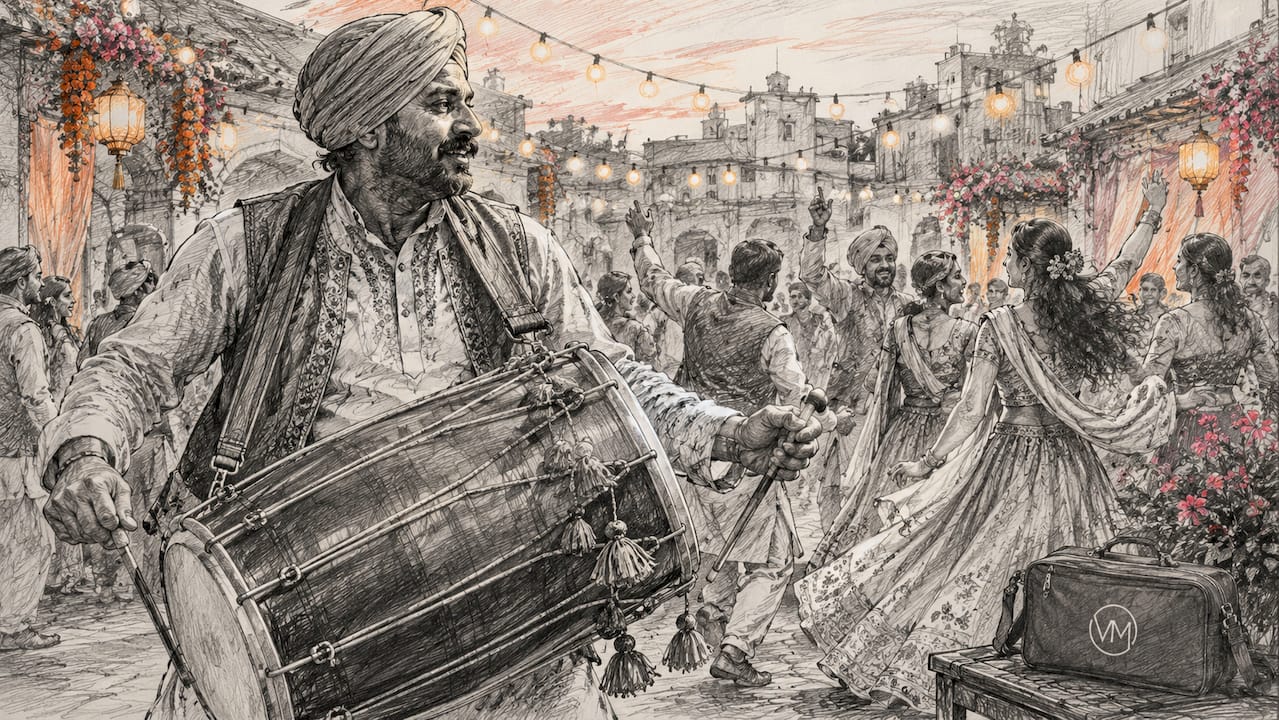
- Baraat procession: Live dhol and brass bands drive the groom's arrival. Groups like Ministry of Dhol specialize in high-energy Punjabi rhythms that transform a simple entrance into a full street celebration. The dhol is not decorative. It sets the pace of the procession and signals the crowd to engage.
- Ceremony rituals: Classical instruments including sitar, tabla, bansuri, and shehnai create a contemplative atmosphere during vows and sacred rites. Solo instruments work precisely because they do not compete with spoken words or prayers.
- Sangeet night: This pre-wedding event has grown into a full production. Modern Sangeet events rival small Western weddings in scale, featuring choreographed family performances, emcees, and professional lighting. The music here is participatory, not performed at guests.
- Geet-Gawai: In Bhojpuri tradition, women lead ritualistic singing and dancing using household instruments in call-and-response patterns. This ceremony is one of the most communal musical experiences in any wedding tradition worldwide.
Pro Tip: Book your classical musicians and your dhol players separately. Their roles are completely different, and a single entertainment vendor rarely excels at both.
Regional variation matters here. A South Indian ceremony may use Carnatic vocal music and nadaswaram. A Pakistani wedding may feature qawwali. Knowing your family's specific regional tradition is the starting point for any music selection for weddings.
How does contemporary music blend with tradition in South Asian receptions?
The biggest trend in South Asian wedding music is blending traditional and modern elements for broader generational appeal. The challenge is doing it without alienating either side of the family.
Here is how experienced entertainment providers structure the blend:
- Establish a ratio. A 70% Bollywood, 30% Western music split is a common starting point, but it shifts based on your family's demographics. A crowd with many guests from India will lean Bollywood. A crowd of mostly second-generation South Asian Americans may want more Western pop and hip-hop.
- Sequence by emotional beat. The reception set should not open with the highest-energy tracks. Build from mid-tempo Bollywood classics into current hits, then into Western crossover tracks as the night progresses. This mirrors how energy naturally builds in a crowd.
- Hire a specialist DJ. A DJ with South Asian wedding expertise reads the crowd in real time. They know when to drop a Bhangra remix to pull elders onto the floor and when to switch to a Drake track for the younger guests. A general wedding DJ rarely has that range.
- Consider a live band for key moments. Live music for South Asian weddings adds a layer of energy that a DJ cannot replicate during the Baraat or the first dance. Many couples use a live dhol player alongside a DJ for the reception entrance.
The cultural significance of wedding music comes through most clearly when the sequencing is right. A club playlist during a processional breaks immersion for older guests. That is a planning error, not a taste difference.
How can couples plan music for a multi-day South Asian wedding?
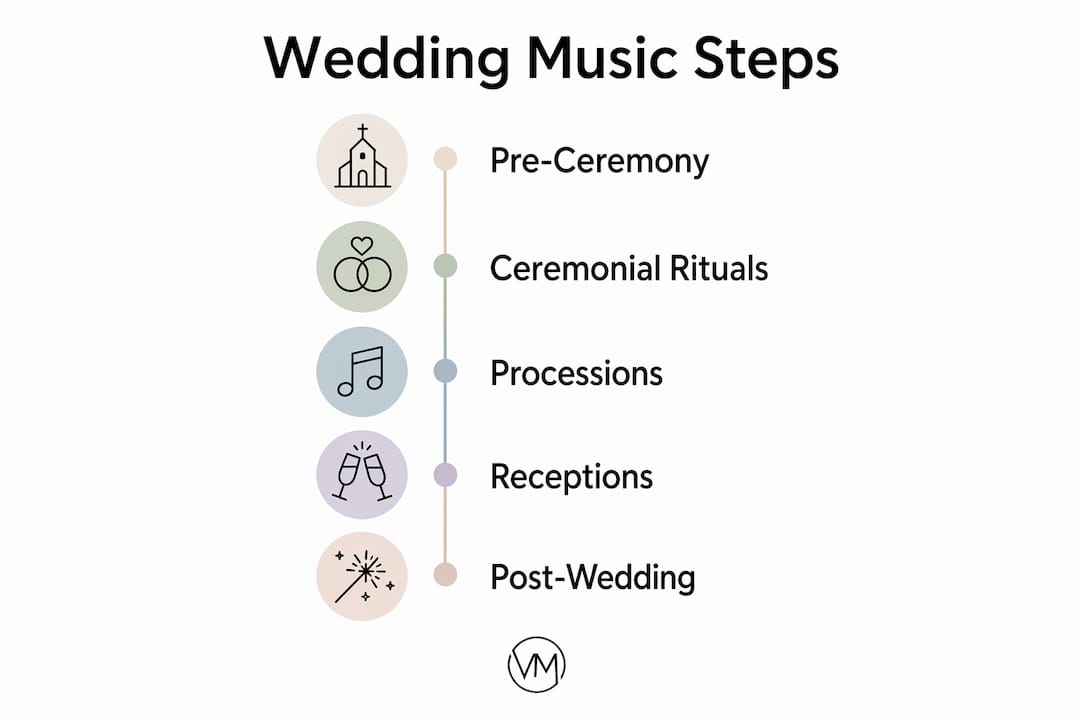
Planning music across multiple events requires a phased approach, not a single playlist. The impact of music on wedding atmosphere depends on managing intensity over time, not just picking good songs.
- Arrivals and cocktail hours: Use soft ambient music, light classical, or acoustic Bollywood covers. This is not the moment for high energy. Guests are greeting each other and settling in.
- Ceremony: Classical instruments only. No DJ, no amplified pop music. The shehnai or sitar sets a sacred tone that recorded music cannot.
- Baraat and reception entrance: Maximum energy. Live dhol, brass, and a DJ working together create the peak moment of the celebration.
- Reception dinner sets: Drop back to mid-energy. Guests need to eat and talk. Constant high-energy music during dinner causes fatigue before the dance floor opens.
- Dance floor: Build in peaks and valleys. Plan two or three high-energy peaks separated by slower tracks. This keeps guests returning to the floor rather than burning out in the first 30 minutes.
Pro Tip: Share a written timeline with your DJ and musicians at least two weeks before the wedding. Include the exact moment each ceremony begins and what emotional tone you want. Verbal briefings get forgotten.
Communicating your preferred Bollywood-to-Western ratio explicitly with your entertainment providers is critical for reception success. Do not assume they will guess correctly. A written brief prevents empty dance floors.
You can find a detailed breakdown of how to structure each event in this South Asian wedding day workflow guide.
What is the emotional impact of music on family bonding at South Asian weddings?
Music carries cultural memory in a way that speeches and décor cannot. When a grandmother hears a folk song from her home region, she is not just listening. She is reconnecting with a version of herself that predates the wedding entirely.
"Ceremony music acts as a neurological primer, setting the emotional temperature before key rituals begin." — History of Wedding Music
The Sangeet ceremony is the clearest example of music as storytelling. Family members perform choreographed acts that retell the couple's relationship. Aunts sing folk songs that have been passed down for generations. These performances are not entertainment. They are the family's way of publicly claiming the couple as their own. The cultural significance of Sangeet lies in this act of collective authorship.
Geet-Gawai takes this further. The call-and-response structure requires participation. No one sits passively. That communal format creates a shared memory that guests carry for years. It is one of the reasons pre-wedding ceremonies often feel more emotionally resonant than the reception itself.
Music also bridges generations in a way that nothing else at a wedding does. A Bhangra track pulls a 70-year-old grandfather and a 20-year-old cousin onto the same dance floor. That moment of shared joy is not accidental. It is the result of deliberate music selection. For more on how music shapes wedding films, the connection between sound and memory runs even deeper on screen.
Key Takeaways
Music in South Asian weddings is the primary tool for managing emotional transitions, cultural expression, and guest engagement across multi-day celebrations.
| Point | Details |
|---|---|
| Music drives ceremony transitions | Each event requires specific musical forms. Dhol for Baraat, classical instruments for rituals, folk songs for Sangeet. |
| Ratio planning prevents empty floors | A 70/30 Bollywood-to-Western split is a common starting point, adjusted by family demographics. |
| Peaks and valleys prevent burnout | Plan high-energy moments followed by softer sets to sustain guest engagement across the full event. |
| Specialist vendors matter | DJs and bands with South Asian wedding experience read crowds and sync with ritual timing in ways general vendors cannot. |
| Music carries cultural memory | Sangeet performances and Geet-Gawai singing create shared family memories that outlast the wedding day itself. |
Why I think most couples underestimate music until it's too late
I have filmed dozens of South Asian weddings in New York and New Jersey. The couples who had the most memorable celebrations shared one thing: they treated music as a structural decision, not a vendor checkbox.
The most common mistake I see is booking entertainment last, after the venue, catering, and photography are locked in. By that point, the best South Asian wedding DJs and dhol players are already booked. You end up with whoever is available, and the difference shows on the dance floor.
The second mistake is treating all events the same. Couples sometimes hire one DJ for everything and ask them to "handle it." A Sangeet and a reception have completely different musical needs. A DJ who excels at high-energy reception sets may have no feel for the slower, more intimate folk music that makes a Sangeet meaningful.
My honest advice: start music planning at the same time you start venue planning. Build your entertainment team the way you build your vendor team, with specific roles, clear briefs, and enough lead time to find people who genuinely specialize in your traditions. The six core South Asian wedding ceremonies each have distinct musical needs. Knowing that early changes how you plan.
— Anthony
How Visualizemedia captures the music-driven moments of your celebration
South Asian weddings are built on sound and movement, and the best wedding films reflect that. Visualizemedia specializes in cinematic wedding films for couples in New York and New Jersey, with deep experience documenting music-driven events like Sangeet nights, Baraat processions, and multi-day celebrations.

Every Visualizemedia film is built around the emotional beats of your celebration, including the dhol entrance, the choreographed family performances, and the quiet classical moments during your ceremony. The team also offers a photo booth with culturally relevant props, giving your guests a way to celebrate and create memories between events. If you are ready to talk about your wedding, explore wedding cinematography packages or fill out the wedding questionnaire to get started.
Follow Visualizemedia on Instagram to see recent South Asian wedding films and get a feel for the style before you book.
FAQ
What is the role of music in South Asian weddings?
Music in South Asian weddings functions as the emotional guide for every ceremony, signaling transitions between sacred rituals and joyful celebrations. It is not background noise. It is the primary tool for managing guest emotion and cultural expression.
What music is played at a Baraat procession?
Live dhol and brass bands are standard for Baraat processions, delivering high-energy Punjabi rhythms that drive the groom's entrance. Groups like Ministry of Dhol specialize in this format.
How do couples balance Bollywood and Western music at receptions?
A 70% Bollywood and 30% Western split is a widely used starting point, adjusted based on the family's generational makeup and regional background. Communicating this ratio clearly to your DJ prevents mismatched sets.
What is Geet-Gawai and why does it matter?
Geet-Gawai is a Bhojpuri pre-wedding tradition of call-and-response folk singing led by women, recognized as a UNESCO heritage practice. It creates one of the most communal and participatory musical experiences in South Asian wedding culture.
When should couples start planning wedding music?
Music planning should begin at the same time as venue booking. The best South Asian wedding DJs and live musicians book out early, and starting late limits your options significantly.