
Many couples spend months planning every detail of their wedding day, then assume their videographer's camera captured it all in one clean, cinematic package. The moment they hear "raw footage," they picture a complete, watchable movie. The reality is far less romantic. Raw wedding footage is technical, fragmented, and often impossible to play on a home TV without the right software. Before you make a request that could cost extra and deliver less than you hoped, understanding exactly what raw footage means can save you real disappointment on what should be one of the happiest experiences of your life.
Table of Contents
- What does 'raw wedding footage' actually mean?
- What do you actually receive when requesting raw footage?
- Raw footage vs. edited and documentary wedding films
- Should you request raw wedding footage? Key considerations
- Why most couples are happier skipping the raw footage
- Elevate your wedding memories with professional cinematic films
- Frequently asked questions
Key Takeaways
| Point | Details |
|---|---|
| Raw footage is unedited | Expect unpolished, technical files rather than a finished film. |
| Difficult to view at home | Most raw wedding footage needs special software to play and organize. |
| Edited films offer more joy | Couples typically cherish professionally edited wedding films over hours of raw clips. |
| Alternatives exist | Extended or documentary-style edits provide full coverage in a watchable form. |
What does 'raw wedding footage' actually mean?
Raw wedding footage is not a polished, ready-to-watch video but unedited files from all cameras used throughout your wedding day. It is the direct output from the camera's memory cards, transferred as digital files without any editing, color grading, sound mixing, or narrative structure applied.
Think of it this way: raw footage is the raw ingredients before the meal. No chopping, no seasoning, no plating. What you receive is exactly what the camera recorded, including five minutes of a camera sitting on a tripod before the ceremony started, shaky pans between setups, test shots, and awkward in-between moments.
Common myths about raw wedding footage:
- It looks like a finished wedding film
- It plays automatically on a smart TV or laptop
- It tells a coherent story you can follow
- It includes only the "good" moments from your day
None of those are true. Raw files are often recorded in formats like ProRes, BRAW, or LOG color profiles, which appear flat and desaturated without color grading. You would not recognize your gorgeous venue in that footage because everything looks washed out and gray by design. These formats are built for professional editing, not for watching.
"Raw footage is not a finished product. It is a technical source file intended for use by editors, not end consumers."
That distinction matters because cinematic wedding filming involves deliberate choices: camera angles, movement, lighting, and timing that only come together in the edit. The camera captures ingredients. The editor builds the story.
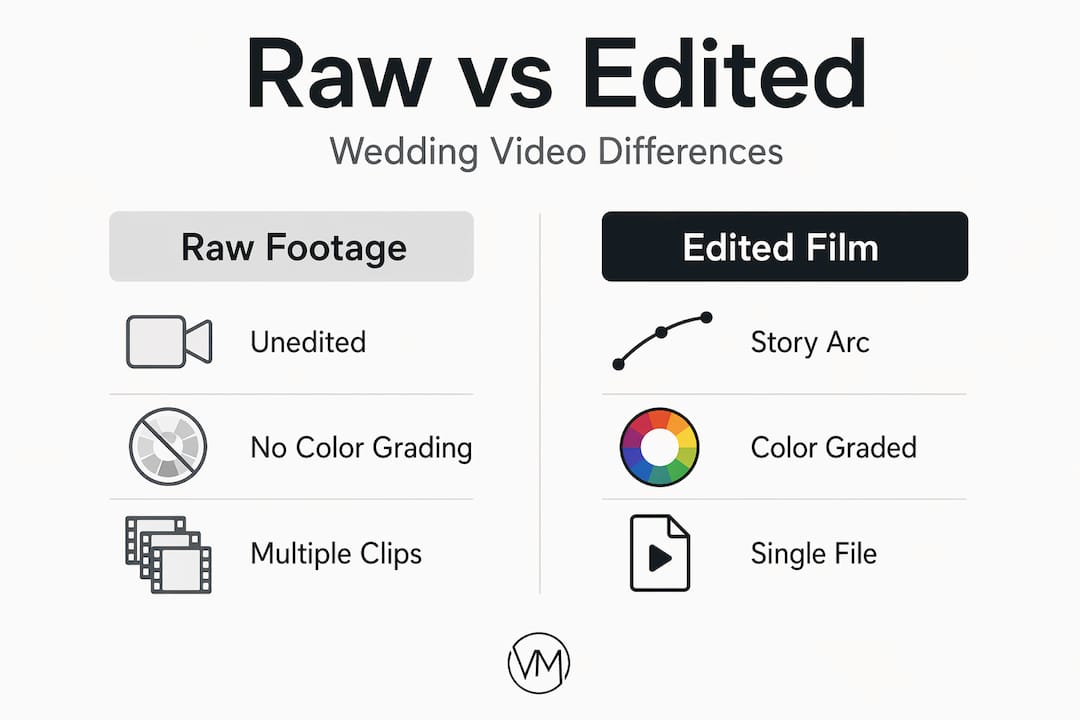
| Feature | Raw footage | Edited wedding film |
|---|---|---|
| Color graded | No | Yes |
| Narrative structure | None | Story arc |
| Ready to watch | No | Yes |
| Emotional impact | Minimal | Maximum |
| Requires special software | Often yes | No |
What do you actually receive when requesting raw footage?
With raw footage defined, it is important to know what you actually receive if you request it from your videographer. The answer is usually a hard drive or a download link containing dozens, sometimes hundreds, of individual video files.
Here is what a typical raw footage delivery looks like for a full wedding day:
- Multiple camera files. If your videographer used two or three cameras, each angle is a separate set of clips. A ceremony alone could produce 30 to 50 individual files.
- Audio tracks. Wireless lavalier microphones, boom mics, and audio recorders each create their own separate files that need to be synced manually.
- B-roll clips. Detail shots of rings, flowers, table settings, and venue spaces are short, fragmented clips without context.
- Untrimmed takes. Everything the camera recorded, including pauses, re-takes, and moments between events, is included.
- Technical format files. These are not MP4 files you can double-click to open. They require editing software like Adobe Premiere Pro, DaVinci Resolve, or Final Cut Pro to access properly.
Raw multi-angle originals can be overwhelming and hard to play on consumer setups. Your home computer may not even have the processing power to play high-resolution RAW files smoothly.
How much storage are we talking about? A single-camera setup shooting in 4K ProRes can generate 100GB in just a few hours. A multi-camera wedding can easily reach 300GB to 600GB total. That data needs dedicated storage, not just a USB stick.
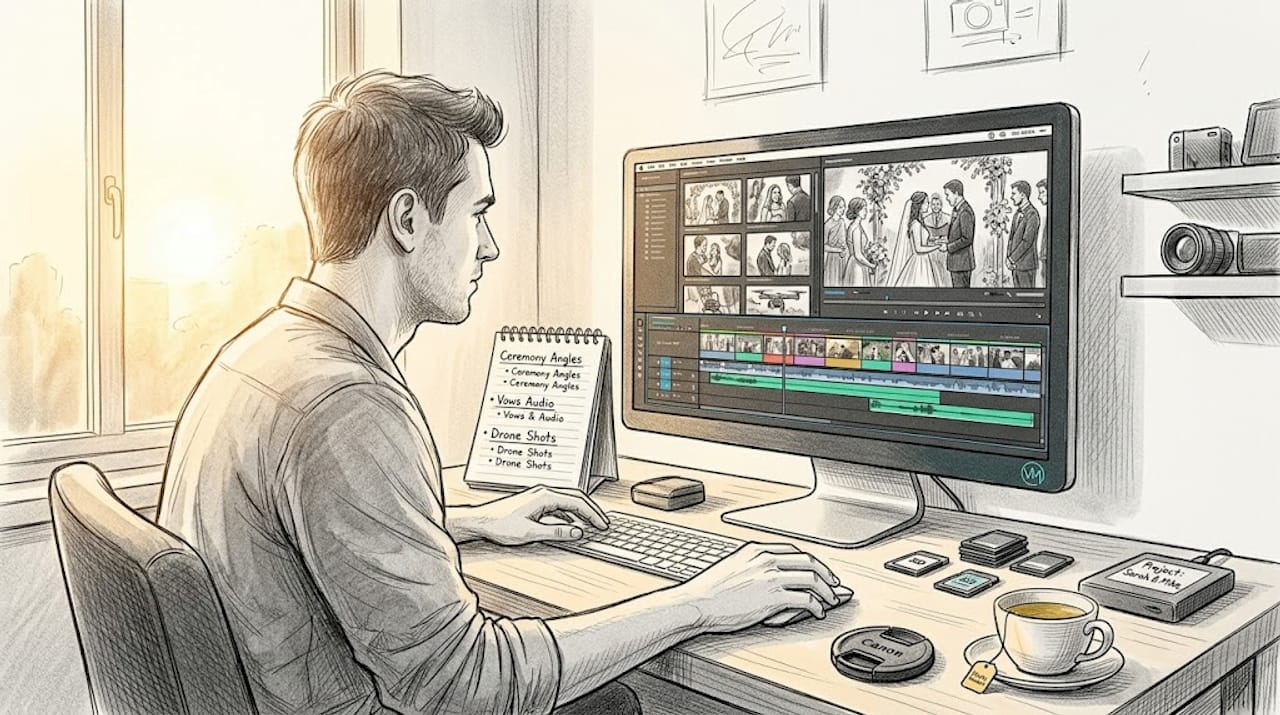
Pro Tip: Before requesting raw footage, ask your videographer what codec and format they shoot in. If they say RAW, LOG, or ProRes, you will need editing software and a powerful computer just to preview the files, let alone watch them for enjoyment.
Understanding wedding video turnaround timelines also helps here. While an edited film takes time to craft, the raw files exist immediately after the wedding. But having access to them faster does not mean you can actually use them productively.
| Delivery format | Watchable at home | Requires editing software | File count | Typical file size |
|---|---|---|---|---|
| Raw footage | Rarely | Yes | 50 to 200+ | 200 to 600+ GB |
| Edited highlight film | Yes | No | 1 to 2 | 5 to 15 GB |
| Documentary full edit | Yes | No | 1 to 3 | 15 to 40 GB |
Raw footage vs. edited and documentary wedding films
To better understand if raw footage is right for you, let's compare it directly with edited and documentary-style wedding films.
An edited highlight film is typically 4 to 8 minutes long, beautifully color graded, and set to music that enhances emotion. It is the version you will actually watch on your anniversary. It is the version you will share with family and friends. It is crafted with intention, every second chosen to tell your story.
A documentary-style wedding film takes a different approach. It runs longer, sometimes 30 to 90 minutes, and captures entire events like the full ceremony and reception speeches from start to finish. It is edited for continuity and viewability but does not require heavy creative choices like a highlight film does.
Couples often request documentary-style edits as a compromise when they want more completeness without the chaos of raw files. This is a genuinely smart middle ground.
Here is how the three options compare for everyday couples:
- Raw footage: Complete but unwatchable without effort; suited only for those with editing experience
- Highlight film: Short, emotional, and highly rewatchable; misses extended events
- Documentary edit: Long-form, watchable, and covers full events; less cinematic but more complete
The choice between film vs digital styles and between these edit formats comes down to how you plan to revisit your wedding memories. Most couples watch their highlight film many times. Most couples who receive raw footage watch it once, struggle to navigate the files, and move on.
Pro Tip: If you want full ceremony coverage, ask for a "documentary ceremony edit" instead of raw footage. You get everything important, in order, without needing a film degree to watch it.
Should you request raw wedding footage? Key considerations
Now that you have seen how raw, edited, and documentary films compare, let's look at the pros, cons, and real-world implications of requesting raw footage.
Many couples are surprised by how difficult it can be to actually use raw wedding footage once they have it. The appeal makes total sense: you want everything captured on your day. The reality is that "everything" becomes overwhelming fast.
Real benefits of requesting raw footage:
- Access to every moment filmed, even those cut from the final edit
- Ability to hire another editor someday to create a different style film
- Peace of mind knowing nothing was permanently discarded
- Archival value for future generations
Real challenges you should prepare for:
- High cost: many videographers charge extra fees for raw footage delivery
- Technical barrier: requires professional software and hardware to view
- Storage cost: you need to purchase high-capacity hard drives
- No storytelling: raw files are a library, not a movie
- Emotional flatness: ungraded footage does not look like what you remember
Pro Tip: Ask your videographer if they offer extended ceremony and reception edits as an add-on. When choosing a videographer, ask specifically about long-form deliverables. This way, you get complete event coverage in a format you can actually enjoy, and you can think about personalizing your wedding film to make it truly unique.
Why most couples are happier skipping the raw footage
Here is the honest truth most wedding blogs will not say directly: requesting raw footage is almost always driven by fear of missing out, not by genuine need. Couples worry the editor left something beautiful on the cutting room floor. And sometimes, they did. That is the nature of editing. Every great film has scenes that never made the final cut.
But here is what we have seen consistently in our work: couples who receive raw footage rarely find what they were looking for. They open a folder of 200 files, cannot figure out which camera angle has the vow they wanted, and close it within 20 minutes. Clients often become overwhelmed when receiving unfiltered, multi-angle wedding footage. Overwhelm is not the same as joy.
The edited film does something the raw footage never can. It builds emotional tension, releases it at exactly the right moment, and leaves you with a feeling rather than a file. That is what capturing emotion in wedding films is really about. A skilled videographer is not just operating a camera. They are making decisions about what matters, what connects, and what will make you cry in the best possible way ten years from now.
If there is a specific moment you are worried about missing, tell your videographer before the wedding. Request a particular speech or a specific dance. Work with them, not around them. That collaboration produces far better results than stockpiling hundreds of gigabytes of files you may never open again.
Elevate your wedding memories with professional cinematic films
If you are ready to capture your celebration with expert artistry, here is how to take the next step.
At Visualize Media, we create luxury wedding cinematography for couples throughout New York and New Jersey who want more than documentation. They want a film. Our packages include multi-camera coverage, aerial footage, full color grading, and beautifully edited films designed to be watched and rewatched for decades. We also offer extended ceremony and reception edits for couples who want complete event coverage without the burden of raw files. Whether you are planning your wedding or just beginning to explore your options, we invite you to experience our work firsthand at our wedding film expo and see the difference that cinematic storytelling makes.
Frequently asked questions
Is raw wedding footage the same as the final wedding film?
No. Raw footage is unedited clips, while the final film is professionally edited, color graded, and structured to tell your story emotionally and cohesively.
Can I easily watch the raw footage at home?
Most raw formats are hard to play on standard home setups and require professional editing software and a capable computer to access.
How much storage space does raw wedding footage need?
Raw footage from a multi-camera wedding can require 300 to 600 gigabytes or more, depending on camera resolution and hours of coverage.
Are there better alternatives to raw wedding footage if I want complete event coverage?
Yes. Many videographers offer extended documentary-style edits covering full ceremonies and receptions in a format that is easy to watch and share without requiring any technical knowledge.
Can I edit the raw footage myself later?
Technically yes, but raw files require professional software like Adobe Premiere Pro or DaVinci Resolve, along with real editing skills to turn those clips into anything watchable.