
Detail shots are the visual punctuation of a wedding film. They connect emotional peaks, control pacing, and tell the story of every intentional choice a couple made. Before your wedding day, ask your photographer or videographer two questions: "How much time do you block for detail coverage?" and "How many motion detail clips do you plan to capture?" The answers reveal whether you're booking a documentarian or a filmmaker. Visualizemedia's team builds detail coverage into every NY/NJ wedding from the first minute of prep. See their approach on Instagram.
Why do detail shots matter in cinematic wedding storytelling?
Think of a wedding film without detail shots. The ceremony ends, the music swells, and suddenly you're watching guests dance. The cut feels abrupt because something is missing: the visual breath between scenes. Detail shots function as bridges that smooth tonal gaps between high-emotion moments and wide establishing footage, preventing jarring transitions.
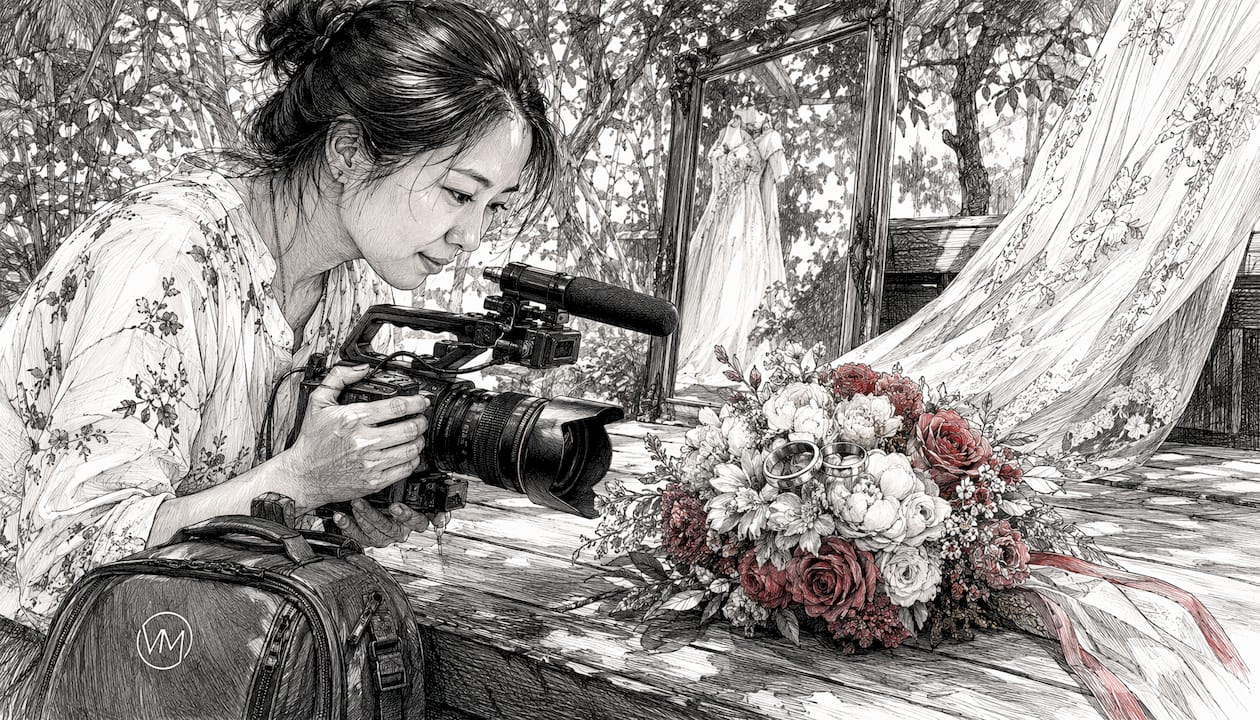
The sequencing logic is simple: wide shot establishes location, medium shot introduces people, close-up detail shot focuses attention. That progression controls what the viewer feels and when. A single ring shot placed between the ceremony and the first dance gives the editor a rhythmic buffer and the viewer a moment to absorb what just happened.
Perceived quality follows the same logic. Clients scrutinize ring and invitation photos more closely than almost any other element. A technically excellent ring shot raises the perceived value of the entire gallery. A blurry one does the opposite, regardless of how strong the portraits are.
Pro Tip: Ask your videographer to show you a detail-shot sequence from a past film, not just a highlight reel. That 30-second clip tells you more about their editing craft than any full-length sample.
Which detail shots deliver the most value in a luxury wedding?
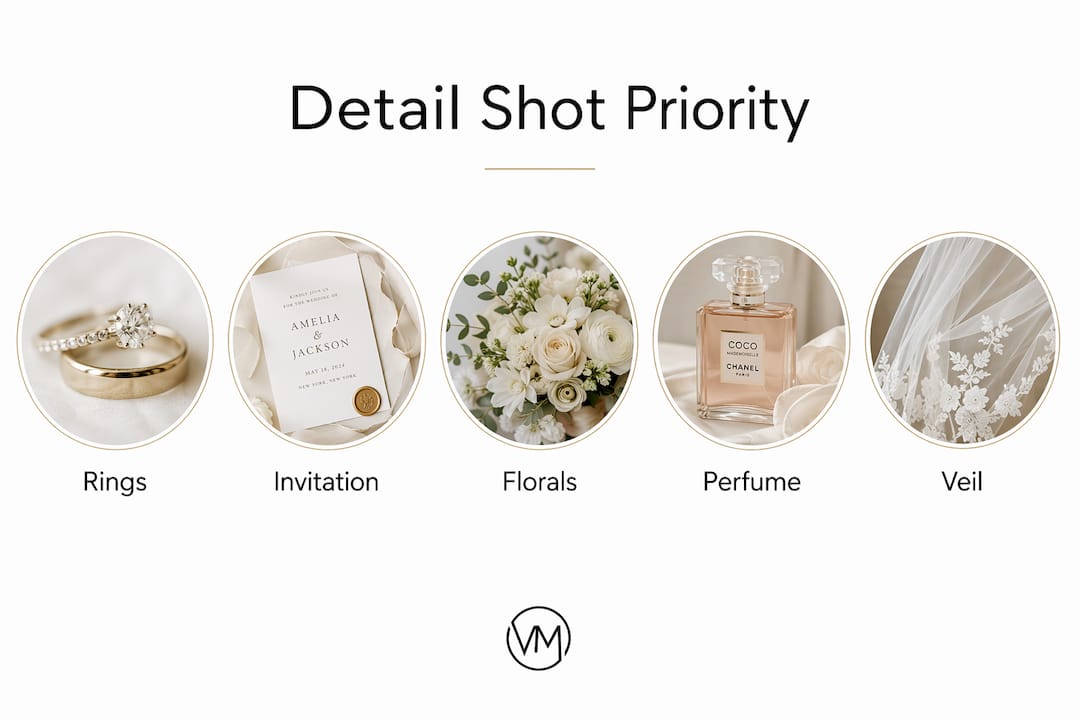
Not every detail deserves equal screen time. Selection should be driven by narrative need, not volume. A thorough detail set for a full-day wedding typically produces 40–80 edited images across categories; variety across categories matters more than shooting the same ring from twelve angles.
| Detail Shot | Cinematic Use | Priority |
|---|---|---|
| Rings (styled flatlay or macro) | Opens or closes ceremony sequence | Must-have |
| Invitation suite | Establishes wedding identity and tone | Must-have |
| Bouquet / florals | Transitions between prep and ceremony | Must-have |
| Perfume / cologne bottle | Sensory anchor for prep montage | Highly recommended |
| Dress texture / veil movement | Motion macro for music stretch | Highly recommended |
| Cufflinks / watch | Groom prep narrative | Highly recommended |
| Ceremony décor / pew details | Establishes venue atmosphere | Highly recommended |
| Table settings / place cards | Reception room reveal sequence | Highly recommended |
| Cake / topper | Reception pacing buffer | Optional |
| Champagne pour / bubbles | Motion macro for toast sequence | Optional |
For a cinematic film, motion macros — a veil lifting in a breeze, champagne bubbles rising, a focus pull across embroidered lace — are where detail shots go from decorative to genuinely filmic. A Super 8 insert on a bouquet or ring flatlay adds an organic, grain-textured layer that separates a luxury film from standard HD coverage.
Pro Tip: Give your videographer the invitation suite, rings, and perfume bottle the moment they arrive. Items handled by multiple people for hours lose their pristine look fast.
How do professionals capture detail shots that look cinematic?
Strong detail coverage starts with equipment choices, not luck. Here's what the technical setup looks like for high-end wedding detail work:
| Element | Recommendation | Why It Matters |
|---|---|---|
| Lens | 100mm macro or 85mm f/1.4 | Compression and subject isolation |
| Aperture | typical aperture range | Shallow DOF isolates subject; f/5.6 keeps text sharp |
| Lighting | Natural window light (morning prep) | Soft, directional, no harsh shadows |
| Stabilization | Tripod or slider for motion macros | Eliminates micro-shake at close focus |
| Motion technique | Slow push-in, subtle focus pull | Creates cinematic movement without distraction |
Natural window light during morning preparations creates a soft, intimate quality that artificial light rarely matches. Shoot rings and invitations on a white or linen surface positioned near a window, side-lit for texture.
Scheduling matters as much as technique. Capture detail shots in the first 20–30 minutes after arrival at the prep location while items are pristine and lighting is controlled. The second window is cocktail hour, when the reception room is set but guests haven't entered — often a 15–20 minute gap that disappears fast.
For Super 8 inserts, shoot at 18fps for the classic slightly-undercranked look, and plan for the 4:3 aspect ratio when composing. Editors can letterbox or crop to 16:9 in post, but the framing decision should be intentional, not an afterthought.
How do editors use detail shots to shape a highlight film?
Editors treat detail shots as tools, not decoration. They bridge lighting mismatches between scenes, extend music phrases, and give voiceover room to breathe. Here's how they typically appear in a 5-minute highlight film:
| Timestamp | Scene | Detail Shot Function |
|---|---|---|
| 0–45 seconds | Prep montage | Rings, perfume, dress texture as opening sequence |
| 0:45–1:30 | Ceremony approach | Invitation, florals as tonal transition |
| 1:30–2:30 | Ceremony highlights | Vow book, ring exchange macro |
| 2:30–3:15 | Cocktail hour bridge | Table settings, décor reveal |
| 3:15–4:30 | Reception moments | Cake, champagne pour as pacing buffers |
| 4:30–5:00 | Closing sequence | Ring flatlay or motion macro as emotional landing |
Industry professionals often aim for a ratio of approximately three detail shots for every one wide or establishing shot to prevent visual fatigue and preserve rhythm. This approach provides editors with significant flexibility in a typical highlight film.
Detail shots also support audio design in ways couples rarely notice. A slow ring macro can hold under a voiceover line that would otherwise cut awkwardly. A champagne pour syncs naturally to a music beat. These aren't happy accidents; they're planned during the shoot.
How should you brief your vendors and build a shot list?
A short, prioritized shot list prevents gaps and saves vendor time. Share it with your photographer, videographer, and planner at least two weeks before the wedding. Here's a copy-ready version:
| Item | Who Holds It | When to Hand Off | Notes |
|---|---|---|---|
| Rings | Maid of honor / best man | First 20–30 minutes after arrival | Clean with microfiber cloth |
| Invitation suite | Couple or planner | First 20–30 minutes after arrival | Bring two copies |
| Bouquet | Florist delivery | Before photographer arrives | Keep in water until shoot |
| Perfume / cologne | Bride / groom getting ready | During prep window | Original bottle preferred |
| Dress / veil | Hanging near window | First 20 min of arrival | Steamed the night before |
| Ceremony décor | Venue coordinator | 30 min before ceremony | Confirm access with venue |
| Table settings | Venue coordinator | During cocktail hour | Confirm room is fully set |
Budget 15–45 minutes of total dedicated detail time across the day. That's not extra time; it's the difference between a gallery with depth and one that feels thin. Planners coordinating vendor photo opportunities should note that florists and stationery designers often expect and share high-quality detail images, which extends the value of that investment well beyond the wedding day. For planners managing multiple vendor deliverables, wedding booth terminology and prop coordination follow similar handoff logic.
Key Takeaways
Detail shots are the structural and emotional backbone of a cinematic wedding film, and selecting them intentionally — not capturing everything — is what separates a luxury deliverable from a crowded gallery.
| Point | Details |
|---|---|
| Schedule detail time early | Capture rings, invitations, and florals in the first 20–30 minutes of prep while items are pristine. |
| Use a 3:1 ratio | Aim for roughly three detail shots per wide shot to maintain pacing and prevent visual fatigue. |
| Prioritize narrative value | A full-day wedding yields 40–80 edited detail images; variety across categories beats volume of the same item. |
| Brief vendors in advance | Share a prioritized shot list at least two weeks out and assign a person to hold each item. |
| Visualizemedia for NY/NJ couples | Visualizemedia builds dedicated detail coverage into every cinematic package for New York and New Jersey weddings. |
Pro Tip: Follow @visualizemedia on Instagram to see how detail shots appear in real cinematic films from NY/NJ weddings.
Why detail shots define the films I'm most proud of
Most couples focus their pre-wedding energy on the big moments: the ceremony, the first dance, the speeches. Those moments carry themselves. What separates a film that genuinely moves people from one that simply documents the day is almost always what happens between those moments.
The detail work is where a filmmaker's eye actually shows. Anyone can point a camera at a first kiss. Fewer people think to capture the way a veil catches light during prep, or the texture of a handwritten vow card, or the stillness of a ring sitting on an heirloom Bible. Those shots don't just fill time in an edit. They carry emotional weight that the wide shots can't replicate.
Working across New York and New Jersey, the Visualizemedia team runs a multi-camera setup that captures wide coverage and intimate detail simultaneously. That parallel approach means detail shots aren't rushed afterthoughts; they're built into the production rhythm from the first minute. The result is a film where every cut feels intentional, because it was.
Cinematic detail coverage for NY/NJ luxury weddings
Visualizemedia delivers dedicated detail coverage as part of every cinematic wedding package for couples in New York and New Jersey. Multi-camera production, professional color grading, and optional Super 8 inserts combine to give your film the textural depth that single-camera coverage simply can't produce. Detail shots are planned, scheduled, and edited with the same intentionality as your ceremony footage.
If you want to see how detail shots appear in a finished film before you book, the portfolio at visualizemedia.co includes full sample films. To discuss your wedding date and what a detail-focused package looks like for your venue, reach out through the contact form on the weddings and events page.
Useful sources and where to see examples
- Visualizemedia weddings and events — full package details and sample films with detail coverage
- Visualizemedia on Instagram — real NY/NJ wedding films showing detail shots in context
- Top cinematic wedding shots — deeper breakdown of how specific shots build emotional engagement
- How cinematic wedding films capture emotion — storytelling approach behind Visualizemedia's filmmaking style
- How to review wedding video edits — guidance for evaluating how detail shots appear in your final film