

A well-structured wedding day workflow for a South Asian ceremony is defined as a sequenced, event-by-event plan that locks ritual times first and builds all logistics around them. South Asian weddings are among the most complex events to coordinate, often spanning multiple days, dozens of vendors, and hundreds of guests across ceremonies with fixed cultural timing. The muhurtham, the astrologically determined auspicious window for core rituals, is non-negotiable. Every other scheduling decision flows from that anchor. This guide breaks down how to build your South Asian wedding schedule by region, manage guests across events, and avoid the day-of disruptions that derail even the best-laid plans.
How does a South Asian wedding day workflow differ by tradition?
The structure of a South Asian wedding day varies significantly by community, but every tradition shares one organizing principle: sacred rituals come first, and logistics bend around them. Understanding this is the foundation of any effective wedding day checklist for South Asian couples.
Telugu Hindu weddings in Hyderabad typically start between 5:00 and 7:00 AM, with the Mangalya Dharanam muhurtham window running from 6:30 to 11:30 AM. The full wedding day spans 10 to 14 hours, which means traffic and vendor timing must be planned with precision from the night before.
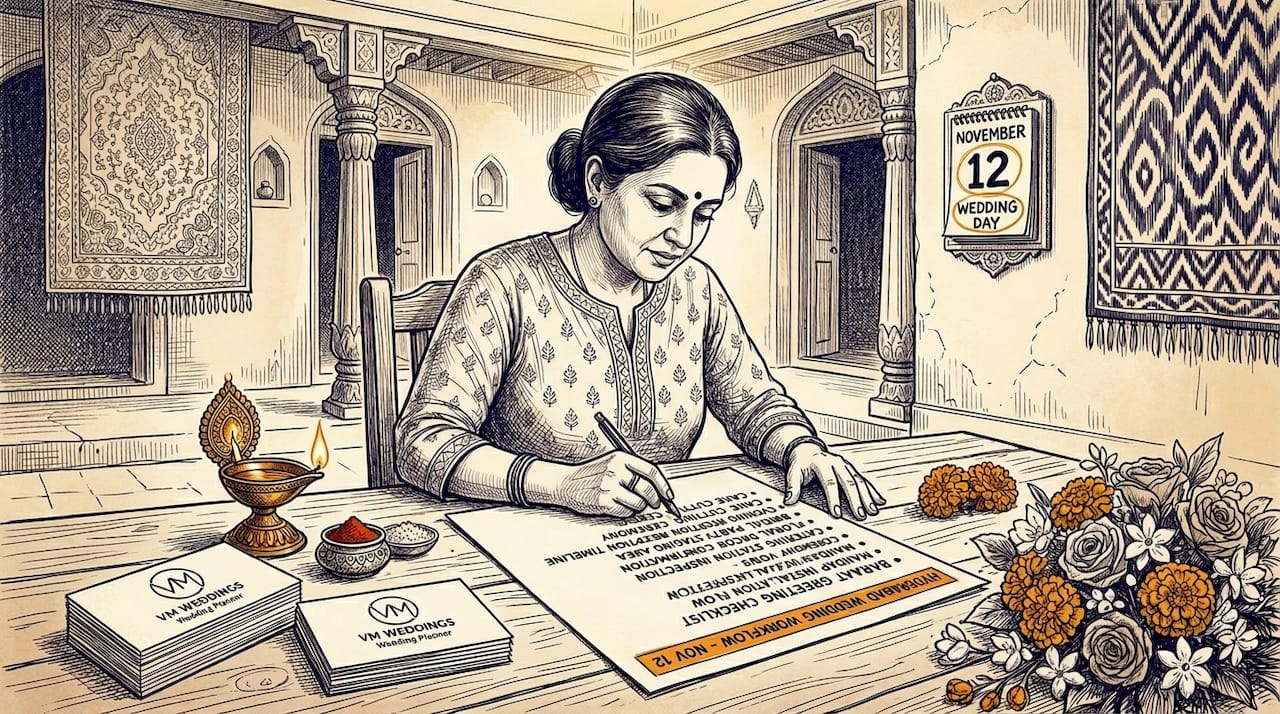
Kerala Hindu weddings run from 4:00 AM to 10:00 PM overall, with core rituals like the thalikettu taking 60 to 90 minutes and the muhurtham commonly set between 10:00 AM and 12:30 PM. The Sadya meal follows from 12:30 to 2:30 PM, and the evening reception runs 6:00 to 9:00 PM. Non-negotiable rituals like the thalikettu must be executed at exact times set by family astrologers. All other scheduling derives from those fixed points.
Punjabi wedding days include chooda, sehrabandi, baraat, milni, varmala, pheras, dinner, and vidaai, spread across three to five days. Baraat arrival coordination is one of the biggest logistical challenges in any Punjabi wedding schedule. Muslim weddings follow a different sequence, with the Nikah typically held in the afternoon and the Walima as a separate evening or next-day celebration.
| Tradition | Key Ritual | Typical Timing |
|---|---|---|
| Telugu Hindu | Mangalya Dharanam muhurtham | 6:30–11:30 AM |
| Kerala Hindu | Thalikettu | 10:00 AM–12:30 PM |
| Punjabi Hindu/Sikh | Pheras after baraat arrival | Afternoon, variable |
| Muslim | Nikah | Afternoon |
What are the key steps to build a South Asian wedding schedule?
Building an effective South Asian wedding day schedule requires working backward from your fixed ritual time, not forward from when guests arrive. This distinction alone prevents most timeline failures.
- Lock the muhurtham or ceremony time first. Consult your family astrologer or religious authority before booking any vendor. Diaspora couples often compress rituals to preserve core muhurtham events while shortening optional ceremonies, so early consultation determines what is flexible and what is not.
- Segment the day by event type. Divide your timeline into distinct blocks: pre-ceremony preparation, ritual ceremony, portraits, meals, and reception. Each block needs its own start time, end time, and responsible contact person.
- Build traffic and transition buffers. Hyderabad wedding logistics require 60 to 90 minute travel buffers due to heavy traffic during peak morning and evening hours. Apply this standard to any urban South Asian wedding, whether in New York, New Jersey, or Mumbai.
- Set vendor call times well in advance. Photographers, videographers, hair and makeup artists, and caterers should all receive call times that are 30 to 45 minutes earlier than their first required task. Coordination delays are the primary cause of timeline slips.
- Create separate headcounts per event. Not every guest attends every ceremony. Treating each event as its own operational unit with separate guest lists and dietary counts reduces catering and seating errors significantly.
- Use digital communication channels. WhatsApp groups organized by event or vendor category keep everyone aligned in real time without the chaos of mass phone calls.
Pro Tip: Build your master timeline in a shared Google Sheet with columns for event name, start time, end time, vendor responsible, and guest count. Share it with your day-of coordinator and key family members the week before the wedding.
How to coordinate guests across a multi-event South Asian wedding
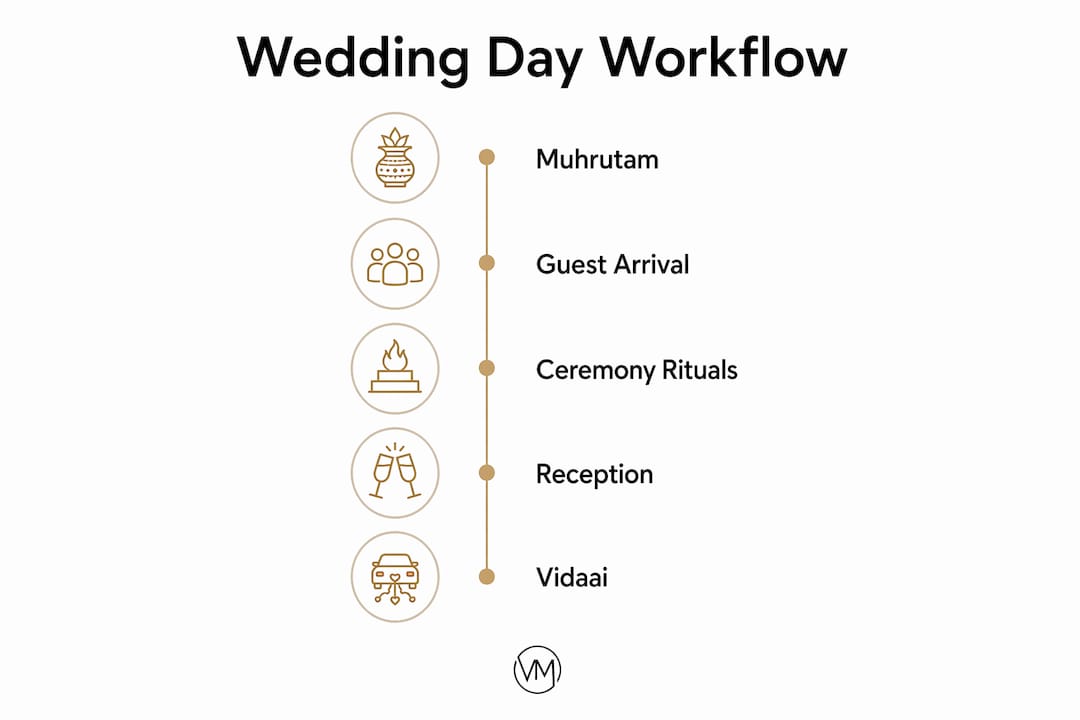
Guest management across a multi-event South Asian wedding is its own discipline. The average South Asian wedding involves multiple ceremonies with different attendance lists, dietary requirements, and seating configurations.
Separating guest lists per event reduces confusion and improves catering accuracy. Tools like Invyt allow you to track RSVPs separately per ceremony, which is critical when your Mehndi has 80 guests and your reception has 400. Mixing those counts leads to food shortages, seating chaos, and vendor miscommunication.
- Build one master guest list, then create filtered sub-lists for each event.
- Track dietary restrictions per event, not just per person, since menus differ across ceremonies.
- Assign a family coordinator for each event to handle arrivals, seating questions, and last-minute changes.
- For baraat arrivals, designate a point person on both the groom's and bride's side to coordinate timing and signal the processional start.
- Communicate the wedding day schedule to guests at least one week in advance, including parking, dress code, and ceremony start times.
Pro Tip: Send a one-page wedding day guide to all guests via WhatsApp the evening before. Include venue addresses, parking details, ceremony start times, and a contact number for the day-of coordinator. This single step eliminates the majority of guest confusion calls on the morning of the wedding.
For a deeper look at how six major traditions structure their ceremonies and what that means for your timeline, that resource covers ritual sequences across Telugu, Punjabi, Tamil, and other communities in detail.
What are the most common day-of disruptions and how do you prevent them?
The most common South Asian wedding day disruptions are not caused by bad luck. They are caused by predictable, preventable gaps in coordination.
"Experienced South Asian wedding photographers plan their day around key rituals and build detailed call sheets to capture moments without interfering." SLR Lounge
Building buffers around the muhurtham preserves ritual integrity and removes timing pressure from photographers and vendors. A family photo session that runs 20 minutes long should never delay the start of pheras or the thalikettu. Schedule family portraits before the ceremony begins or after it concludes, never during the buffer window.
- Designate one day-of point person for vendor communication. That person is the single contact for caterers, photographers, videographers, and entertainment. Splitting vendor communication across five family members guarantees conflicting instructions.
- Effective real-time updates and separate headcount tracking stabilize complex South Asian weddings. Assign someone to monitor vendor arrivals against the timeline and flag delays immediately.
- Synchronize entertainment and stage setup with ceremony flow. A DJ or live band that starts soundcheck during the Nikah or pheras is a coordination failure, not a vendor failure.
- Respect the cultural importance behind each ritual when deciding what can be compressed. Knowing which ceremonies are sacred and which are social gives you flexibility without sacrificing meaning.
The role of family coordinators in managing these moments is substantial. Appointing trusted, organized family members to specific roles before the wedding day is one of the highest-leverage decisions you can make.
Key takeaways
A successful South Asian wedding day workflow is built by locking muhurtham times first, separating guest management by event, and assigning clear day-of communication roles to prevent cascade delays.
| Point | Details |
|---|---|
| Muhurtham anchors everything | Set your auspicious ritual time with an astrologer before scheduling any vendor or venue. |
| Segment guests by event | Track RSVPs and headcounts separately per ceremony to avoid catering and seating errors. |
| Build traffic buffers | Allow 60 to 90 minutes for urban travel between venues, especially during morning peak hours. |
| Designate day-of coordinators | Assign one point person per vendor category to prevent conflicting instructions and delays. |
| Know what can be compressed | Understand which rituals are sacred and which are social before shortening any ceremony. |
What I have learned from filming South Asian weddings
After filming dozens of South Asian weddings across New York and New Jersey, the pattern I see most often is not disorganization. It is over-optimism about transitions. Couples build beautiful timelines and then assume that moving 300 guests from a ceremony hall to a reception ballroom takes 10 minutes. It takes 35.
The couples who have the smoothest days are the ones who started vendor conversations early, not just to book dates but to co-create the timeline. When your videographer, photographer, and caterer all understand the muhurtham window and the baraat arrival sequence before the wedding week, they show up as partners, not just service providers. That changes the energy of the entire day.
The other thing I would tell every couple: do not try to protect everyone from the schedule. Share it widely. When your aunties know that portraits start at 4:00 PM sharp and the reception doors open at 6:30 PM, they show up on time. Secrecy about the timeline creates confusion. Transparency creates cooperation.
For couples who want to see how a well-coordinated South Asian wedding translates on film, follow along on Instagram for real examples from ceremonies across the tri-state area.
— Anthony
How Visualizemedia captures your South Asian wedding day
Visualizemedia specializes in cinematic wedding films for South Asian couples in New York and New Jersey, with deep experience across Telugu, Punjabi, Kerala, and Muslim wedding formats.

Every Visualizemedia team arrives with a detailed call sheet built around your muhurtham and ceremony sequence. The team coordinates directly with your photographer, caterer, and event planner to stay synchronized across every ritual block. Packages include multi-camera ceremony coverage, aerial footage, color grading, and full reception edits. For couples who want their perfect South Asian wedding film captured without disrupting a single sacred moment, explore wedding cinematography and photography packages built specifically for multi-event South Asian celebrations.
FAQ
What is a wedding day workflow for South Asian weddings?
A wedding day workflow for South Asian weddings is a sequenced, event-by-event schedule built around fixed ritual times like the muhurtham, with vendor call times, guest logistics, and transition buffers mapped around those anchors.
How early should a South Asian wedding day start?
Telugu Hindu weddings typically start between 5:00 and 7:00 AM to meet the muhurtham window, while Kerala weddings can begin as early as 4:00 AM. Start times depend entirely on the astrologically set ritual time for your specific tradition.
How do I manage RSVPs for multiple South Asian wedding events?
Track RSVPs separately for each ceremony using digital tools like Invyt or a segmented spreadsheet. Mixing headcounts across events causes catering shortages and seating errors, especially when attendance varies significantly between a Mehndi and a reception.
How much buffer time should I build into a South Asian wedding schedule?
Build 60 to 90 minutes of travel buffer for urban venues during peak morning and evening hours, and add 20 to 30 minute buffers before and after the muhurtham window to protect ritual timing from family photo sessions or vendor delays.
Who should be the day-of coordinator for a South Asian wedding?
Designate one trusted person as the single point of contact for all vendors, and assign separate family coordinators per event for guest management. Splitting vendor communication across multiple family members is the most common cause of day-of confusion.