
Your wedding film will outlive your flowers, your cake, and possibly your centerpieces by decades. Yet most couples spend more time researching caterers than understanding the role of filmmaker in weddings. A wedding filmmaker is not simply someone who shows up with a camera. They are the person responsible for shaping how your entire day gets remembered, felt, and retold. Getting this choice right means understanding what filmmakers actually do, how their style shapes your story, and what questions separate the right hire from a costly mismatch.
Table of Contents
- Key takeaways
- The role of filmmaker in weddings, defined
- How filmmaking style shapes your final film
- Filmmakers vs. content creators: understanding the difference
- Choosing the right wedding filmmaker
- My honest take on what couples get wrong
- How Visualize Media captures your wedding story
- FAQ
Key takeaways
| Point | Details |
|---|---|
| Filmmakers tell stories | A wedding filmmaker builds a narrative arc, not just a recording of events. |
| Style match matters most | Couples who choose based on emotional resonance, not price, report stronger satisfaction. |
| Filmmakers vs. creators differ | Videographers deliver cinematic films over weeks; content creators deliver social clips in hours. |
| Chemistry builds better films | Trust between couple and filmmaker directly shapes how authentic intimate moments are captured. |
| Ask before you book | Reviewing full-length films and asking about deliverables prevents style and expectation mismatches. |
The role of filmmaker in weddings, defined
Most people picture a wedding filmmaker as someone standing in the back with a camera. The reality is far more layered. A professional wedding filmmaker functions more like a film director on location, making real-time creative decisions while coordinating with your photographer, planner, and venue.
Their day typically starts during preparations, and full-day coverage spans from getting ready through the last dance at the reception. That means capturing quiet moments between you and your partner before the ceremony, the texture of the dress, the nerves in your father's hands, and the raw emotion of vows, not just the vows themselves.
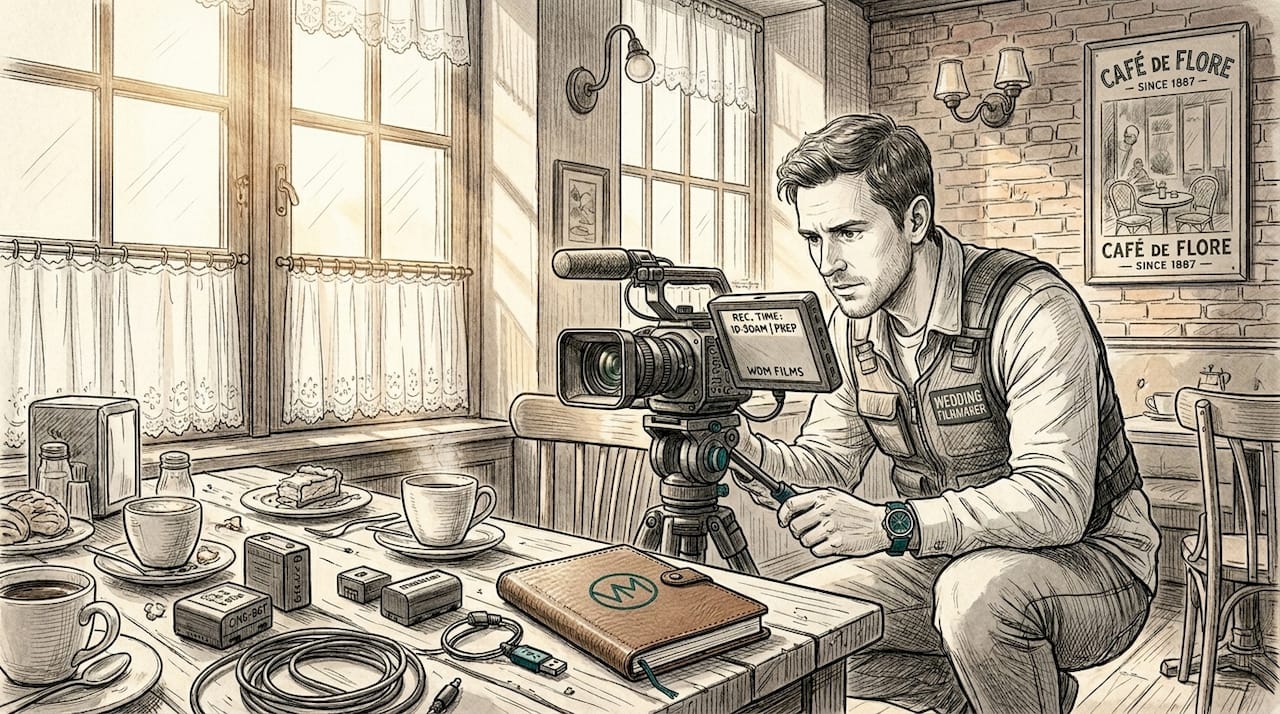
The technical side of this work is significant and mostly invisible to couples on the day. Professional filmmakers manage multi-camera setups, work with natural and artificial lighting, and build audio redundancy systems using wireless lavalier microphones, direct DJ soundboard feeds, and independent backup recorders. If a microphone fails during your vows, a skilled filmmaker already has a backup running.
Post-production is where the wedding film production role becomes most creative. Editing is not assembling clips in order. It is selecting which moments carry emotional weight, building pacing through music, and constructing a narrative that mirrors how the day felt rather than just how it looked. Dedicated editing partnerships between filmmakers and specialized editors improve consistency and allow for faster, higher-quality turnarounds.
Deliverables vary by package but most professional filmmakers offer highlight reels and full edits, typically a short highlight film between 3 and 8 minutes and a longer documentary edit running 20 to 60 minutes.
Pro Tip: Always ask to see a full-length documentary edit, not just highlight reels. Highlight films are easy to make beautiful. A 40-minute documentary edit reveals a filmmaker's true storytelling depth.
How filmmaking style shapes your final film
Here is what most booking guides skip entirely. Two filmmakers can attend the same wedding, capture the same moments, and deliver films that feel completely different. The reason is style. And couples who overlook style alignment frequently end up with films that look technically fine but feel nothing like their day.
The three most common styles in wedding cinematography are cinematic, documentary, and storytelling or editorial. Each serves a different emotional priority.
| Style | Visual approach | Best for |
|---|---|---|
| Cinematic | Dramatic lighting, wide angles, color grading, music-driven pacing | Couples who want a movie-like, emotionally heightened film |
| Documentary | Natural light, candid moments, minimal staging, chronological flow | Couples who want an authentic, unscripted record of the day |
| Storytelling / editorial | Narration-driven, non-linear structure, emotion-first sequencing | Couples who want a film centered on their personal story |
Style also determines how filmmakers handle music selection, shot pacing, and the balance between wide establishing shots and close personal moments. A cinematic-style film might open with aerial footage of your venue at golden hour, while a documentary film might open with the sound of laughter in the bridal suite. Neither is wrong. But one of them is more you.
Choosing based on emotional resonance over popularity is the most reliable decision framework available. Watch each filmmaker's work and notice where you feel something. That feeling is data. To understand how filmmakers use these techniques to create emotional impact, this guide to cinematic wedding films breaks down exactly what that process looks like.
Filmmakers vs. content creators: understanding the difference
A growing number of couples are now hiring both a wedding filmmaker and a social-first content creator. Understanding why requires knowing where these roles actually differ.
A wedding filmmaker is focused on long-term storytelling. They capture your day with cinematic techniques, narrative structure, and professional equipment, then spend weeks in post-production crafting a film you will watch for decades. Wedding film turnaround for professional videographers typically runs 8 to 16 weeks.
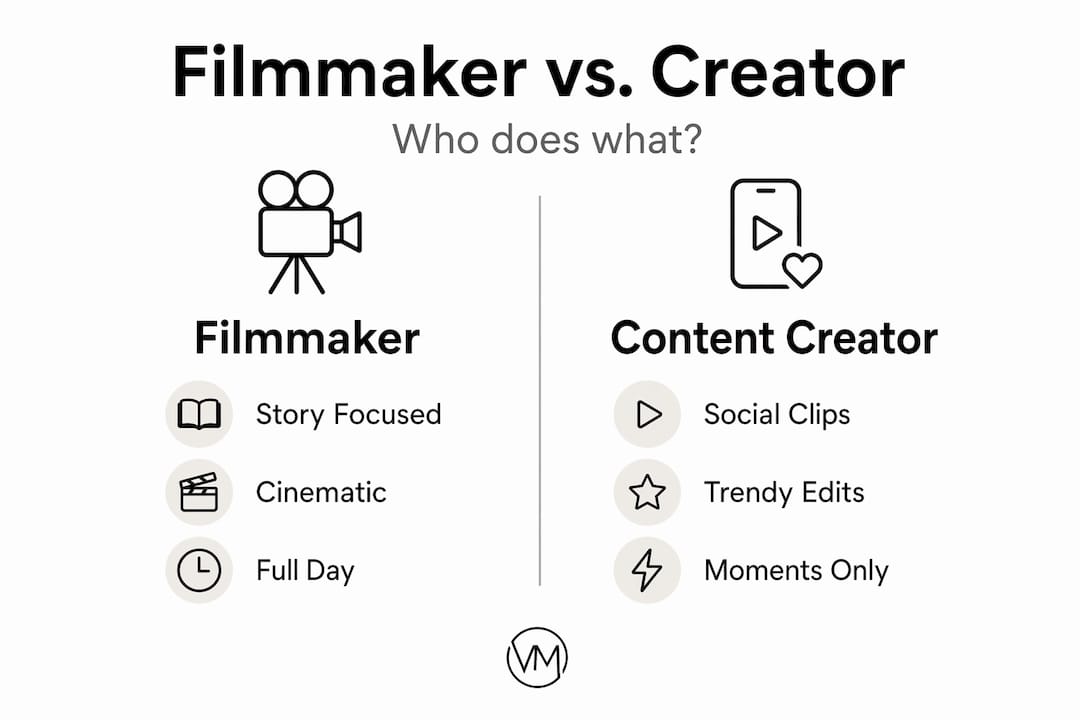
A content creator operates on a completely different timeline and purpose. Social-first content creators use smartphones to capture candid, high-energy moments and deliver shareable clips within 72 hours. Their goal is immediacy and relatability, not archival storytelling.
Here is a quick breakdown of how the two roles compare:
- Wedding filmmaker: Multi-camera setup, professional audio, cinematic editing, 8 to 16 week delivery, long-form films
- Content creator: Smartphone or mirrorless camera, quick cuts, natural sound, 24 to 72 hour delivery, short social clips
- Best use case for filmmakers: Archival wedding film, ceremony documentation, formal speeches and vows
- Best use case for content creators: Instagram Reels, day-after sharing, capturing energy and candid interactions
- Combined coverage: Ideal for couples who want both lasting artistry and immediate shareable content from their day
Neither role replaces the other. They answer different needs. The importance of the wedding filmmaker sits in the long game. Your Instagram post from the wedding weekend fades in relevance within a week. The film you watch on your tenth anniversary does not.
Choosing the right wedding filmmaker
This is where most couples make avoidable mistakes. Here is a straightforward process for selecting a filmmaker who is actually right for your wedding.
- Watch full-length films, not just trailers. Anyone can cut a beautiful 90-second trailer to a great song. The full film shows pacing, narrative structure, and how the filmmaker handles quieter, less dramatic moments.
- Match style to your priorities. If your wedding is intimate and low-key, a heavily cinematic style might feel disconnected. Know your priorities before reaching out.
- Ask about equipment and backup plans. What cameras do they use? Do they carry backup gear? How do they handle audio failure? These questions reveal professionalism.
- Confirm vendor coordination. Pre-wedding communication between your filmmaker, photographer, and planner prevents day-of conflicts and scheduling gaps.
- Ask about deliverables in writing. How many cameras? What edits are included? When will you receive the final film? Get specifics.
Pro Tip: For destination or luxury weddings, ask specifically about the filmmaker's experience with your venue type. Luxury and destination weddings require logistical knowledge, cultural awareness, and a level of discreet professionalism that not every filmmaker has developed.
My honest take on what couples get wrong
I have spent years behind the scenes at weddings, and the pattern I see most often is this: couples evaluate filmmakers the same way they evaluate photographers, by looking at the prettiest images. But a wedding film lives and breathes in movement, audio, pacing, and the relationship between you and the person filming you.
Chemistry and trust with your filmmaker matter more than any single frame in a portfolio. When you feel comfortable with your filmmaker, you stop performing for the camera. And that is when the real film gets made. The authentic glance, the nervous laugh, the moment you did not know anyone caught because you forgot the camera was there.
What I encourage every couple to do is get on a call before booking. Not to ask about packages. To talk. See if you connect. A filmmaker who listens, asks questions about your relationship, and genuinely cares about how storytelling transforms your wedding film will always outperform one with a technically superior portfolio who treats your wedding as a job.
Price is the last thing to consider, not the first. The right filmmaker pays for itself every time you watch the film. The wrong one is something you stop watching after the first year.
— Anthony
How Visualize Media captures your wedding story
At Visualize Media, we approach every wedding as a film project, not a recording session. Working across New York and New Jersey, our team brings multi-camera coverage, aerial cinematography, professional audio systems, and dedicated post-production expertise to every couple we work with. We specialize in matching our filmmaking style to your vision, whether that means a dramatic cinematic film or an intimate documentary-style edit that feels exactly like your day.
Every package includes full ceremony coverage, highlight films, and longer documentary edits with color grading and custom music selection. You can view our full wedding cinematography services to see the packages in detail and watch sample films. Follow us on Instagram for recent work, and reach out when you are ready to start the conversation.
FAQ
What does a wedding filmmaker actually do?
A wedding filmmaker covers the full day from preparations through reception, handling camera work, audio, lighting, and post-production editing to create a finished narrative film of your wedding.
How is a wedding filmmaker different from a videographer?
The terms are often used interchangeably, but a filmmaker typically emphasizes storytelling, cinematic technique, and narrative structure. A standard videographer may focus more on documentation without the same creative editorial approach.
What questions should I ask a wedding filmmaker before booking?
Ask to see full-length films, confirm what deliverables are included, ask about backup equipment and audio systems, and discuss how they coordinate with your photographer and planner on the day.
How long does it take to receive a wedding film?
Professional wedding filmmakers typically deliver finished films within 8 to 16 weeks after the wedding date. Social content creators, by contrast, deliver short clips within 24 to 72 hours.
Should I hire both a wedding filmmaker and a content creator?
Yes, if your budget allows. A filmmaker creates the archival, long-form film you will watch for decades. A content creator delivers shareable social clips within days. Both serve different but complementary purposes for your wedding coverage.