
Most couples treat wedding video music like a playlist for background atmosphere. Pick something pretty, hand it to the editor, and call it done. But the role of music in wedding videos goes far deeper than that. Music is the emotional architecture of your film. It determines whether viewers cry, smile, or feel completely detached from what they are watching. Get it right, and your wedding video becomes something people rewatch for decades. Get it wrong, and even beautiful footage falls flat.
Table of Contents
- Key takeaways
- The role of music in wedding videos and emotional pacing
- Choosing music that reflects who you actually are
- Music licensing and copyright: what you cannot skip
- How to sync music to footage without losing the emotion
- Combining music with natural audio and silence
- My honest take on music in wedding films
- See how Visualizemedia brings music and film together
- FAQ
Key takeaways
| Point | Details |
|---|---|
| Music drives emotional pacing | The tempo and mood of your music shapes how every scene lands, not just how it sounds. |
| Personalization beats trends | Music that reflects your actual relationship creates more emotional impact than whatever is popular. |
| Licensing is non-negotiable | Using unlicensed music can get your wedding film taken down on every platform you share it on. |
| Sync to meaning, not every beat | Cutting to musically significant moments creates emotional clarity, while cutting to every beat creates chaos. |
| Silence is a storytelling tool | Strategic quiet moments can amplify emotion more powerfully than any soundtrack. |
The role of music in wedding videos and emotional pacing
Music does not just play under your wedding footage. It tells your brain how to feel about everything it is seeing. This is the single most misunderstood thing about the role of soundtracks in weddings and why so many otherwise beautiful wedding films feel hollow.
Music shapes how transitions land and determines the emotional weight of every moment in the film. A slow-motion shot of the bride walking toward the altar hits completely differently under a spare piano melody versus a building orchestral swell. Same footage, entirely different film.
The practical mechanics work like this:
- Fast edits with rhythmic, energetic music create excitement and celebration, perfect for reception highlights and dance floors
- Slow edits with spacious melodies allow emotional moments to breathe, giving viewers time to feel rather than just watch
- Music builds and drops signal to the viewer that something significant is about to happen, creating subconscious anticipation
- Tempo shifts can mark transitions between ceremony, cocktail hour, and reception without a single title card
Pro Tip: Don't choose music you love in isolation. Play it against actual footage and notice how the scene changes. Music that made you cry on Spotify might not serve your wedding film at all.
Matching music tempo and edit pacing is what separates a wedding video from a wedding film. One is documentation. The other is storytelling.
Choosing music that reflects who you actually are
Here is where most couples outsource the decision entirely to their videographer. And while a skilled editor absolutely has strong instincts, no one knows your relationship better than you do. The impact of music on wedding films is multiplied when the music feels authentically chosen rather than generically appropriate.

Orchestral and classical scores are trending in 2026 precisely because couples are moving away from the predictable acoustic pop tracks that dominated wedding videos for the better part of a decade. The shift is toward music that matches the specific emotional energy of each couple's story.
Here are some music genres worth considering against your wedding style:
- Classical and orchestral: Works beautifully for formal venues, black tie weddings, and couples who want a cinematic, dramatic tone
- Acoustic singer-songwriter: Warm and intimate, well suited to outdoor ceremonies and couples with a personal, low-key aesthetic
- Jazz and soul: Perfect for New York City loft weddings or cocktail-hour heavy receptions with a sophisticated, urban feel
- Ambient and instrumental pop: Flexible and contemporary, works across many styles without feeling dated
- Folk and Americana: Ideal for barn weddings, vineyard settings, and couples who want something emotionally honest and unpolished
Think about lyrics carefully. A song with meaningful lyrics can anchor a moment beautifully, but lyrics competing with spoken vows or a heartfelt speech become a distraction. Multiple tracks across a single film allow you to shift mood from ceremony to celebration without the whole film feeling tonally flat.
Music licensing and copyright: what you cannot skip
This section is where good intentions meet real legal and financial consequences. Using your favorite song without the proper license is not a gray area. It is copyright infringement, and the penalties are concrete.
Sync licensing requires permission from both the master rights holder (typically the record label) and the publishing rights holder (typically the songwriter or publisher). These are two separate permissions, and both are required before a song can legally appear in a film.
Here is how the fee structure generally works:
- Independent or lesser-known artists: Licensing fees can start as low as $50 to a few hundred dollars for limited personal use
- Mid-tier commercial tracks: Expect fees ranging from $500 to several thousand dollars depending on usage scope
- Major label songs: Fees can reach well over $500,000 for broad commercial use, though private wedding use negotiations exist at lower rates
- Music licensing platforms: Services offering pre-cleared single purchase licenses cover both master and publishing rights globally, making them the most practical option for most videographers
| Option | Cost range | Best for |
|---|---|---|
| Popular commercial song | $500 to $500,000+ | Couples with specific meaningful songs |
| Independent artist licensing | $50 to $500 | Authentic, unique music on a budget |
| Pre-cleared library platforms | $15 to $200 per track | Videographers needing efficient workflow |
| Royalty-free music | Free to $50 | Budget projects with flexible taste |
Unauthorized use triggers Content ID claims on YouTube and DMCA takedowns on social media. Your wedding film can be muted, removed, or monetized by the rights holder the moment it goes online.
Pro Tip: Ask your videographer specifically which licensing platform they use and what rights are covered. A vague answer here is a red flag worth following up on before you sign a contract.
How to sync music to footage without losing the emotion
Syncing music to footage is a craft. Many editors fall into the trap of cutting on every single beat of a song, which creates frantic pacing rather than emotional momentum.
The more effective approach is to cut to musically significant downbeats and section changes. A new verse or a chorus arrival should signal something visually meaningful. A cut at the moment the music swells should reveal a shot that earns that emotional weight.
Common syncing mistakes that weaken wedding films:
- Cutting on every beat during slow moments, which rushes the viewer past emotional scenes before they can feel anything
- Ignoring music dynamics, so the loudest part of a song plays under a quiet intimate moment instead of a grand visual reveal
- Treating the whole film as one uniform pace, rather than using music's structural role to shape distinct emotional chapters
- Choosing tracks that are too short, forcing awkward loops or cuts before the story is complete
A mismatch between music pace and scene length causes viewer disengagement by creating emotional confusion. Your viewer cannot process what they should feel, so they feel nothing.
Combining music with natural audio and silence
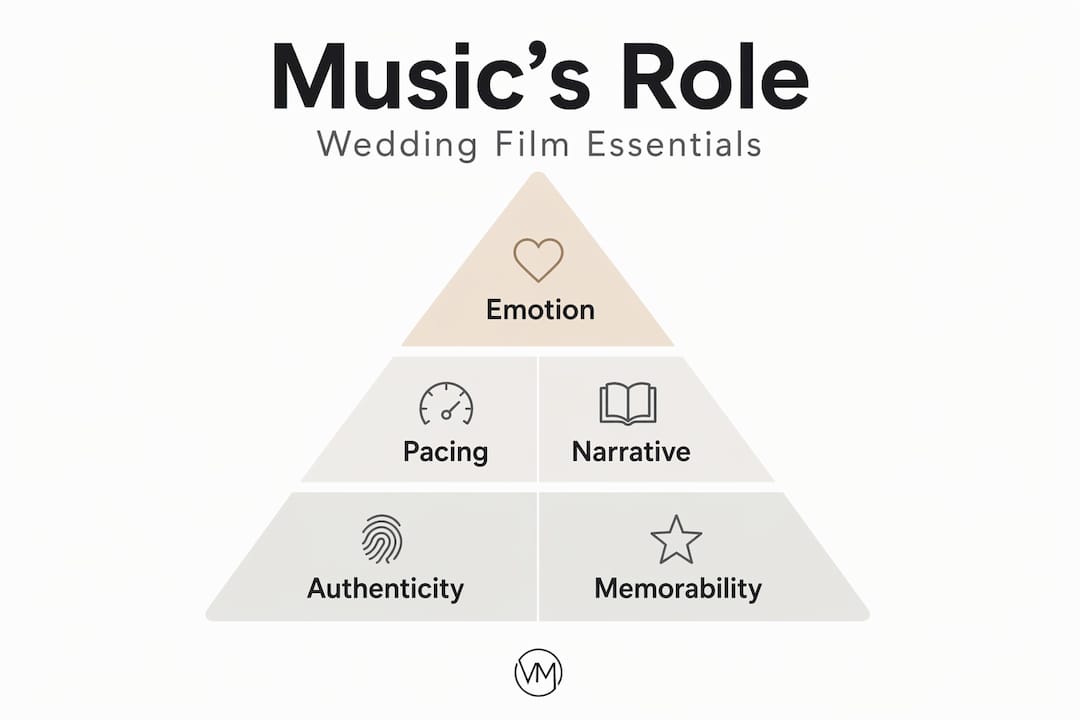
Music is not the only audio element that matters. The best wedding films layer music with real sound from your day, and they use silence deliberately.
Consider how audio elements interact:
- Natural audio under music: The distant sound of the crowd cheering after your first kiss, just barely audible under the music, adds texture that pure soundtrack cannot replicate
- Dialogue-heavy moments: Drop the music during heartfelt speeches or vows. Let the words stand alone. Underscore music here competes and weakens both
- Ambient sound bridges: The crunch of gravel outside a church, birds before the ceremony begins, clinking glasses. These sounds ground the film in a real moment
- Silence before a key moment: A beat of near-silence right before the music builds into a climax makes the emotional payoff land harder than if the music never stopped
The importance of music in weddings is inseparable from how it coexists with the natural world of the day itself.
My honest take on music in wedding films
I've worked on enough wedding films to know that music decisions are where the most value gets left on the table. Couples spend months choosing flowers and almost no time thinking about music. Then they watch their film and wonder why a scene that was emotionally charged in real life feels flat on screen.
The shift toward orchestral and authentic scores I am seeing in 2026 is not a trend. It is couples finally realizing that wedding video music trends matter as much as visual style. What I've learned is that the best music conversations happen before filming, not in the edit room. When a couple tells me which songs were playing when they fell in love, or which artist they listened to through a hard season, that information changes everything about how I approach the film.
I've also seen editors fight with a piece of footage for hours trying to make a song work when the real issue is the song was wrong from the start. The right track makes editing feel effortless because the music and footage want the same thing emotionally.
Collaborate with your videographer on music early. It is not an afterthought. It is the foundation of how music enhances wedding memories that last a lifetime.
— Anthony
See how Visualizemedia brings music and film together
At Visualizemedia, music selection is part of the creative conversation from your very first consultation, not something added after the fact. The team approaches every wedding film as a director would approach a short film, pairing cinematic footage with music that reflects the specific emotional story of your relationship. From aerial footage over New Jersey's countryside to intimate close-ups during New York City ceremonies, every shot is edited with intentional music choices in mind. Explore our wedding cinematography services or check the latest wedding film trends to see how this approach comes to life. Follow along on Instagram for behind-the-scenes film work and music-driven wedding highlights.
FAQ
What is the role of music in wedding videos?
Music shapes the emotional pacing, tone, and narrative structure of a wedding film. It is not background decoration but the framework around which the entire film is edited and felt.
Do I need a license to use a song in my wedding video?
Yes. Any music used in a wedding video requires sync licensing, which means clearing both master and publishing rights. Using unlicensed music can result in your video being removed from platforms like YouTube.
What music genres work best for wedding highlight films?
Orchestral and classical scores, acoustic singer-songwriter tracks, and ambient instrumental pop are among the most effective. The right genre depends on your wedding setting, personal story, and the emotional tone you want to create.
Should music play during wedding vows and speeches in the video?
Generally, no. Dialogue-heavy moments like vows and speeches are more powerful when music is pulled back or removed entirely. Underscore music during these scenes competes with the words and weakens both.
How do videographers sync music to wedding footage effectively?
Skilled editors cut to musically significant downbeats and section changes rather than every beat. This approach maintains emotional clarity and gives viewers time to connect with what they are seeing.