
Wedding vendors are the professionals responsible for executing every distinct element of your wedding day, from the first flower arrangement to the final dance. The role of wedding vendors goes far beyond showing up with equipment. Each supplier owns a specific function, and when those functions align, the result is a wedding that feels effortless. The average wedding involves 8–15 vendors, which means you are managing a small team of specialists, each with their own timelines, contracts, and expectations. Getting that coordination right is the difference between a joyful celebration and a day spent putting out fires.
What are the primary roles of wedding vendors?
Every wedding vendor category covers a specific slice of the event. Understanding what each one delivers helps you build a complete team without gaps or overlaps.
The core vendor types most couples hire include:
- Venue: Provides the physical space and often dictates load-in rules, catering restrictions, and vendor access times.
- Caterer: Handles food, beverage, staffing, and often rentals like linens and tableware.
- Photographer: Captures still images of the ceremony, portraits, and reception moments.
- Videographer: Documents the day as a cinematic film, preserving vows, speeches, and candid emotion in motion.
- Florist: Designs and delivers floral arrangements, bouquets, and ceremony décor.
- DJ or band: Manages all audio, from ceremony music to reception dancing.
- Officiant: Leads the ceremony and handles legal documentation.
- Hair and makeup artist: Prepares the couple and wedding party before the ceremony.
- Rental company: Supplies furniture, lighting, tents, and specialty items the venue does not provide.
- Wedding planner: Coordinates all other vendors and manages the master timeline.
Vendor specialization matters because no single supplier can cover everything well. A florist and decorator, for example, often work together on the same physical space. If they do not communicate before the event, their visions can clash on the day. Venue preferred vendor lists reduce this risk by connecting you with professionals who already know the space's quirks, from load-in logistics to power access. Photographers and videographers also need to coordinate closely, and a guide on photo and video coordination can help you manage that relationship well.
Pro Tip: Book your photographer, videographer, and DJ at least 10–12 months out. These vendors serve only one client per day, so they fill up fast, especially during peak season.

How do wedding vendors collaborate to keep the day on track?
Vendor coordination is the most underestimated challenge in wedding planning. When you have 10 or more suppliers working in the same space, timing conflicts and communication gaps become real risks.
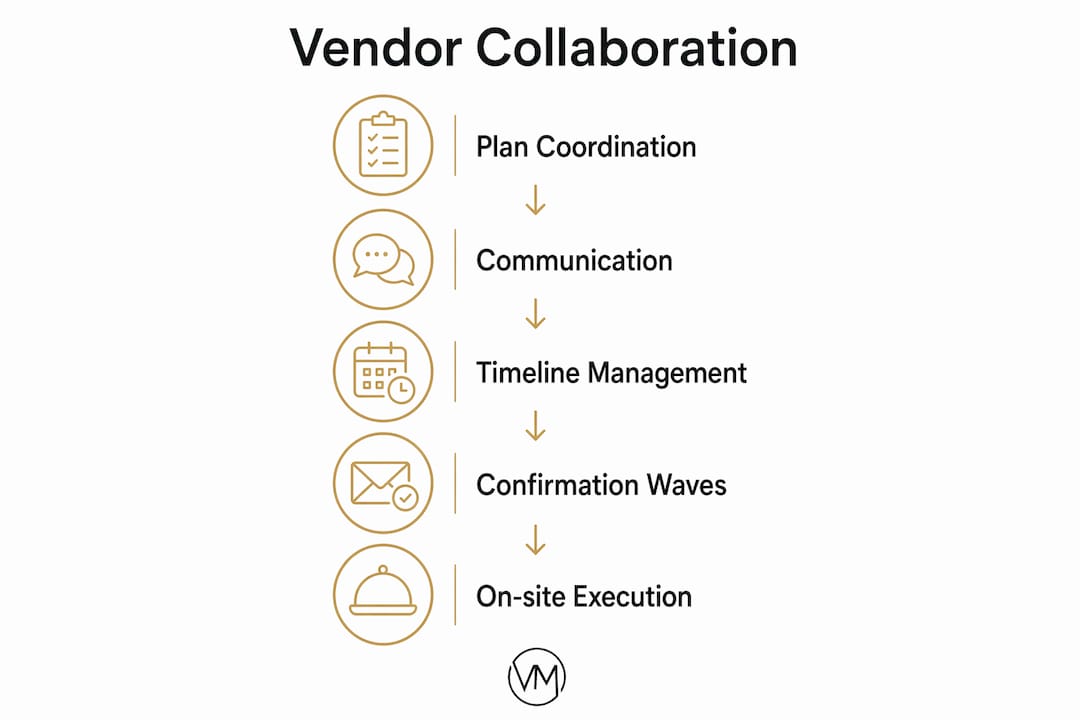
The most reliable system professionals use is reverse timeline scheduling. You start from the ceremony time and work backward, assigning each vendor a specific arrival, setup, and departure window. Coordinating 15 or more vendors triples the number of cross-dependencies you need to manage. That number makes a structured system non-negotiable, not optional.
The industry standard for preventing day-of surprises is the 3-wave confirmation protocol:
- 30 days out: Confirm all vendor bookings, share the master timeline, and flag any changes to the original contract.
- 7 days out: Send updated logistics including venue address, parking, load-in times, and point-of-contact details.
- 48 hours out: Final confirmation of arrival times, headcounts, and any last-minute adjustments.
This 3-wave confirmation system is the industry standard for reducing on-site issues. Each wave catches a different category of problem before it becomes a crisis. A single point of contact, whether that is you, your planner, or a trusted family member, should own all vendor communication. Splitting that responsibility across multiple people creates confusion fast.
Pro Tip: Create one shared document with every vendor's name, contact number, arrival time, and specific task. Share it with your planner and venue coordinator the week before the wedding.
What should couples look for beyond portfolios when choosing vendors?
Choosing vendors based on portfolio alone is one of the most common mistakes couples make. A stunning Instagram feed does not tell you how a vendor behaves when the timeline slips or the weather turns.
The concept of "whole vibe" fit means evaluating a vendor's communication style, flexibility, and energy alongside their work. Choosing vendors based on process and adaptability predicts a stress-free experience far better than their portfolio does. A vendor who responds slowly during the booking process will likely respond slowly on the day you need them most.
"A vendor's ability to handle pressure quietly and adapt to chaos is the single best predictor of whether your wedding will feel joyous rather than stressful. Technical skill gets you 60% of the way there. How they behave under pressure gets you the rest."
Price is another trap. The cheapest vendors rarely offer the best value because hidden fees and poor performance often require expensive last-minute fixes. When evaluating entertainment vendors beyond price, the same principle applies. Ask every vendor what their backup plan is if they get sick or their equipment fails. A vendor without a clear answer to that question is a liability.
Contracts protect you when things go wrong. Clear contracts with defined cancellation terms, backup plans, and precise service scopes reduce risk significantly. Read every line before signing, and ask for clarification on anything vague.
When should couples book vendors and how do they manage them?
Booking timelines vary by vendor type and season. Missing the right window for high-demand suppliers means settling for your second or third choice.
| Vendor type | Recommended booking window | Notes |
|---|---|---|
| Photographer / videographer | 10–12 months out | Single-client vendors; fill quickly in peak season |
| DJ / band | 10–12 months out | Limited availability on popular dates |
| Venue | 12–18 months out | Anchor booking that drives all other decisions |
| Caterer | 6–8 months out | Can serve multiple events; more flexible |
| Florist | 6–9 months out | Earlier for large or custom installs |
| Hair and makeup | 6–8 months out | Book the full team at once |
| Rental company | 4–6 months out | Inventory varies by season |
Single-client vendors like photographers and DJs should be booked 10–12 months in advance, while caterers and rental companies can often be secured 6–8 months out. Your venue booking anchors everything else, so that comes first.
Track every vendor payment in a single spreadsheet. Untracked add-ons and delivery fees are a leading cause of budget overruns. Per-vendor financial tracking keeps your total spend visible and prevents surprises at the final invoice stage. For a full breakdown of how to vet and hire each supplier, the 2026 vendor hiring guide covers the process in detail.
84% of women in opposite-sex couples report carrying the majority of the planning load. That statistic explains why a professional wedding planner, who acts as the architect of the entire vendor team, is one of the highest-value hires you can make.
Key Takeaways
The role of wedding vendors is to each own a specific function, and their coordinated execution is what turns your vision into a real, memorable event.
| Point | Details |
|---|---|
| Vendor count drives complexity | The average wedding uses 8–15 vendors; each addition multiplies coordination demands. |
| Book single-client vendors first | Photographers, videographers, and DJs should be secured 10–12 months in advance. |
| Use the 3-wave confirmation system | Confirm vendors at 30 days, 7 days, and 48 hours out to prevent day-of surprises. |
| Evaluate fit, not just portfolio | Communication style and adaptability predict a smooth day better than past work alone. |
| Track every vendor payment | Per-vendor financial tracking prevents budget overruns from hidden fees and add-ons. |
What I've learned watching vendor teams succeed and fail
After filming dozens of weddings across New York and New Jersey, I can tell you that the couples who have the best days are not always the ones with the biggest budgets. They are the ones who built a vendor team that actually communicates.
The most stressful weddings I have witnessed share one pattern: a vendor who was technically skilled but operationally isolated. They did their job in a silo, did not check in with the planner, and created a ripple effect that threw the timeline off by 45 minutes. That kind of disruption is invisible in photos but very visible in how the couple feels by the time they reach the reception.
What I tell every couple is this: trust your gut during the consultation. If a vendor makes you feel like a transaction rather than a client, that feeling will show up on the wedding day. The vendors who ask thoughtful questions, respond quickly, and treat your event like it matters to them personally are the ones who deliver. Relational fit is not a soft consideration. It is a practical one.
Follow Visualizemedia on Instagram to see how vendor teamwork shows up in real wedding films.
— Anthony
Visualizemedia's role in your wedding vendor team
Every wedding deserves a cinematographer who coordinates as well as they create. Visualizemedia works alongside your full vendor team in New York and New Jersey, syncing with your planner, photographer, and venue to capture the moments that matter most.

From multi-camera ceremony coverage to aerial footage and color-graded edits, Visualizemedia builds its workflow around your timeline, not the other way around. Couples who want to see the standard in action can browse wedding cinematography packages or fill out the booking questionnaire to start the conversation. When your vendor team works together, the film reflects it.
FAQ
What is the role of wedding vendors?
Wedding vendors are specialists hired to handle specific functions of a wedding, including venue, catering, photography, videography, florals, and entertainment. Together, they execute every element of the event so the couple can be present rather than managing logistics.
How many vendors does the average wedding require?
The average wedding involves between 8 and 15 distinct vendors. That number scales coordination complexity significantly, which is why a structured communication system is critical.
When should you start booking wedding vendors?
Venue and single-client vendors like photographers and DJs should be booked 12–18 months and 10–12 months out respectively. Caterers and rental companies can typically be secured 6–8 months before the event.
Why does vendor communication style matter?
A vendor's communication style during planning predicts their behavior on the wedding day. Vendors who respond slowly or vaguely before the event tend to create problems when real-time decisions are needed.
What should every wedding vendor contract include?
Every contract should clearly define the service scope, payment schedule, cancellation terms, and backup plan. Contracts without these details increase the risk of disputes and day-of surprises.