
Most videographers building their first serious kit make the same mistake: they spend 80% of their budget on a camera body and treat everything else as an afterthought. The result is sharp footage nobody wants to watch because the audio sounds like it was recorded inside a refrigerator. A true videography equipment list is not about one hero piece of gear. It's about a balanced system where every category earns its place. This guide breaks down exactly what you need, at every budget tier, with the kind of specificity that actually helps you make purchasing decisions.
Table of Contents
- Key takeaways
- 1. A framework for your videography equipment list
- 2. Cameras: mirrorless bodies that work at weddings
- 3. Audio: the category that separates good from great
- 4. Lighting: the difference between flat and cinematic
- 5. Camera support gear for smooth, polished video
- 6. Secondary gear that makes or breaks shoot days
- 7. Budget tiers for complete videography kits
- My honest take on building a wedding videography kit
- See how professional gear translates to cinematic wedding films
- FAQ
Key takeaways
| Point | Details |
|---|---|
| Balance your gear budget | Allocate 40% to camera/lenses, 20% to audio, 20% to lighting, and 20% to support gear. |
| Audio is your highest ROI upgrade | Bad audio kills engagement faster than any camera flaw ever will. |
| Test everything before the wedding day | Pre-production gear testing one week out is your best defense against on-set failure. |
| Secondary gear gets overlooked | Cables, batteries, and memory cards are the items most likely to end a shoot early. |
| Budget tiers exist for every level | Starter kits run around $300, mid-tier around $800, and pro setups start at $2,000. |
1. A framework for your videography equipment list
Before you buy a single piece of gear, you need a framework. A solid videography equipment guide is built around five categories: cameras, lenses, audio, lighting, and support gear. Every dollar you spend should map back to one of those buckets.
The most practical budget allocation divides your gear spend roughly like this:
- Camera and lenses: 40% of total budget
- Audio gear: 20%
- Lighting: 20%
- Support and accessories: 20%
This balance matters more than the absolute dollar amount you spend. A $1,500 kit built with this ratio will outperform a $2,500 kit where $2,000 went to the camera alone.
Pro Tip: Before your next wedding shoot, run every piece of gear through a full power cycle and record a five-minute test clip. You will catch failing batteries, corrupted memory cards, and loose audio connections before they become your problem on the wedding day.
2. Cameras: mirrorless bodies that work at weddings
For wedding videography, mirrorless cameras have become the professional standard. The Sony A6700 and Canon EOS R50 both deliver excellent autofocus, good low-light performance, and compact form factors that do not draw attention during ceremonies.
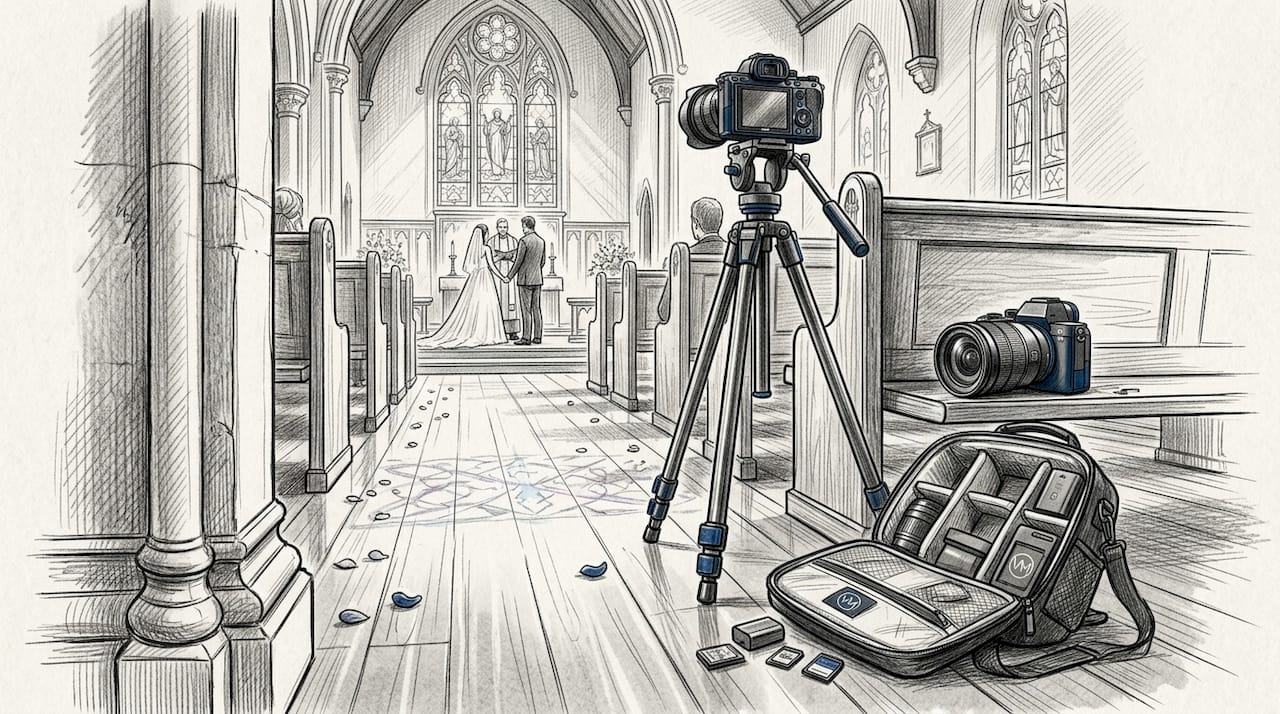
You want at least two camera bodies for a wedding shoot. One handles wide establishing shots. The other stays tight on the subjects during vows and speeches. If you are shooting solo, a second body on a tripod with a wide lens locked off gives you coverage without needing an extra operator.
For lenses, pair a versatile zoom like the Sigma 18-35mm f/1.8 with two primes: a 50mm and an 85mm. The zoom handles run-and-gun moments. The 85mm gives you that compressed, cinematic background blur during portraits and first dances.
Pro Tip: Shoot in a flat color profile (like S-Log2 on Sony or C-Log on Canon) to retain maximum dynamic range. You will thank yourself during color grading when you are pulling detail from bright window light and dark reception corners in the same clip.
3. Audio: the category that separates good from great
Audio quality drives audience engagement more than any camera specification. The Rode Wireless Go II and the DJI Mic 2 are both excellent wireless lavalier systems in the $300 range. Clip a lav on the officiant and another on the groom, and you have ceremony audio covered from two angles.
For a backup, mount a shotgun mic on your primary camera. This gives you a safety track during speeches and receptions where approaching a subject with a lav is not practical.
Budget 20 to 25% of your total gear spend on audio, and always pack extra XLR cables, wind muffs, and fresh batteries for your wireless transmitters. Running out of a lav battery mid-ceremony is the kind of mistake you only make once.
4. Lighting: the difference between flat and cinematic
Good lighting transforms footage. Three-point lighting with bi-color LED panels is the standard setup for controlled environments like getting-ready rooms and detail shots. Your key light defines the subject, the fill light softens shadows, and the backlight separates the subject from the background.
For wedding videography, here is a quick comparison of the go-to LED lighting brands:
| Brand | Best for | Price range |
|---|---|---|
| Aputure | Reception and ceremony lighting | $200 to $600 |
| Godox | Budget getting-ready setups | $80 to $300 |
| Nanlite | Compact on-camera fill lights | $100 to $400 |
Learning how lighting shapes cinematic wedding films is just as important as knowing which panels to buy. A $150 Godox panel used well will beat an expensive Aputure panel pointed directly at someone's face.
Pro Tip: Invest in a quality fluid-head tripod first, then build your lighting kit. A reliable video tripod like the Manfrotto 504X will outlast three camera bodies and pay for itself on every shoot.
5. Camera support gear for smooth, polished video
Shaky footage signals amateur work immediately. For wedding videography, your support kit should include a fluid-head tripod, a three-axis gimbal, and a camera cage.
The DJI RS series and the Zhiyun Crane are both proven gimbals for cinematic movement shots during processionals, first dances, and venue walkthroughs. A camera cage adds mounting points for your external monitor, follow focus, and microphone without adding significant weight.
External monitors in the five to seven inch range, from brands like SmallHD or Atomos, give you accurate framing and focus confirmation that the camera's built-in screen simply cannot provide in bright outdoor conditions. You catch a soft focus issue on a monitor before the shot is gone. You do not catch it until the edit without one.
6. Secondary gear that makes or breaks shoot days
The items on your videography tools checklist that most people underestimate are the ones that cost the least. Missing cables and dead batteries can shut down a shoot faster than any equipment failure.
Pack these for every wedding shoot:
- Extra LP-E6 or NP-FZ100 batteries (minimum four per camera body)
- At least three memory cards per camera, labeled and organized
- Backup USB-C and HDMI cables for monitors and recorders
- Gaffer tape, velcro straps, and cold shoe adapters
- Portable power bank for charging transmitters during the reception
- A padded, waterproof camera bag that fits in an overhead bin
Treat every wedding like a mini-production with a full gear checklist reviewed the night before. The difference between a seasoned videographer and a nervous one is almost always preparation, not gear.
7. Budget tiers for complete videography kits
Your gear kit does not need to be built all at once. Here is a realistic breakdown of what each tier gets you:
- Starter kit (around $300): Entry-level mirrorless camera, kit lens, one Rode Wireless Go II, and a basic tripod. Good enough to practice and build a portfolio.
- Mid-level kit (around $800): Upgrade to a Sony ZV-E10 or Canon R50, add a prime lens, and swap the tripod for a fluid-head. You can take paying clients at this level.
- Pro kit ($2,000 and up): Dual Sony A6700 bodies, a set of primes, a DJI RS gimbal, an Aputure LED kit, and a full audio system. This is your professional video gear foundation.
Equipment rentals add up quickly, so purchasing core gear in stages is almost always more cost-effective for videographers shooting more than six weddings per year.
My honest take on building a wedding videography kit
I have shot weddings across New York and New Jersey with gear at every price point, and the lesson I keep learning is this: your kit should match your shooting style before it matches any spec sheet. I have watched videographers with $8,000 camera setups deliver underwhelming films because they skimped on audio and had no lighting plan for a dim reception hall.
The pieces of gear I would never compromise on are a reliable wireless audio system and a fluid-head tripod. Everything else is secondary. A smooth pan during the first dance tells a story. A jerky handheld clip of the same moment does not, no matter how expensive the camera.
I have also seen equipment failure up close. A corrupted memory card during a ceremony that had no backup audio. A gimbal battery that died ten minutes into a reception because it was never charged the night before. Meticulous pre-production planning is not optional in this work. It is the job.
Build your kit in layers. Start with the categories that affect quality the most, which are audio and support gear, and grow from there. You can always rent a camera body. You cannot rent preparation.
— Anthony
See how professional gear translates to cinematic wedding films
Every piece of gear on this list exists to serve one goal: capturing a wedding day in a way that feels like a film, not a recording. At Visualizemedia, we use professional camera systems, dual-angle coverage, wireless audio setups, and cinematic lighting to create wedding films for couples in New York and New Jersey who want something genuinely beautiful. If you want to see what a fully optimized professional videography setup looks like in real wedding films, browse our work and explore our packages. You can also follow us on Instagram for behind-the-scenes footage and inspiration from recent shoots. When you are ready to talk about your wedding, we are here.
FAQ
What is the most important item on a videography equipment list?
Audio gear is the highest-impact category at every budget level. Bad audio causes immediate viewer drop-off regardless of how sharp the video looks.
How much should a beginner spend on a videography kit?
A functional starter kit can be assembled for around $300, with mid-level kits running approximately $800 and pro setups starting at $2,000.
What camera support gear do videographers need for weddings?
A fluid-head tripod and a three-axis gimbal cover the majority of wedding shooting scenarios, providing both locked-off stability and smooth motion tracking for dynamic moments.
How do I avoid equipment failure on a wedding shoot day?
Test all gear one week before the shoot and carry backups for every critical item, including memory cards, batteries, and audio cables.
Do I need a Super 8 camera on my videography tools checklist for weddings?
A Super 8 camera is a specialty item rather than a daily driver, but it produces a warm, grainy, analog aesthetic that pairs beautifully with modern digital footage for highlight reels and cinematic wedding films. It is worth adding once your core kit is solid.