
A wedding ceremony order is the planned sequence of events that guides your celebration from the moment guests arrive to the final recessional. Getting this structure right determines whether your ceremony feels effortless and emotional or rushed and disjointed. Most couples follow a traditional framework, then customize it to reflect their personalities, culture, and priorities. Understanding the standard wedding ceremony structure gives you the foundation to build something truly your own.
What is the typical order of events in a wedding ceremony?
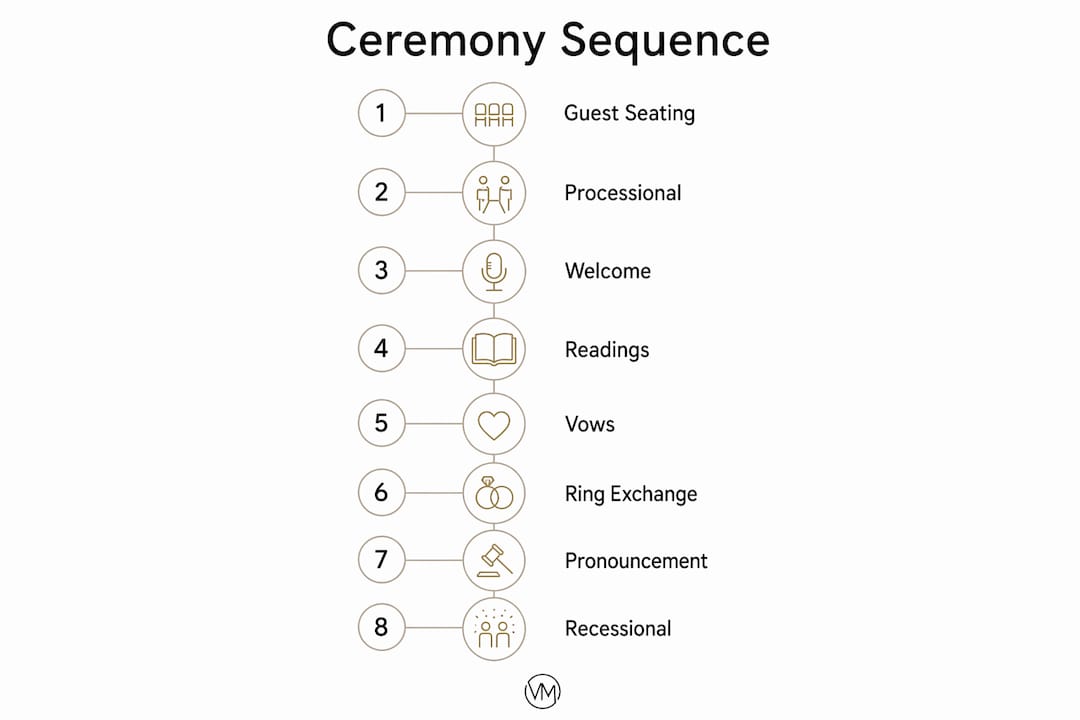
The standard ceremony sequence follows a clear, proven pattern. Each element serves a specific emotional purpose, and the order is not arbitrary. It builds anticipation, delivers the emotional peak at the vows and kiss, then releases guests into celebration.
A non-religious ceremony typically runs 20–45 minutes, while religious ceremonies run 45–60 minutes. The processional alone takes 5–10 minutes. That timing matters because it shapes your entire wedding day schedule.
| Ceremony element | Approximate duration | Purpose |
|---|---|---|
| Guest seating | 30 minutes before start | Settle guests, set atmosphere |
| Processional | 5–10 minutes | Build anticipation, introduce wedding party |
| Welcome and opening words | 3–5 minutes | Set tone and context |
| Readings | 3–6 minutes | Add depth and meaning |
| Vows | 4–8 minutes | Emotional centerpiece |
| Ring exchange | 2–3 minutes | Symbolic commitment |
| Pronouncement and kiss | 1–2 minutes | Peak moment |
| Recessional | Up to 10 minutes | Joyful close |
The processional sets the emotional temperature for everything that follows. Guests who are moved during the entrance arrive at the vows already emotionally open. The recessional then releases that built-up feeling into pure celebration. Think of the ceremony flow as a story arc, not a checklist.
Pro Tip: Ask your officiant to walk you through the full sequence during your first meeting. Hearing it spoken aloud reveals pacing issues you will never catch on paper.
How do variations and personalizations affect the ceremony order?
Personalization is the norm in modern weddings. Ceremony order works best when treated as a sequence of meaningful moments rather than a rigid tradition. That said, changing the order without communicating it clearly to guests and vendors creates confusion.
Common customizations include:
- Joint entrance: Both partners enter together instead of one waiting at the altar. This works especially well for couples who want to share the walk equally.
- Unity rituals: Candle lighting, sand ceremonies, or handfasting can be placed after the vows or between readings. Position them where they feel emotionally natural, not just convenient.
- Additional readings: A second or third reading adds depth but extends timing. Keep total reading time under 8 minutes to maintain momentum.
- Cultural or religious elements: Jumping the broom, the seven circles, or the tea ceremony each have specific placement traditions. Consult with your officiant and family elders before repositioning them.
- Interactive moments: Some couples invite guests to participate in a group blessing or a moment of silence. These work well directly after the welcome.
Printed copies of readings reduce speaker anxiety and prevent stumbles. This is especially true for non-professional readers who may be nervous. A printed script also looks more polished on camera than a phone screen.
Pro Tip: Send every participant a written rundown of the ceremony sequence at least one week before the wedding. Verbal instructions at the rehearsal alone are not enough.
How to plan your wedding ceremony schedule for a smooth experience
Planning the ceremony schedule requires working backward from your reception end time. Start time is the anchor for your entire wedding day, affecting lighting for photos, vendor arrival windows, and guest comfort. Get it wrong and every vendor downstream feels the ripple.
Follow this sequence to build your schedule:
- Set your reception end time. Work backward from there, accounting for dinner, dancing, and toasts.
- Block portrait time. Allow 30–60 minutes after the ceremony for couple and family portraits before guests enter the reception.
- Set your ceremony start time. Add the portrait window, travel time, and a 15-minute buffer for late arrivals.
- Schedule guest arrival. Guests should arrive 30 minutes before the ceremony begins. Communicate this clearly on your invitation.
- Plan the rehearsal. Schedule it the day before. Rehearsals are operational necessities, not formalities. They lock in music cues, spacing, and movement so nothing looks improvised on the day.
- Limit vow length. Vows run 1–2 minutes per person. Longer vows lose emotional impact and test guest patience.
Coordinating music with your officiant is one of the most overlooked steps. The processional song needs to match the walking pace of your wedding party. A song that ends too early or runs too long throws off the entire entrance. Work with your musician or DJ to time the music against an actual walk-through.
Pro Tip: Record a voice memo of your vows and time yourself. Most couples are surprised to find their written vows run three to four minutes when spoken aloud.
For a deeper look at how ceremony timing connects to your photo and video coverage, the wedding day coordination guide from Visualizemedia breaks down exactly how to sequence your day for the best results. You can also explore reception entertainment timing to make sure your ceremony schedule connects cleanly to what follows.
What roles do key participants play in the ceremony order?
Every person in your wedding party has a specific position in the processional, and knowing that order prevents chaos at the start of your ceremony. The traditional processional follows this sequence:
- Officiant: Takes position at the altar first, before any guests process.
- Groom and best man: Walk out together or the groom is escorted by parents.
- Groomsmen and bridesmaids: Walk in pairs or individually, depending on party size.
- Maid of honor: Enters last among the wedding party, directly before the ring bearer and flower girl.
- Ring bearer and flower girl: Walk together, setting the stage for the main entrance.
- Bride with escort: The final entrance, timed to the peak of the processional music.
The role of family members in the processional varies by tradition. In many ceremonies, grandparents and parents are seated by ushers before the wedding party enters. In others, parents walk their child down the aisle. Decide this early and communicate it at the rehearsal.
A skilled officiant does more than legal formalities. Officiants control pacing and guest engagement, which directly shapes the emotional tone of the entire ceremony. Choose someone who has led ceremonies of your size and style before.
Key Takeaways
A well-planned wedding ceremony order is the single most effective tool for creating a ceremony that feels both personal and effortless.
| Point | Details |
|---|---|
| Standard ceremony length | Non-religious ceremonies run 20–45 minutes; religious ceremonies run 45–60 minutes. |
| Work backward from reception | Set your ceremony start time by working back from reception end time and portrait needs. |
| Rehearsal is non-negotiable | Rehearsals lock in music cues, spacing, and movement before the wedding day. |
| Limit vow length | Keep each set of vows to 1–2 minutes to maintain emotional impact and guest attention. |
| Communicate all changes | Send every participant a written ceremony rundown at least one week before the wedding. |
Why ceremony flow matters more than most couples realize
The ceremony order is the one part of the wedding day that cannot be paused, rewound, or rescheduled. Every other element, the flowers, the food, the playlist, can be adjusted on the fly. The ceremony cannot. That reality is what makes planning it so worth the effort.
I have watched ceremonies where the couple spent months on centerpieces and 20 minutes on the ceremony sequence. The result is always the same: a beautiful room and a forgettable ceremony. The guests remember how the ceremony felt, not what the napkins looked like.
The couples who get this right share one habit. They treat the ceremony as a performance with a script, a director (the officiant), and a rehearsal. They time their vows out loud. They walk the processional route. They brief every reader and musician in writing. That preparation does not make the ceremony feel stiff. It makes it feel free, because no one is guessing what comes next.
If you are planning a ceremony with cultural elements or non-standard sequencing, build in extra rehearsal time. Guests who are unfamiliar with a tradition need a moment to orient themselves. A brief explanation from the officiant at the start of the ceremony solves this completely.
The essential wedding planning tips that actually move the needle all come back to the same principle: clarity creates freedom. Know your sequence, communicate it clearly, and your ceremony will carry itself.
— Anthony
How Visualizemedia captures your ceremony, moment by moment
Every element of your ceremony order, from the processional to the first kiss, deserves to be captured with the same care you put into planning it. Visualizemedia specializes in cinematic wedding films for couples in New York and New Jersey, with multi-camera coverage designed around your specific ceremony timeline and flow. The team coordinates directly with your officiant and vendors to make sure no moment is missed. If you are ready to document your ceremony the way it deserves, explore wedding cinematography packages built for couples who want their day remembered exactly as it happened. Follow along on Instagram to see real ceremonies brought to life on film.
FAQ
How long does a typical wedding ceremony last?
A non-religious wedding ceremony runs 20–45 minutes. Religious ceremonies typically last 45–60 minutes, depending on the tradition and number of rituals included.
What is the standard order of events for a wedding ceremony?
The standard sequence is: guest seating, processional, officiant welcome, readings, vows, ring exchange, pronouncement, kiss, and recessional. Each element builds on the one before it.
How far in advance should couples plan the ceremony structure?
Couples should begin planning their ceremony structure 6–9 months before the wedding date to properly coordinate officiants, vows, readings, and music.
Can couples change the traditional ceremony order?
Yes. Personalization is encouraged, but any changes to the standard sequence should be communicated in writing to all participants and rehearsed before the wedding day.
How long should wedding vows be?
Each set of vows should run 1–2 minutes when spoken aloud. Longer vows reduce emotional impact and can cause the ceremony to lose momentum.