
A wedding day coordinator is the professional who takes over logistics in the final weeks before your wedding so you can be fully present on the day itself. According to Paperlust, active involvement typically begins 4 to 6 weeks before the wedding day, which is why the industry more accurately calls this a "month-of" coordinator. For couples booking luxury cinematic videography with Visualizemedia, that distinction matters: a coordinator keeps vendors on cue, protects private vow moments, and guards golden-hour windows so your cinematography team captures the film you envisioned.
What a wedding day coordinator actually does
The core responsibilities are vendor point-of-contact, master timeline management, setup and breakdown oversight, rehearsal direction, and on-the-day troubleshooting. Each one has a direct effect on how your wedding film turns out.
Vendor point-of-contact. The coordinator becomes the single source of truth for every vendor on the day. Florists, caterers, DJs, and cinematographers all route questions through one person, not through you. That single contact role keeps your videography team free to film rather than chase down answers about where the cake is being cut.

Master timeline. Coordinators build minute-by-minute timelines that cue processionals, reception transitions, and vendor arrivals. Your cinematographer knows exactly when the first look happens, when the ceremony doors open, and when to position for the grand entrance.
Setup and breakdown oversight. They direct vendor load-in, confirm decor placement, and manage load-out after the reception. This prevents the kind of last-minute chaos that pulls a videographer away from coverage.
Rehearsal management. The coordinator runs the rehearsal, so the wedding party moves confidently on the actual day. Confident movement reads beautifully on camera.
On-the-day troubleshooting. A missing boutonnière, a delayed shuttle, a vendor who shows up at the wrong entrance — the coordinator handles it without interrupting you or your film crew.
Pro Tip: Ask your coordinator to share the final master timeline with your videographer at least 72 hours before the wedding, not the morning of. That buffer lets the cinematography team pre-plan camera positions for each transition.
When a coordinator starts and the timeline they build
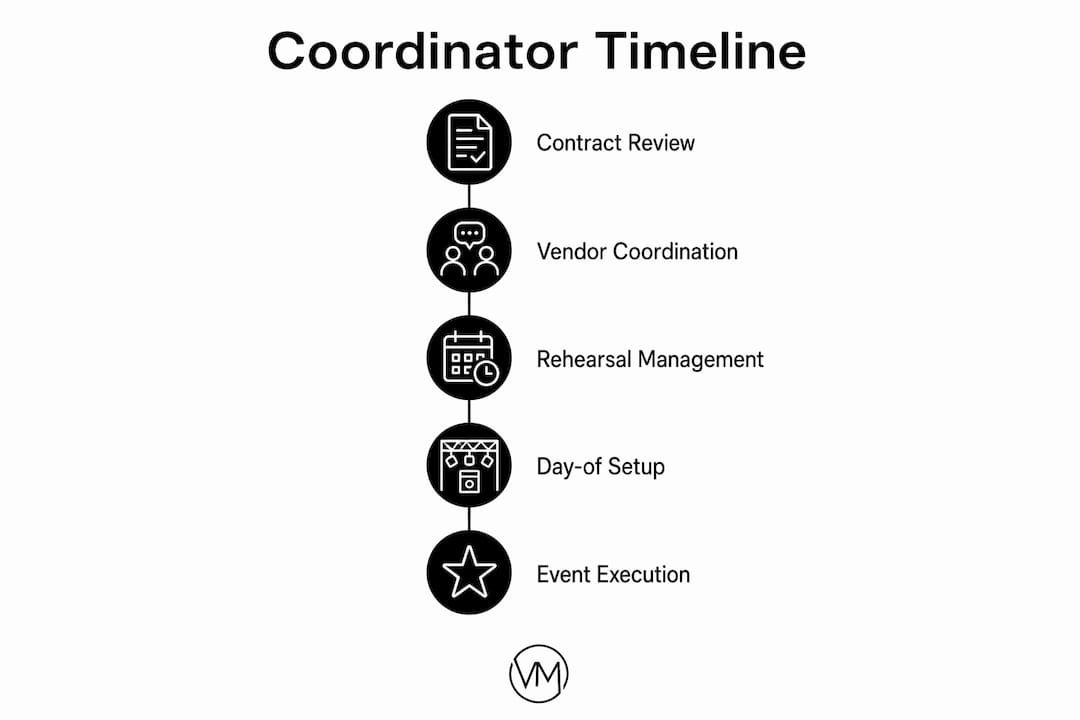
Most coordinators begin active work 4 to 6 weeks before the wedding. The term "day-of coordinator" is technically a misnomer — true day-of-only coordination is impractical because contracts need review and logistics need confirmation well before the event.
Sample coordinator touchpoints:
- 4 to 6 weeks before the wedding: Initial meeting, vendor contract review, draft master timeline
- 4 to 6 weeks before the wedding: Vendor confirmation calls, venue walk-through, floor plan review
- 2 to 4 weeks before the wedding: Finalize timeline, distribute to all vendors including videographer
- Rehearsal day: Run ceremony rehearsal, confirm cues with DJ/band and officiant
- Wedding morning: Coordinator arrives 1–2 hours before first vendor load-in
- Ceremony: Cue processional, manage sightlines, signal videographer for key moments
- Cocktail hour: Oversee room flip, confirm reception setup with all vendors
- Reception: Cue grand entrance, first dance, toasts, cake cutting, and send-off
- Post-event: Supervise breakdown, collect gifts and personal items
Before the coordinator's rehearsal meeting, couples should have these items finalized:
- Signed contracts with every vendor
- Decor notes and floor plan approved by the venue
- Full vendor contact list with cell numbers
- Shot priorities and must-capture moments shared with your videographer
- Ceremony order and any cultural or religious cues documented
Pro Tip: Schedule your private vows, first look, and golden-hour couple portraits as named blocks on the master timeline — not just "photos." Named blocks are harder to compress when the day runs long.
How a coordinator differs from a full planner
The distinction matters when you're deciding what to budget and who to hire. According to Brides, a planner is involved from the start — vendor sourcing, design direction, budget management — while a coordinator focuses on final-stage execution.
What a full-service planner handles:
- Vendor sourcing and contract negotiation
- Budget tracking across all categories
- Design concept and aesthetic direction
- Planning meetings over 12–18 months
What a month-of coordinator handles:
- Reviewing contracts already signed
- Building and distributing the master timeline
- Vendor confirmation calls in the final weeks
- Rehearsal direction and day-of execution
One important note: a venue coordinator is not a substitute for either. Venue staff manage the building, house catering, and in-house lighting — they do not manage your outside vendors, personal items, or rehearsal.
When coordinator-only is sufficient: You planned everything yourself, all vendors are booked, and you just need someone to execute. When you need planner plus coordinator: You're starting from scratch, have a complex multi-vendor event, or are planning a South Asian, Jewish, or multi-day ceremony where workflow complexity is high.
Why coordinators protect your cinematic wedding film
The primary value of a coordinator for videography is simple: couples who manage their own logistics get pulled away from significant moments. Coordinators prevent that.
Concrete effects on your film:
- Uninterrupted shots: No vendor questions reaching you mid-ceremony
- Protected private moments: First look and private vows stay off-limits to foot traffic
- Golden-hour timing: Coordinator holds the reception timeline so couple portraits happen in the right light
- Multi-camera sequencing: Videography teams covering ceremony and reception simultaneously need precise transition cues — the coordinator provides them
Consider the contrast. Without a coordinator, a vendor arrives at the wrong entrance during the first dance. Someone pulls the couple aside. The cinematographer loses the shot. With a coordinator, that vendor is redirected silently, and the camera never moves.
"A coordinator acts as the final handoff, allowing the couple to release control of logistics they planned for months so they can fully engage in the celebration — and so their cinematographer can capture unscripted emotional moments without interruption." — The Knot
How to align your coordinator and videography team
This is where most couples leave value on the table. Sharing information between your coordinator and your cinematography team early prevents the gaps that cost you shots.
Send both your coordinator and your videographer:
- Shot priorities and must-capture moments (written list, not verbal)
- The master timeline PDF as soon as it's finalized
- Full vendor contact list with arrival windows
- Venue floor plan with camera position notes
- Any cultural, religious, or family-specific cues the videographer needs to anticipate
Additional coordination notes worth sharing:
- Confirm ceremony sightlines: where can cameras stand without blocking guests?
- Note electrical access points for lighting rigs
- Flag any restricted areas (some venues limit drone flight or restrict certain rooms)
- Confirm load-in sequence so videography gear arrives before decor obscures access
For a deeper look at aligning your photo and video teams, the photo and video coordination guide on the Visualizemedia blog covers this in detail.
Pro Tip: Build a 20-minute golden-hour window into the master timeline as a protected block. Tell your coordinator it is non-negotiable. That window is often where the most cinematic footage of the entire day gets captured.
What coordinators typically cost and what to put in the contract
Day-of and month-of coordinators generally cost less than full-service planners, though pricing varies by market, wedding size, and scope. New York and New Jersey weddings tend to run at the higher end of national ranges given venue complexity and vendor density. Factors that move the price:
- Wedding guest count and number of vendors to manage
- Whether rehearsal dinner coordination is included
- Travel fees for venues outside the coordinator's base area
- Length of coverage (ceremony only vs. full day)
- Whether a second coordinator or assistant is included
Contract items to confirm before signing:
- Exact arrival and departure times
- Overtime rate if the event runs long
- Whether rehearsal is included or billed separately
- Vendor communication scope (how many calls, how far out)
- Proof of liability insurance and backup plan if coordinator is ill
- Who handles vendor gratuities and final payments
Pro Tip: Negotiate overtime terms in writing before you sign. A coordinator who charges by the hour after 10 PM can add significant cost at a New York reception that runs late.
Questions to ask when hiring a coordinator
Strong interview questions cut through vague answers fast:
- How many weddings have you coordinated at this venue or venue type?
- Can you share a sample minute-by-minute timeline from a past event?
- How do you handle a vendor who arrives late or goes to the wrong location?
- Are you familiar with multi-camera cinematography needs and how to cue transitions?
- What is your backup plan if you have an emergency on the wedding day?
- How do you communicate with vendors in the final 48 hours?
Red flags to watch for:
- No sample timeline available or unwilling to share one
- Vague answers about overtime or what "full day" coverage means
- Refuses to coordinate directly with your videographer
- No proof of insurance or no backup coordinator named
- Cannot provide vendor references from recent weddings
Request at hire: a sample minute-by-minute timeline, rehearsal plan, proof of liability insurance, and a written vendor-contact protocol.
For a broader look at choosing wedding vendors, the Visualizemedia blog covers the full vendor ecosystem.
Key Takeaways
A wedding day coordinator is the single most effective hire for protecting the cinematic moments your videographer needs to tell your story.
| Point | Details |
|---|---|
| Month-of, not day-of | Coordinators start 4 to 6 weeks out to review contracts and build the master timeline. |
| Single vendor contact | All vendor questions route through the coordinator, keeping your film crew free to shoot. |
| Timeline is the product | A minute-by-minute timeline protects golden hour, private vows, and reception transitions. |
| Coordinator vs. planner | Planners design and source; coordinators execute what you've already planned. |
| Share early | Send your coordinator and videographer the same shot list, timeline, and floor plan before rehearsal. |
Visualizemedia's perspective on working with coordinators
Every wedding film Visualizemedia produces benefits from a strong coordinator relationship. When a coordinator distributes the master timeline to the full vendor team in advance, the cinematography crew can pre-plan camera positions, anticipate emotional beats, and move between locations without losing coverage. That preparation is what separates a good wedding film from a great one.
The moments that define a cinematic film — a private first look, unscripted tears during vows, the golden-hour couple portrait — all depend on protected time blocks. Coordinators who understand cinematography needs treat those blocks as fixed, not flexible. When we receive a timeline that names the golden-hour window and the private vow location, we know the couple has a coordinator who gets it.
Couples can follow Visualizemedia on Instagram to see examples of the cinematic moments a well-coordinated wedding day produces. Sharing those posts with your coordinator is a fast way to communicate the visual style and emotional tone you're after — no lengthy brief required.
If you're ready to discuss how your coordinator and cinematography team can work together, reach out through the vendor contact form or explore Visualizemedia's wedding cinematography packages for New York and New Jersey.

Sources and further reading
- Brides — The difference between wedding planners, coordinators, and designers
- Paperlust — What Is a Day-of Wedding Coordinator?
- Ever Weddings — What Does a Day-of Wedding Coordinator Actually Do?
- The Knot — Month-of wedding coordinator
- WeddingClever — Day of Coordinator: Why You Need One
- Behind the Scenes Events — Month-of wedding coordinator
- Indeed — Wedding Coordinator Job Description
- Visualizemedia — Wedding Day Photo and Video Coordination Guide
- Visualizemedia — Why Plan a Videography Timeline for Your Wedding Film