

A wedding photography contract is a binding legal agreement that defines exactly what services your photographer will deliver, how much you will pay, and what happens when things go wrong. Known formally as a photography services agreement, this document protects both you and your photographer by setting enforceable expectations before the wedding day. More than 60% of couples who experienced vendor disputes said the outcome depended on contract language they did not fully understand when signing. That statistic tells you everything about why reading every line matters.
What is a wedding photography contract and why does it exist?
A wedding photography contract is the legal foundation of your relationship with your photographer. Contracts establish clear expectations, define payment terms, and set contingency rules, preventing misunderstandings and costly conflicts. Without one, you have no enforceable recourse if your photographer cancels, delivers late, or misses key moments.
The document covers scope of services, payment schedules, deliverables, cancellation terms, and copyright ownership. Each clause exists because a real dispute happened to a real couple somewhere. Think of the contract not as a sign of distrust but as a shared map that both sides agree to follow before the journey starts.

What are the essential components of a wedding photography contract?
Every wedding photography agreement should contain these core elements. Missing even one can leave you exposed.
- Scope of services. Coverage hours, the number of photographers present, and which specific events are included (ceremony, cocktail hour, reception). Ambiguity in scope causes most post-event disputes.
- Payment terms. The deposit amount, final balance due date, accepted payment methods, and refund policy. Non-refundable deposits are standard but must have clearly stated terms to avoid forfeiture disputes.
- Deliverables. The number of edited images, file formats, and delivery timeline. A typical example is 400 to 600 edited images delivered within four weeks.
- Cancellation and rescheduling. What happens if you cancel, if the photographer cancels, or if a force majeure event (such as a natural disaster) prevents the wedding.
- Copyright and usage rights. Who owns the images and whether the photographer can use them for marketing.
- Limitation of liability. A liability cap typically limits the photographer's responsibility to the total amount you paid. This protects both sides from unlimited financial exposure.
- Substitution policy. Whether the photographer can send a replacement and whether you must approve that person in advance.
Pro Tip: Ask your photographer to define every deliverable with a specific number. "A gallery of images" means nothing legally. "450 edited high-resolution JPEG files" is enforceable.
How does understanding the contract benefit you as a couple?
Standard vendor contracts favor photographers by default because photographers write and reuse them. That is not malicious. It is administrative habit. The result is that the first draft almost always protects the vendor more than it protects you.
Common pitfalls include vague wording, undefined timelines, and cancellation terms that forfeit your full deposit even if the photographer cancels. Each of these is negotiable before you sign. After you sign, your leverage disappears.
"Most couples sign contracts quickly without thorough review, missing their opportunity to negotiate better terms. The window to request changes is open until the moment you add your signature."
Specific deadlines matter more than you might expect. Vague terms like "delivered in a timely manner" leave you without an enforceable deadline if your photographer takes six months to send your gallery. Replace that phrase with a specific date or number of weeks. When choosing wedding vendors, treat the contract review as part of your evaluation, not an afterthought.
- Read the full contract before signing, not after.
- Ask for written clarification on any clause you do not understand.
- Request specific dates wherever the draft uses vague language.
- Negotiate cancellation terms that protect you if the photographer initiates the cancellation.
What practical details should be in the contract to avoid day-of surprises?
The logistics of a 10-hour wedding day create situations that most couples never think to address in writing. Getting these details into the contract prevents friction when you are least equipped to handle it.
- Meal provisions. Including meal provisions for your photography team during long events protects service quality. A photographer who has not eaten since 10:00 AM will not perform at their best during your 7:00 PM first dance.
- Backup equipment and illness policy. The contract should state what happens if the photographer's primary camera fails or if they become ill. A reputable photographer carries backup gear and has a network of colleagues to call.
- Arrival time and venue access. Specify when the photographer arrives and confirm they have reviewed any venue restrictions on flash photography or restricted areas.
- Second shooter approval. Contracts should specify notification requirements and your approval rights for any substitution or second shooter. You hired a specific person. You deserve to know who will actually be there.
- Shot list acknowledgment. If you have specific family groupings or must-have moments, the contract should reference a shot list as an attached exhibit.
Pro Tip: Ask your photographer about their wedding day timeline approach before signing. A photographer who plans around your schedule is far less likely to miss key moments.
How are payment structures and delivery timelines typically handled?
Payment schedules follow a clear industry standard. The standard structure is a 50% deposit upon signing and the remaining 50% balance due on or before the wedding date. On a $2,500 package, that means a $1,250 deposit at signing and $1,250 due before the ceremony.
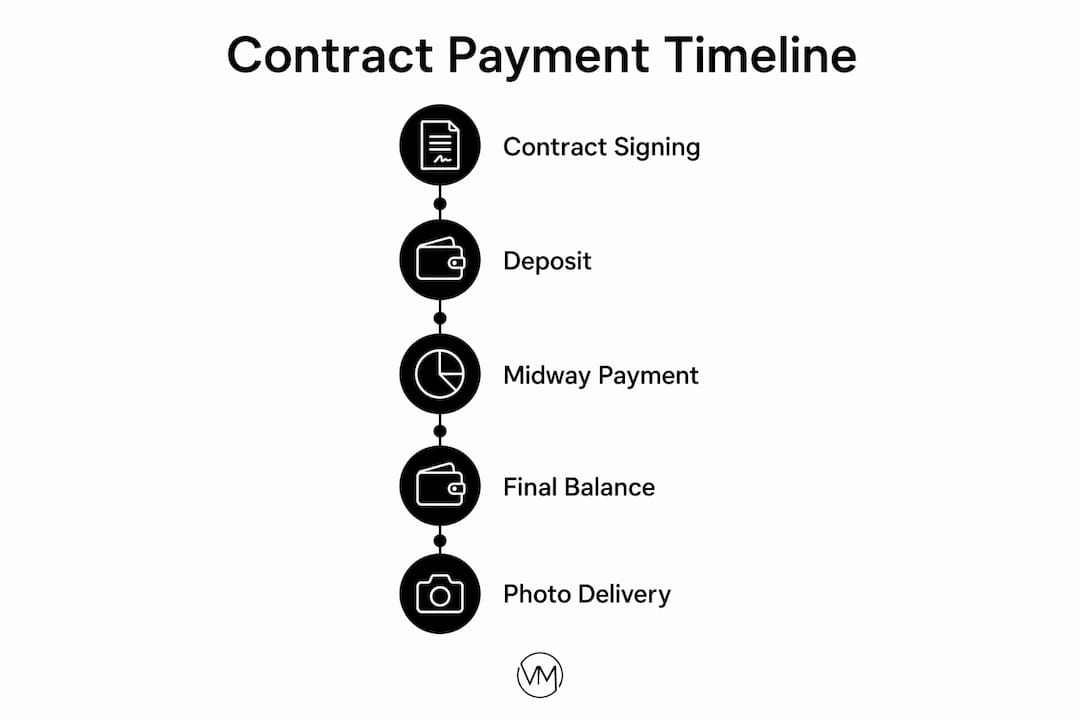
| Payment Stage | Typical Timing | Example Amount |
|---|---|---|
| Retainer deposit | At contract signing | $1,250 (50% of $2,500) |
| Final balance | On or before wedding date | $1,250 (50% of $2,500) |
| Late payment fee | Per contract terms | Varies by photographer |
Delivery timelines follow a similar pattern. Photographers generally deliver final edited images within four weeks post-event, but the contract language determines whether that timeline is enforceable. For context on how delivery expectations apply to video as well, the wedding video turnaround guide explains what realistic post-production timelines look like.
Watch for these red flags in payment and delivery clauses:
- No specific delivery date, only "a reasonable time."
- Late payment penalties that are disproportionate to the fee.
- No refund provision if the photographer cancels.
- Accepted payment methods that exclude credit cards, removing your chargeback protection.
Key Takeaways
A wedding photography contract protects you by defining scope, payment, deliverables, and contingency terms in legally enforceable language before your wedding day.
| Point | Details |
|---|---|
| Read before signing | Over 60% of contract disputes stem from language couples did not understand at signing. |
| Demand specific deadlines | Replace vague terms like "timely manner" with exact delivery dates or week counts. |
| Negotiate before signing | Standard contracts favor photographers; your leverage ends the moment you sign. |
| Confirm practical logistics | Meal provisions, backup plans, and arrival times belong in the contract, not in conversation. |
| Verify payment terms | The industry standard is 50% deposit at signing and 50% balance before the wedding date. |
Why I think most couples treat contracts as a formality
Working in the wedding industry, I have seen couples spend weeks choosing a floral arrangement and 90 seconds reviewing a contract. That imbalance costs people real money and real heartbreak.
A contract is not a sign that you distrust your photographer. It is proof that both of you respect the relationship enough to define it clearly. The photographers I respect most welcome questions about their contracts. They want you to understand every clause because a client who understands the agreement is a client who trusts the process.
The one thing I would tell every couple: do not let excitement rush you past the fine print. Ask the uncomfortable questions before you sign. What happens if you get sick? What happens if they get sick? What if the venue burns down? These are not pessimistic questions. They are the questions that protect the most important day of your life. Follow Visualizemedia on Instagram to see how professional wedding storytelling looks when every detail, including the contract, is handled with care.
— Anthony
Visualizemedia's approach to wedding contracts and coverage
Visualizemedia works with couples across New York and New Jersey who expect both cinematic quality and professional clarity from their wedding vendors. Every package comes with transparent terms covering coverage hours, deliverables, payment schedules, and contingency plans.

If you are planning your wedding and want to work with a team that treats the contract as a foundation rather than a formality, explore Visualizemedia's wedding services to see available packages and start a conversation. You can also complete the wedding questionnaire to share your vision and get a response tailored to your day.
FAQ
What is a wedding photography contract?
A wedding photography contract is a legally binding agreement between a couple and their photographer that defines services, payment terms, deliverables, and contingency plans. It protects both parties by making expectations enforceable.
What should a wedding photography agreement always include?
Every agreement should include scope of services, payment schedule, delivery timeline with a specific date, cancellation terms, copyright ownership, and a substitution policy.
How much is a standard deposit for wedding photography?
The industry standard is a 50% non-refundable deposit at signing, with the remaining balance due on or before the wedding date.
Can you negotiate a wedding photography contract?
Yes. Contracts favor vendors by default because photographers write them. You can request changes to delivery timelines, cancellation terms, and substitution clauses before signing.
What happens if a photographer delivers images late?
If the contract contains a specific delivery deadline, you have legal recourse. Vague language like "timely manner" is not enforceable, which is why replacing it with an exact date or week count is critical before you sign.